What is the force responsible for the collapse of a nebula into a protostar?
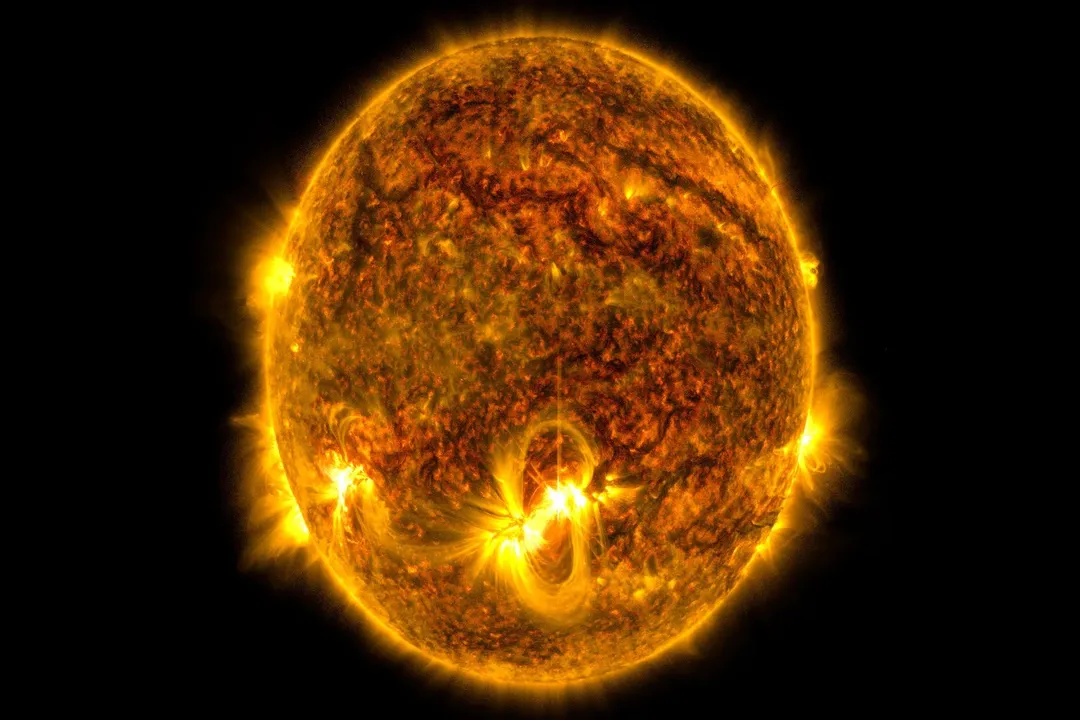
The force responsible for initiating the collapse of a diffuse nebula into a dense core that eventually yields a protostar is fundamentally gravity. [6][7] While the vastness of space can make the gaseous components of a nebula seem weightless, these clouds accumulate immense total mass, sometimes equivalent to many stars, and every atom exerts a mutual gravitational attraction upon every other atom. [1] This self-attraction is the engine that pulls the material together, overcoming the expansive forces that would otherwise keep the cloud dispersed. [7]
The transformation from a vast, cold cloud to a blazing stellar object is one of the most dramatic events in astrophysics. It relies on the inexorable pull of gravity acting on an enormous scale, but it often requires a helping hand to get started against the cloud's internal resistance.
# Cosmic Constituents

A star begins its existence within a stellar nursery, which is a large, cold cloud of gas and dust known as a nebula. [3][6][7] These molecular clouds are the building blocks of stars and are primarily composed of roughly $70%$ hydrogen and $28%$ helium by mass, with trace amounts of heavier elements created by previous generations of stars. [6] The scale of these nurseries is staggering; they can range from a few hundred to many thousands of light-years in diameter and possess masses up to six million times that of the Sun. [6]
Despite their immense mass, these clouds are initially stable. The internal pressure from the kinetic energy of the gas particles balances the potential energy locked up in their self-gravity, achieving what is mathematically described by the virial theorem. [6] For collapse to occur, the mass of a region must exceed a critical threshold, known as the Jeans mass, meaning the outward gas pressure must become insufficient to support the cloud against its own immense gravitational burden. [6] In their resting state, the temperature within these clouds is extremely low, often around $10$ Kelvin, which keeps the thermal pressure low enough to maintain a tenuous balance. [2][6]
# Overcoming Stability
While gravity is the ultimate cause of collapse, the initial state of most dense interstellar clouds is one of stability or even expansion. [2] For this stable state to break, a trigger is usually required to sufficiently compress a region, increasing its density past that critical Jeans mass. [2][6][7]
Several external events are thought to provide this necessary external compression:
- Supernova Shockwaves: The explosion of a nearby massive star sends a powerful shockwave tearing through the interstellar medium, compressing the gas cloud enough to initiate the collapse. [2][6][7] Our own solar system is theorized to have begun forming following such an event. [1]
- Cloud Collisions: The physical impact between two or more molecular clouds can generate compression sufficient to initiate gravitational instability throughout the affected regions. [1][6]
- Galactic Dynamics: Collisions between entire galaxies can agitate and compress gas clouds across vast scales, potentially triggering massive bursts of star formation, which may even lead to the formation of globular clusters. [6]
Observations also suggest that collapse can occur intrinsically, driven solely by the cloud's internal conditions, meaning an external trigger is not always necessary, although an external push often helps overcome the initial energy barrier. [1][6]
# The Mechanics of Infall
Once triggered, the dominance of gravity becomes undeniable. In a localized, gravitationally unstable region, every bit of matter pulls on every other bit, causing the overall structure to contract inward toward the center of mass. [1] This contraction process is not instantaneous; the term "suddenly" in cosmic terms is highly relative—it takes time for the forces to overcome inertia and initiate a sustained collapse. [1]
As the cloud contracts, the particles move closer together, and their kinetic energy—which manifests as heat—increases due to the release of gravitational potential energy. [3][7] Initially, this increasing thermal pressure attempts to push outward, counteracting the gravity that is trying to compress it further. [2]
However, a crucial mechanism prevents the cloud from simply rebounding due to this rising internal heat: radiative cooling. In the extremely cold, dense regions where stars form, certain molecules, particularly carbon monoxide (), are highly effective at emitting photons, especially in the radio wave portion of the spectrum. [1] These photons can escape the cloud relatively easily, carrying the heat away with them. [1] This efficient cooling prevents the thermal pressure from building up too quickly, allowing gravity to continue winning the tug-of-war and driving the contraction deeper and deeper. [2]
If the cloud were composed only of atomic gas without these cooling agents, it would require significantly greater mass for gravity to overcome the resulting thermal pressure, which is one reason why the very first stars in the universe—lacking heavier elements like Carbon and Oxygen—had to be exceptionally massive to ignite fusion. [1]
It is fascinating to consider that on Earth, we are constantly experiencing the $1$ atmosphere of pressure from the air above us, yet we do not notice it because the gas inside our bodies presses outward with an equal and opposite force. [1] In space, the sheer mass of a nebula provides the necessary "weight" for this pressure to become an inward force, despite the low density relative to Earth's atmosphere. [1] When a cloud reaches tens of times the mass of the Sun, the internal gravitational attraction at the edge of that region scales with (volume), while the opposing gravitational force falls off only as (surface area), meaning that as the structure grows larger, the net pull toward the center becomes overwhelmingly dominant over local fluctuations. [1]
# Embryonic Objects
As the gravitational collapse proceeds in a hierarchical fashion, the large molecular cloud fragments into smaller and smaller pieces, each destined to become one or more stars. [6] Within these stellar-mass fragments, the density rises sharply toward the center. [6]
This process of continued collapse and heating eventually leads to the formation of a temporary, quasi-stable object called the first hydrostatic core. [6] The collapse is momentarily halted when the density becomes high enough (around ) that the core becomes opaque to its own radiation, trapping the heat temporarily and raising the internal temperature significantly. [6] As more material crashes onto this opaque barrier, shockwaves form, further heating the center. [6]
When the core temperature approaches about , the trapped heat is energetic enough to break apart the molecular hydrogen () into individual atoms, a process called dissociation, which absorbs energy and allows the collapse to continue momentarily at free-fall velocity. [2][6] This is followed by ionization of the gas, leading to further energy absorption. [6]
Once the density increases further, the material becomes transparent enough for the energy generated by this deep compression to radiate away, allowing the object to contract again until the internal pressure is finally sufficient to balance gravity. This state of balance, achieved before fusion begins, defines the protostar. [6][7]
# Protostar Dynamics
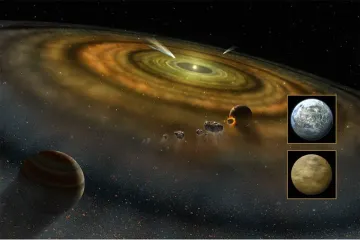
The newly formed protostar is not a solitary entity. It is deeply embedded within the remaining envelope of gas and dust and is surrounded by a rotating accretion disk in its equatorial plane. [2][7] This disk is essential because it channels the surrounding material onto the growing protostar, allowing it to accumulate the necessary mass. [6][7] The conservation of angular momentum dictates that as this material spirals inward, the rotation speed increases. [3][7]
Furthermore, as the protostar accretes mass, it often expels material in powerful, narrow streams perpendicular to the disk—known as bipolar outflows—which are seen as Herbig-Haro objects in some cases. [2][6] These outflows serve a vital purpose: they sweep away excess gas and dust from the immediate vicinity, managing the excess angular momentum that would otherwise cause the protostar to spin itself apart or halt accretion. [2][6]
For a moment, we can reflect on the necessity of managing this spin. If the initial cloud core were spinning too rapidly, the centrifugal force could destabilize the entire structure, potentially causing it to break into two or more orbiting objects—an elegant explanation for how many binary star systems are initially formed from a single collapsing fragment. [2] It shows that the collapse isn't just about mass accumulation; it's a complex interplay where rotation acts as a necessary distributor rather than just a hindrance. [6]
The energy powering the protostar during this phase is not yet nuclear; it comes entirely from the heat released by the ongoing gravitational contraction—the Kelvin-Helmholtz mechanism. [6] The object continues to shrink, grow hotter, and become denser until one final hurdle is overcome.
# Final State
The collapse only ceases when the central temperature and density become so extreme that the hydrogen nuclei are forced together with enough energy to initiate nuclear fusion. [2][7] When four hydrogen nuclei successfully fuse to create a helium nucleus, a tremendous amount of energy is released, drastically increasing the internal temperature and outward pressure. [2][7]
This outflowing pressure, generated by sustained fusion, finally becomes strong enough to perfectly counterbalance the crushing inward force of gravity. At this point, the object achieves hydrostatic equilibrium and is officially designated a true star—a main-sequence star. [2][7] This balance dictates the star's size, temperature, and lifespan. [5]
The resulting star's fate and characteristics are entirely set by the initial mass it managed to accumulate:
| Mass Comparison | Outcome | Lifetime Characteristic |
|---|---|---|
| Low Mass () | Never ignites fusion | Becomes a Brown Dwarf (a failed star) [2] |
| Solar Mass () | Achieves stable fusion | Main-sequence life lasts billions of years [2][7] |
| High Mass () | Burns fuel extremely fast | Main-sequence life lasts only a few million years [5][7] |
| Extreme Mass () | Radiation pressure overwhelms gravity | Blows itself apart before becoming a stable star [2] |
The initial collapse, driven by gravity, is thus a process of cosmic filtering. It sorts the available raw material into objects that either cannot ignite fusion, those that will shine steadily for eons, or the rare, hyper-luminous giants whose brilliant but brief lives enrich the galaxy with the heavy elements needed for future stellar generations and planetary systems. [5][6] The seemingly simple question of what causes the collapse reveals a deep choreography where gravity must first be aided by external compression, then sustained by efficient cooling, before finally establishing the long-term balance required for stable stellar existence. [1][2]
#Videos
What Causes A Nebula To Collapse? - Physics Frontier - YouTube
Related Questions
#Citations
Star Basics - NASA Science
What Causes A Nebula To Collapse? - Physics Frontier - YouTube
Star formation - Wikipedia
how a star is born? - The Physics of the Universe
Lecture 12: Star Formation
What causes a nebula - a very diffuse cloud of Hydrogen to ... - Reddit
Massive Star | Definition & Life Cycle - Lesson - Study.com