What caused the collapse of the dust cloud that formed our solar system?
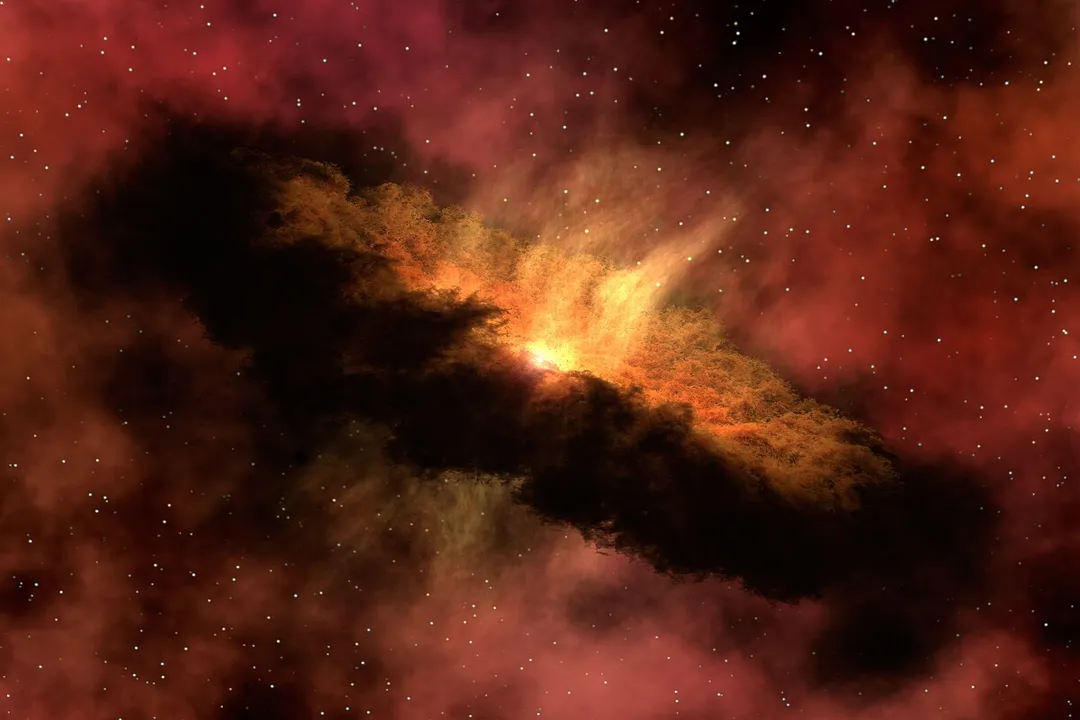
The story of how our solar system began is a dramatic tale of cosmic forces, starting not with a gentle mist but with the violent collapse of an enormous cloud of interstellar gas and dust. This raw material, known as the solar nebula, existed for a time as a cold, diffuse, and slowly rotating mass floating in the Milky Way galaxy, holding the potential for everything from the Sun to the most distant icy comet. [1][6] Astronomers estimate this pivotal event took place approximately 4.6 billion years ago. [2][6] The initial cloud was far larger than our current system, containing more mass than the Sun and all the planets combined. [1] The critical question that puzzled early astronomers was what could possibly kick-start the process? A cloud that large, comprised mostly of light elements like hydrogen and helium, would normally maintain a stable equilibrium for eons, gently spinning in the void. Overcoming this inertia required a significant external push—a cosmic jolt powerful enough to initiate the inevitable tug of gravity across trillions of miles.
# Giant Cloud
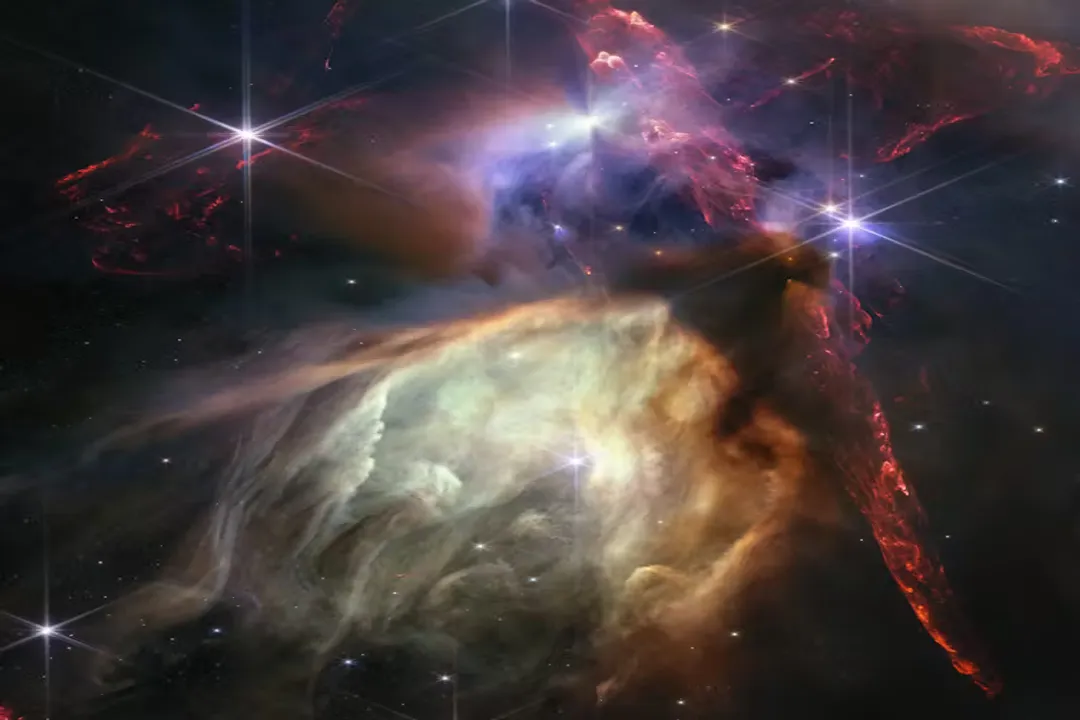
Before the collapse, the solar nebula was essentially a large pocket of stellar dust and gas, the remnants of earlier generations of stars that had lived and died. [6] This material wasn't just uniform; it contained heavier elements created inside those long-gone stars, which are the very building blocks that would eventually form rocky planets like Earth. [1] The cloud was characterized by being cold and exhibiting a slow, steady rotation. [1][6] This rotation is crucial because, even in its initial, diffuse state, the cloud possessed angular momentum, a property that must be conserved as the cloud shrinks, leading directly to the spinning disk structure we see today. [8]
Imagine a sphere of material tens of thousands of times wider than the orbit of Neptune today, made up primarily of hydrogen and helium, laced with trace amounts of dust grains rich in silicates and metals. [1][6] This was the stellar nursery. For it to transition from this cold, stable state into the fiery furnace of the nascent Sun surrounded by a disk of planetary building blocks required a specific, high-energy catalyst. The sheer scale of this initial cloud suggests that even if the gravitational pull within it was trying to cause self-implosion, the process would have been too slow to account for the relatively swift formation timescales implied by the age and structure of our current planetary configuration. [4] Something external must have provided the initial, decisive compression.
# Trigger Event
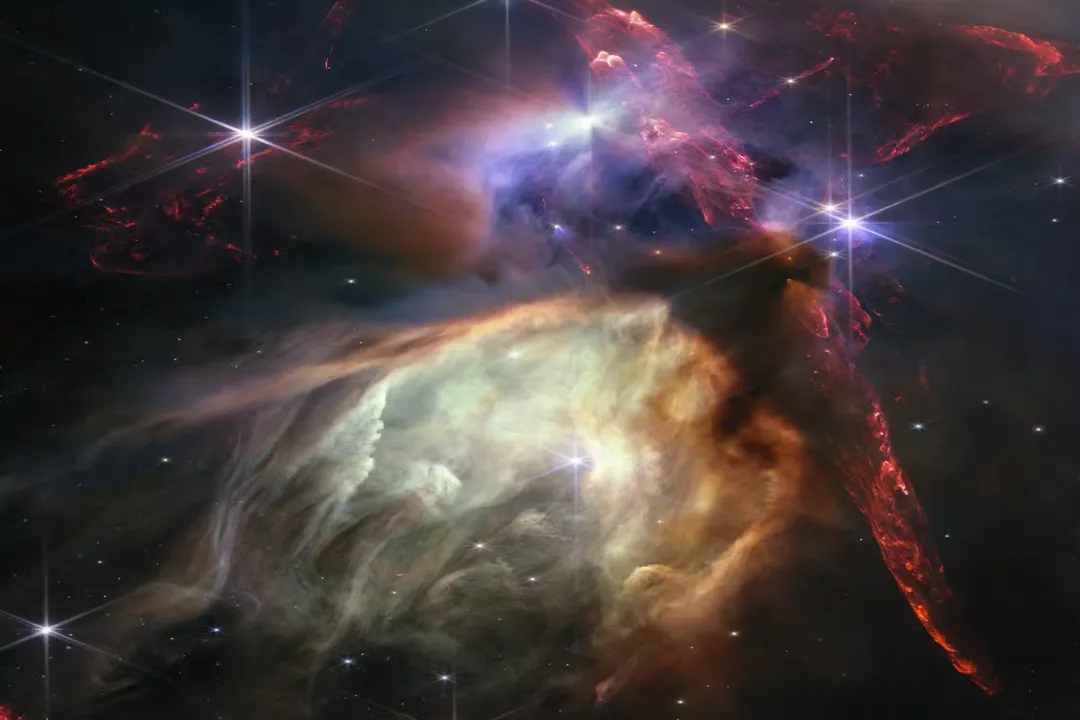
The prevailing scientific consensus points toward a catastrophic, yet common, event in the galactic neighborhood: a nearby supernova explosion. [1][3][6][7] This explosion, marking the death throes of a massive star, sent a powerful shockwave ripping through the galaxy. [3][6] When this high-energy wave slammed into the relatively calm solar nebula, the effect was immediate and profound. [1][6]
The shockwave acted like a cosmic piston, compressing a section of the gas and dust cloud. [1] This sudden increase in density within a region of the nebula provided the critical tipping point. The pressure pulse momentarily overcame the cloud's internal resistance, forcing portions of it to become gravitationally unstable. [6] Once gravity took hold in that compressed region, it became a self-sustaining process. This is fascinating because the very material that formed our familiar, life-bearing Earth was, for a brief moment in cosmic history, mixed with the freshly synthesized, superheated remnants of a dying star. [3] The presence of certain short-lived radioactive isotopes found in meteorites, which decay quickly, strongly supports this scenario, indicating that fresh, exotic material was incorporated into the nebula right at the moment of collapse. [3]
It is interesting to consider the temporal difference here: the violent shockwave provides an almost instantaneous external trigger, a powerful push that might occur over a few hundred thousand years as the wave passes, but the subsequent gravitational infall that builds the Sun takes several million years to fully settle. This contrasts the sudden cosmic violence that initiated the system with the relatively gradual, though still rapid, construction phase that followed. [4]
# Gravitational Fall
Once the shockwave triggered the local gravitational collapse, the process accelerated dramatically due to the principle of conservation of angular momentum. [8] As the massive cloud shrank inward toward its center of mass, its rate of rotation naturally increased, much like a figure skater pulling their arms in to spin faster. [1][6]
The majority of the material—over 99% of the nebula's mass—rushed toward the center. [8] This central mass began to compress and heat up intensely due to the kinetic energy of the infalling gas converting into thermal energy. [8] This hot, dense core was the protosun. [8] Meanwhile, the rotational forces prevented material far from the center from falling directly in; instead, it spread out into a flatter structure perpendicular to the axis of rotation. [1] The velocity of the collapse in the outer regions was dictated by the need to conserve that initial, slow spin while shrinking the volume dramatically. [2]
# Disk Formation
The result of this inward fall and outward spin was the transformation of the spherical cloud into a flattened, spinning structure known as the protoplanetary disk. [1][8] The material that did not end up in the central protosun formed this disk orbiting the new star. [1] This disk was not uniform; it developed a temperature gradient. It was incredibly hot near the central Sun, hot enough only to allow materials with high melting points, like rock and metal, to remain solid. [1][6] Further out, past what is now the asteroid belt, it was cool enough for lighter, volatile materials like water, methane, and ammonia to condense into solid ice grains. [1][6]
This temperature gradient established the basic architecture of the solar system we observe today. The inner, hotter region led to the formation of the smaller, dense, rocky terrestrial planets (Mercury, Venus, Earth, Mars) from the condensation of silicates and metals. [1][6] The outer, cooler region allowed the accumulation of massive amounts of ice, which then gravitationally attracted vast envelopes of the remaining hydrogen and helium gas, leading to the formation of the gas and ice giants (Jupiter, Saturn, Uranus, Neptune). [1][2]
It is insightful to compare the material available in the inner versus outer nebula. If the temperature at the distance of Jupiter had been just slightly higher, the "frost line"—the boundary beyond which ices could condense—would have been closer to the Sun. This subtle change in the condensation temperature around (a difference of perhaps only 50 degrees Celsius) drastically altered the mass budget available to form the giant planets. In essence, the frost line acted as a gate, determining which side of the nebula had enough solid material to accrete gas cores quickly enough to capture the vast hydrogen/helium envelopes before the Sun’s eventual solar wind blew the remaining gas away. [1][6]
# Evidence Found
The entire collapse sequence, from the supernova shock to planetary accretion, is a theory heavily supported by the physical evidence we can analyze today. Scientists don't just rely on modeling the collapse; they can examine the remnants. [4] Primitive meteorites, often called chondrites, are essentially time capsules containing the original, unaltered building blocks that condensed out of that initial solar nebula. [6] By analyzing the isotopic composition and elemental ratios within these ancient space rocks, researchers can trace the chemical signature back to the interstellar medium and confirm the processes of heating, condensation, and accretion that occurred during the nebula's infancy. [4] The fact that the Sun resides in a region of the galaxy with the necessary metallicity—the abundance of elements heavier than hydrogen and helium—also strongly supports the supernova-trigger model, as that event is the primary mechanism for seeding the interstellar medium with these heavier elements necessary for rocky planet formation. [3]
The process was not perfectly smooth, either. The initial collapse and subsequent formation of the disk would have involved immense turbulence, leading to potential planetary embryos colliding and merging over millions of years, a process that explains the seemingly chaotic distribution of mass and orbit characteristics we see in the Kuiper Belt and Oort Cloud today, which retain some of the original, less-accreted material. [2] This initial shockwave didn't just compress the cloud; it initiated a cascade of physical changes—density waves, heating, magnetic field reorganization—all necessary to transition from a cold, inert cloud to a dynamic stellar system governed by a central star. [5]
#Videos
The Mind-Blowing Link Between Supernova and Our Solar System
Related Questions
#Citations
How our solar system was born | Natural History Museum
Formation and evolution of the Solar System - Wikipedia
The sun was born when a dense gas cloud collapsed, 4.6 billion ...
How Did the Solar System Form? | NASA Space Place
The Outer Planets: A Star is Born
8.2: Origin of the Solar System—The Nebular Hypothesis
The Sun Was Born When a Dense Gas Cloud Collapsed
The Mind-Blowing Link Between Supernova and Our Solar System
How did the sun wind up in the middle of the solar system? Did the ...