What causes core collapse?
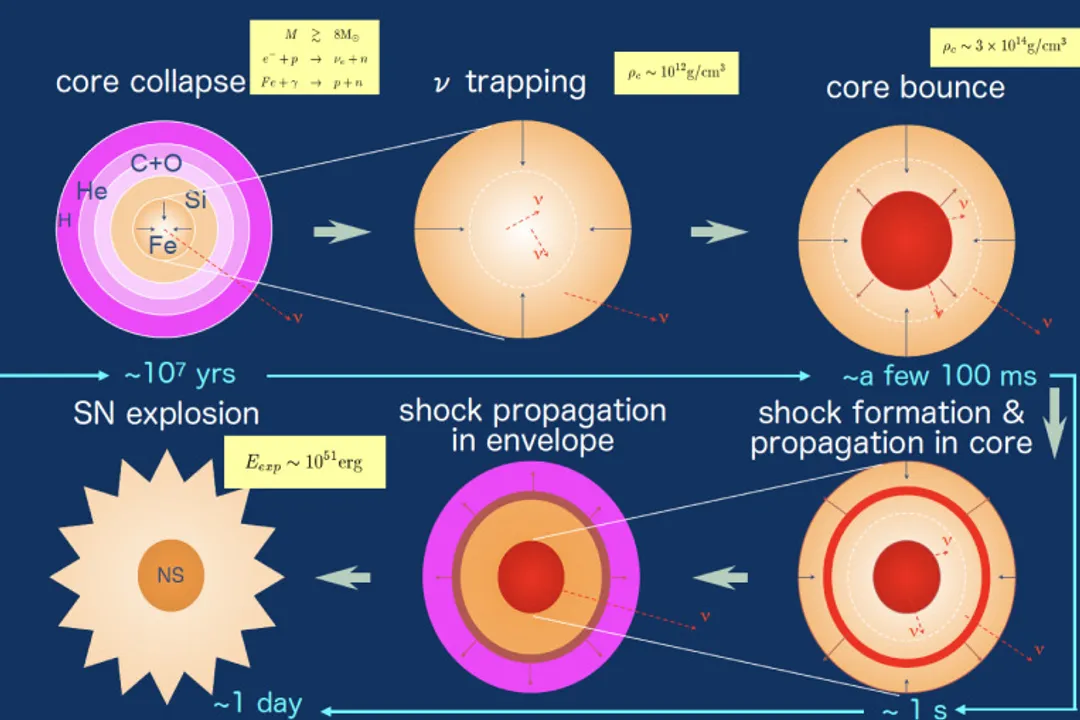
The final moments for a truly massive star are dictated by an unstoppable gravitational imperative, a process known as core collapse. This catastrophic event marks the dramatic end stage for stars significantly heavier than our Sun, specifically those born with masses exceeding about eight times the mass of the Sun. [1][3][8] When this collapse occurs, it unleashes one of the universe's most energetic explosions, a Type II supernova. [3][6] The entire mechanism hinges on the star’s inability to sustain its internal energy generation against its own immense weight.
# Stellar Fusion
For most of its active life, a massive star maintains a delicate equilibrium. The outward pressure generated by thermonuclear fusion occurring in its core perfectly balances the inward crushing force of its own gravity. [5] Think of it as a cosmic standoff: gravity is constantly trying to squeeze the star down to an infinitesimal point, while the energy released by fusion pushes outward, keeping the star inflated and stable. [5]
This fusion process is hierarchical. Lighter elements are fused into heavier ones, releasing energy that fuels the outward pressure. Hydrogen fuses into helium, then helium into carbon, and so on, building up a layered structure within the star, much like the layers of an onion. [6] Each subsequent stage of fusion requires higher temperatures and pressures than the last, meaning the star must burn hotter and contract slightly to initiate the next reaction.
# Iron Core Limit
The sequence of fusion reactions—hydrogen, helium, carbon, neon, oxygen, silicon—continues until the star's furnace begins synthesizing iron, specifically isotope . [3][6] This arrival at iron is the star’s death warrant. Unlike all the lighter elements that preceded it, fusing iron does not release energy; it consumes energy. [3][5]
Once the stellar core is composed of iron, the primary energy source that has supported the star for millennia switches off instantaneously. [3][5] There is no longer a source of thermal pressure capable of resisting the relentless gravitational pull. From an energetic standpoint, the iron core has reached a dead end; it cannot burn further to generate the power needed to support the star's outer layers. [3][8]
# Pressure Failure
The immediate consequence of the fusion engine shutting down is the failure of the pressure support system. Throughout the star's life, the weight of the overlying material was counteracted by electron degeneracy pressure. [3][5] This is a quantum mechanical effect, stemming from the Pauli exclusion principle, which dictates that electrons cannot occupy the exact same quantum state, thereby resisting further compression once they are packed too tightly. [3]
However, once the iron core reaches a critical mass—the Chandrasekhar limit, though the exact boundary here is related to the core mass itself—gravity overwhelms even this powerful quantum resistance. [5] The core starts to contract catastrophically. As it shrinks, the density becomes so extreme that electrons are forced to merge with protons in a process known as inverse beta decay. [3][5] This reaction transforms protons and electrons into neutrons and releases a flood of elusive particles called neutrinos. [3][5]
Expert Commentary: The speed at which this quantum support system fails is staggering. We are talking about a core, several times the mass of the Sun and roughly the size of Earth, collapsing inward at speeds that can reach a quarter of the speed of light. [5] To visualize this, consider that the entire process, from the moment electron degeneracy pressure yields to the moment the core reaches nuclear density, can take less time than a single heartbeat, or perhaps the time it takes for a single electron to travel across a dinner table, depending on the initial mass. [5]
The removal of the electrons further exacerbates the situation because it eliminates the electron degeneracy pressure altogether, leaving only the overwhelming force of gravity to drive the collapse inward towards the nuclear density of the neutrons. [3][5]
# Rapid Implosion
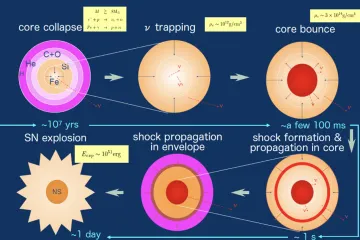
The collapse is swift and violent. As the core shrinks from Earth-size down to only a few tens of kilometers across, the density skyrockets towards that of an atomic nucleus. [5][6] This inner region of the star slams into itself, reaching nuclear density, which effectively brings the implosion to an abrupt halt—a momentary stop known as "core bounce". [6][8]
This halting of the implosion is what drives the massive explosion that follows.
# Neutrino Burst
During the collapse and subsequent rapid compression to nuclear density, the process of inverse beta decay produces an absolutely enormous number of neutrinos. [3][5][9] These particles interact very weakly with normal matter. While the initial collapse takes mere fractions of a second, the sheer quantity of neutrinos produced is unparalleled in any other known astrophysical process. [5]
For a brief instant, the core releases a staggering amount of energy almost entirely in the form of these neutrinos—trillions of times more energy than the Sun will emit over its entire ten-billion-year lifetime. [5] A significant fraction of the total energy released in the entire supernova event, perhaps over 99%, is carried away by this neutrino burst. [5] Although the primary driver of the visible explosion is the mechanical shockwave, the initial neutrino release is a critical piece of the physics puzzle. [9]
# Rebound Shockwave
When the core suddenly stops collapsing because it has reached the point where the strong nuclear force resists further compression (nuclear saturation density), the overlying layers of the star are still rushing inward at high speed. [5][6][8] These infalling materials slam into the newly formed, stiff proto-neutron star core, generating a tremendous outward-moving shockwave. [5][6][8]
This shockwave must travel outward through the dense, infalling stellar envelope. Initially, the shockwave can stall as it burns through the layers, losing energy. [5] This is where the vast neutrino emission becomes essential. The escaping neutrinos deposit enough energy into the stalled shock region to re-energize it, propelling it outward violently. [5]
This rejuvenated shock breaks out through the star's surface, resulting in the brilliant, luminous explosion we observe as a Type II supernova. [3][6][8] The energy released briefly outshines entire galaxies. [6]
# Stellar Remnants
What remains after the explosion depends on the initial mass of the star's core after the outer layers have been ejected.
If the remaining core is between about $1.4$ and $3$ solar masses, the pressure from the neutrons—now known as neutron degeneracy pressure—is sufficient to hold gravity at bay, leaving behind an incredibly dense object called a neutron star. [1][8]
If the initial mass was so large that the remnant core exceeds this upper mass limit (perhaps $3$ solar masses, though the exact threshold is complex), not even neutron degeneracy pressure can halt the crushing force of gravity. [1][8] In this scenario, the core continues to collapse past the point of a neutron star, leading to the formation of a black hole. [1][8][9]
# Observational Signatures
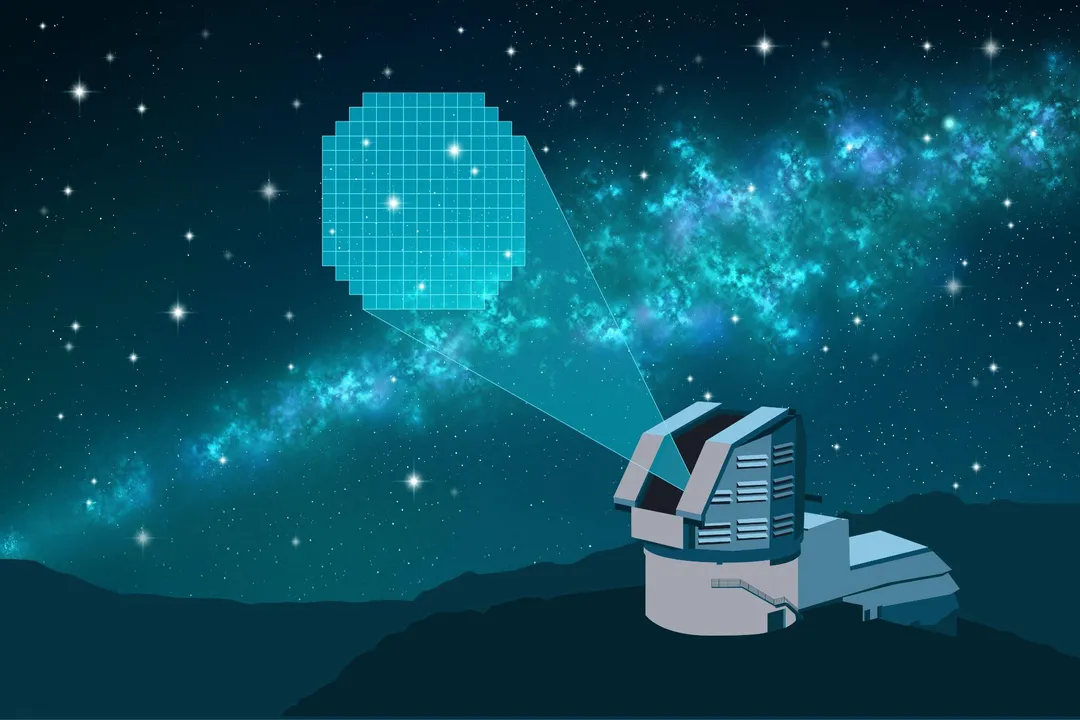
The study of core-collapse supernovae is advancing through several observational avenues. While the light from the explosion itself provides the visual confirmation, scientists are now capable of detecting the very earliest signals associated with the core's final descent. [7]
Modern astrophysics allows for the detection of gravitational waves generated during the catastrophic collapse and bounce. [2] These spacetime ripples offer a direct, near-instantaneous look at the mechanical violence within the core, long before the visible shockwave breaks out through the star's surface. [2] Furthermore, sensitive observatories are learning to identify the tell-tale neutrino signatures that precede the visual flash, allowing for crucial lead time to point other telescopes at the dying star before the light arrives. [7]
This ability to catch the event before the visible explosion—by monitoring the neutrinos or gravitational waves—provides an unparalleled opportunity to study the physics of the collapsing core itself, rather than just the aftermath of the explosion. [7]
Considering the differences in stellar endpoints helps clarify the necessity of the core-collapse mechanism for Type II events. For instance, a different path leads to a Type Ia supernova, which involves a white dwarf in a binary system that accretes too much mass, leading to runaway thermonuclear ignition, not a gravitational core collapse. [3] The core-collapse mechanism is thus uniquely tied to the exhaustion of nuclear fuel in a single, massive star that has built up an inert iron center. [3] The initial condition—a star too massive to handle its own iron ashes—is the defining feature that sets the entire destructive chain in motion.
#Videos
A Detailed Breakdown of Core Collapse Supernovae
Related Questions
#Citations
Core-collapse | COSMOS
Core Collapse Supernovae - gravitationalwaves
Type II supernova
Why do type-2 supernovas involve an explosion?
Core-Collapse Supernovae
A Detailed Breakdown of Core Collapse Supernovae
DOE Explains...Supernovae
Core-collapse supernovae - MPA Garching
Catching Core-Collapse Supernovae Before They Happen
Physical mechanism of core-collapse supernovae that ... - PMC