If the remnant core mass after ejection exceeds approximately 3 solar masses, what stellar remnant forms instead of a neutron star?
A black hole
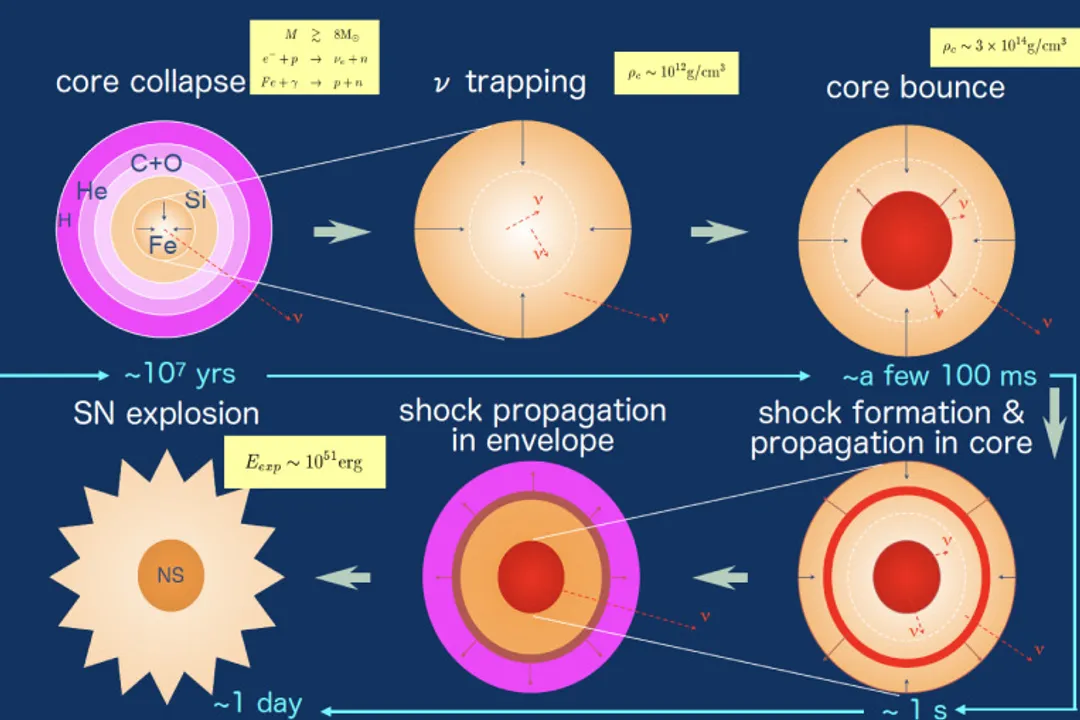
The final fate of the core remnant after a supernova depends entirely on how much mass is left behind after the outer layers are ejected. If the remnant core mass falls within the range of roughly 1.4 to 3 solar masses, the strong resistance provided by neutron degeneracy pressure is sufficient to permanently halt the gravitational collapse, resulting in the formation of an incredibly dense neutron star. However, if the initial star was so massive that the remnant core surpasses this upper limit (cited here as perhaps 3 solar masses), even the powerful neutron degeneracy pressure cannot resist the crushing force of gravity. In this scenario, the collapse continues unimpeded past the neutron star stage, leading inexorably to the formation of a black hole.
#Videos
A Detailed Breakdown of Core Collapse Supernovae