Why does the formation of an iron (Fe) core stop a star's primary energy source?
Fusing iron consumes energy instead of releasing it.
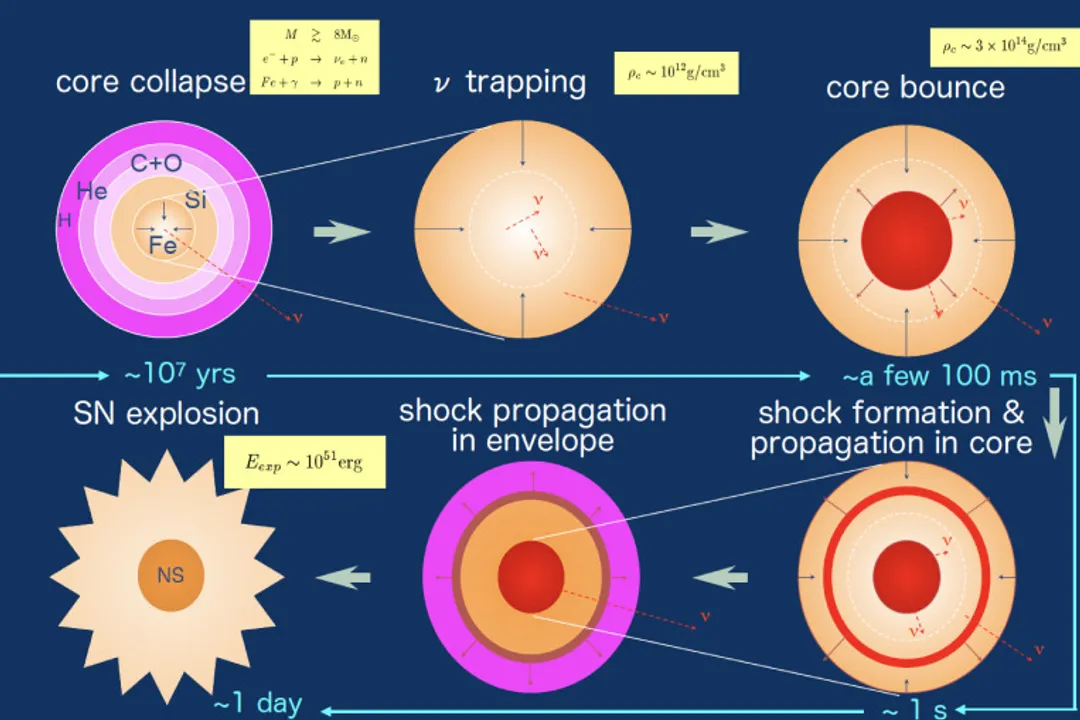
The transition to an iron core represents the absolute terminal point for energy generation via thermonuclear fusion within a massive star. Throughout its life, the star maintains equilibrium by generating energy through fusion, building successively heavier elements like hydrogen, helium, carbon, neon, oxygen, and silicon in concentric shells. While these processes release energy, the fusion of iron ($ ext{Fe}$) is fundamentally different. Iron nuclei possess the highest binding energy per nucleon, meaning that attempting to fuse iron nuclei together requires an input of external energy—it consumes energy rather than producing it. Once the core becomes dominated by iron, the star loses its internal thermal support mechanism that counteracts gravity, leading to an almost instantaneous cessation of energy production and triggering the catastrophic collapse.
#Videos
A Detailed Breakdown of Core Collapse Supernovae - YouTube