What causes the initial powerful shock wave following core impact to stall rapidly?
The dense, hot material behind the shock cools rapidly by emitting neutrinos.
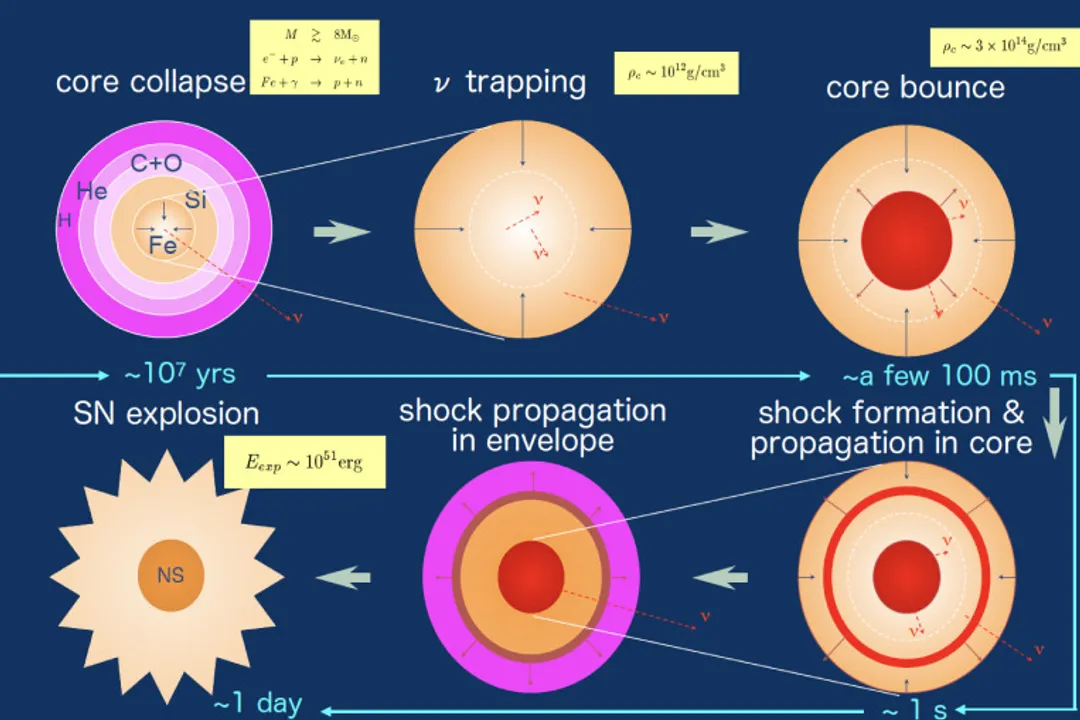
The initial collision between the infalling stellar envelope material and the newly formed, incompressible proto-neutron star (PNS) generates a powerful outward shock wave. However, in standard theoretical models, this shock wave frequently loses momentum and stalls, typically just a few hundred kilometers from the center of the PNS. The primary reason for this stalling is radiative cooling. The ultra-dense, extremely hot material situated immediately behind the advancing shock front emits a massive flux of neutrinos. These neutrinos carry away significant thermal energy from this region, effectively cooling the matter and causing the shock front to lose the energy required to continue propagating outward through the overlying stellar layers. If this stalling persists, the outer layers simply fall back onto the PNS, leading directly to black hole formation without a visible explosion.
#Videos
A Detailed Breakdown of Core Collapse Supernovae - YouTube