How is sustained heat generated in a forming star system before nuclear fusion ignites?
Answer
Conversion of gravitational potential energy into heat
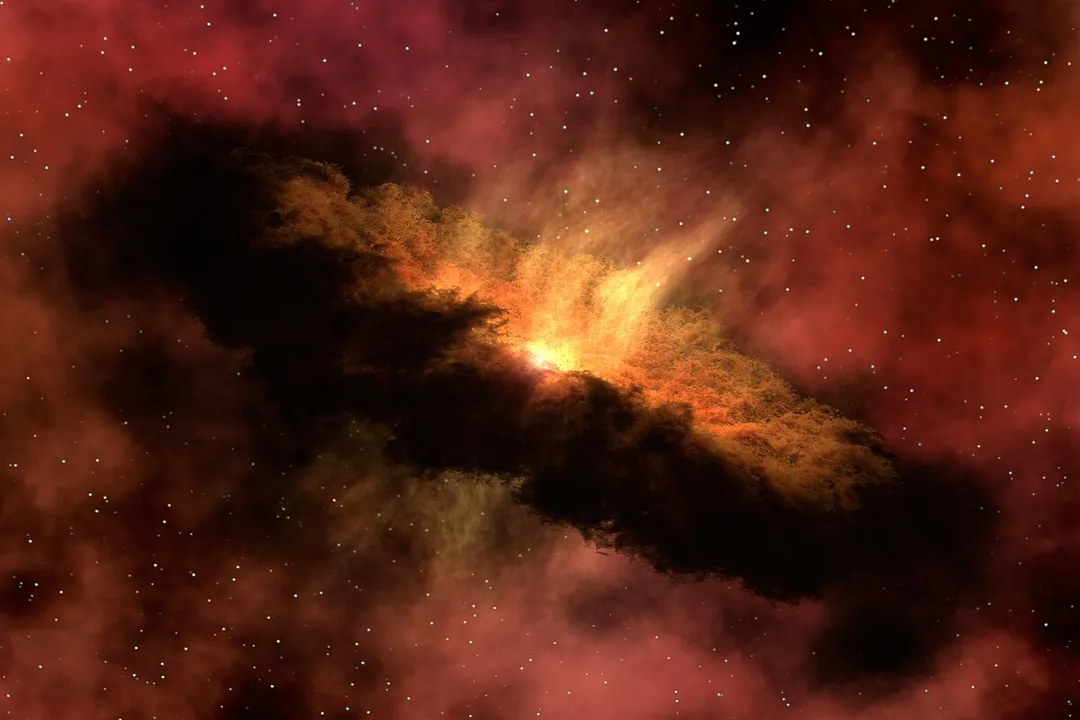
As gas and dust particles fall toward the center of the condensing mass, their gravitational potential energy is converted into kinetic energy, which manifests as heat upon particle collision, providing massive heat in the absence of fusion.
Related Questions
What is the fundamental force driving the contraction and transformation of nebulae into stars?What are the primary components found in the initial diffuse state of a nebula?What internal force primarily pushes outward against gravity in a molecular cloud, resisting initial collapse?What external cosmic event is mentioned as an effective trigger for initiating gravitational collapse in a quiescent cloud?What internal critical threshold must be reached for collapse to begin without an external catalyst?What physical principle dictates that the rotation rate of a contracting nebula must increase as it shrinks?What flattened structure results from the interplay of gravity and increasing rotation during collapse?Along which plane does the centrifugal force generated by spin resist the inward pull of gravity most effectively, leading to disk formation?How is sustained heat generated in a forming star system before nuclear fusion ignites?What is the dense, hot core called that accretes material from the surrounding disk before nuclear fusion begins?