What caused the Veil Nebula?
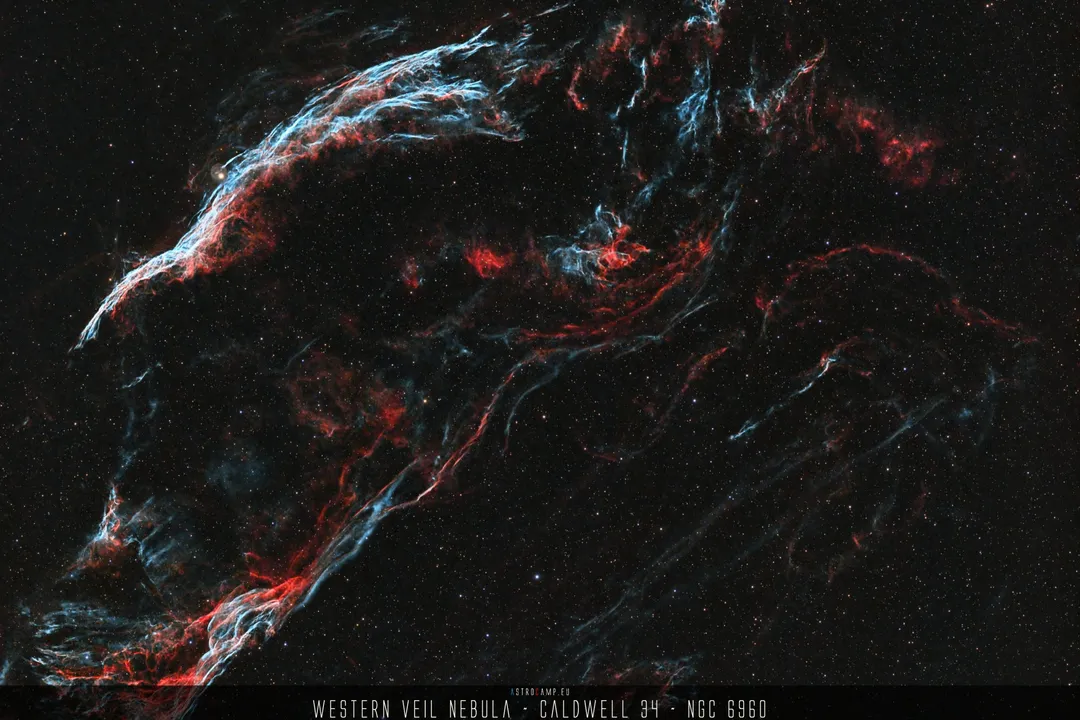
The Veil Nebula, a sprawling, delicate structure visible in the night sky, presents itself as a ghostly collection of glowing cosmic threads and wisps. For the amateur astronomer peering through a telescope, it is a breathtaking sight, often appearing as faint, ethereal lace stretched across the darkness of the constellation Cygnus. [4][5] Yet, this beauty belies its violent origin. This massive structure is not a birthplace of stars, but rather the aftermath of one of the most energetic events in the universe: a supernova explosion. [1][4][5]
The primary cause of the Veil Nebula is the catastrophic death of a giant star that existed thousands of years ago. This event created what astronomers call a supernova remnant, a rapidly expanding cloud of gas and dust resulting from the star’s final, violent expansion. [1][4]
# Star Death
The story begins with a star far more massive than our Sun. Estimates suggest the progenitor star was at least 20 times the mass of the Sun or greater. [1][4] Such massive stars live fast and die young, consuming their nuclear fuel rapidly before collapsing under their own immense gravity. [4]
When this star exhausted its core fuel, gravity overwhelmed the outward pressure supporting it. The core collapsed inward at tremendous speed, initiating a runaway thermonuclear reaction that resulted in a spectacular explosion—a core-collapse supernova. [1] This explosion rapidly ejected the star’s outer layers into space at incredible velocities. [4]
A crucial detail in understanding the nebula is its timeline. For a long period, the event that created the Veil Nebula was dated to approximately 10,000 to 20,000 years ago. [1][2][4] This time frame is determined by calculating how long it would take for the shockwave, traveling at several hundred kilometers per second, to reach its current observable distance from Earth, estimated to be around 2,400 light-years away. [1]
# Shock Physics
The immediate physical manifestation of the supernova is a tremendous shockwave propagating outward through the interstellar medium (ISM). [4] This shockwave travels at phenomenal speeds. Some measurements place this initial expansion rate at approximately 1,000 kilometers per second (km/s), [2] which translates to millions of miles per hour. [4]
As this energetic bubble of gas races outward, it doesn't just expand into empty space; it slams into the pre-existing, diffuse gas and dust that fills the space between stars. [2][4] This collision is where the visible nebula gets its structure and glow. The shock compresses and heats the interstellar material to millions of degrees, causing it to glow intensely, first in X-rays, and then as it cools and slows down, in visible light. [2]
The entire structure, often called the Cygnus Loop, is expanding, but the interaction zones are complex. The knots and filaments seen in the optical light are regions where the shockwave is most violently interacting with denser clumps within the ISM. [4] These glowing threads are essentially the visible evidence of this ongoing deceleration process. [2]
# Age Refinements
The initial age estimate of 10,000 to 20,000 years is derived from optical observations of the expanding shell. [1] However, modern observations focusing on the higher-energy X-ray emissions can provide a different calibration point. Revisiting data, some studies suggested that the X-ray profile of the remnant points toward a slightly younger age, perhaps closer to 8,000 years. [2] This discrepancy highlights the difficulty in pinning down the exact moment of an ancient cosmic event, as the energy decay and visual appearance evolve non-linearly over millennia. While the optical remnants paint a picture of slow cooling, the X-ray signature reflects the hotter, more recent interaction fronts. [2]
# Mapping the Remnant
The Veil Nebula is not a single, uniform object but a vast collection of distinct, overlapping components. [1][5] These subdivisions are primarily defined by their position relative to the observer and their specific characteristics, all originating from the same central explosion.
| Component Name | NGC/Caldwell Designation | Location Relative to Center | Key Feature |
|---|---|---|---|
| Western Veil | NGC 6960 (Caldwell 33) | West edge | The "Witch's Broom" appearance [8] |
| Eastern Veil | NGC 6992/95 (Caldwell 32) | East edge | Brightest, most complete arcs |
| Pickering's Triangle | N/A | Central/interior area | Fainter, centrally located structures |
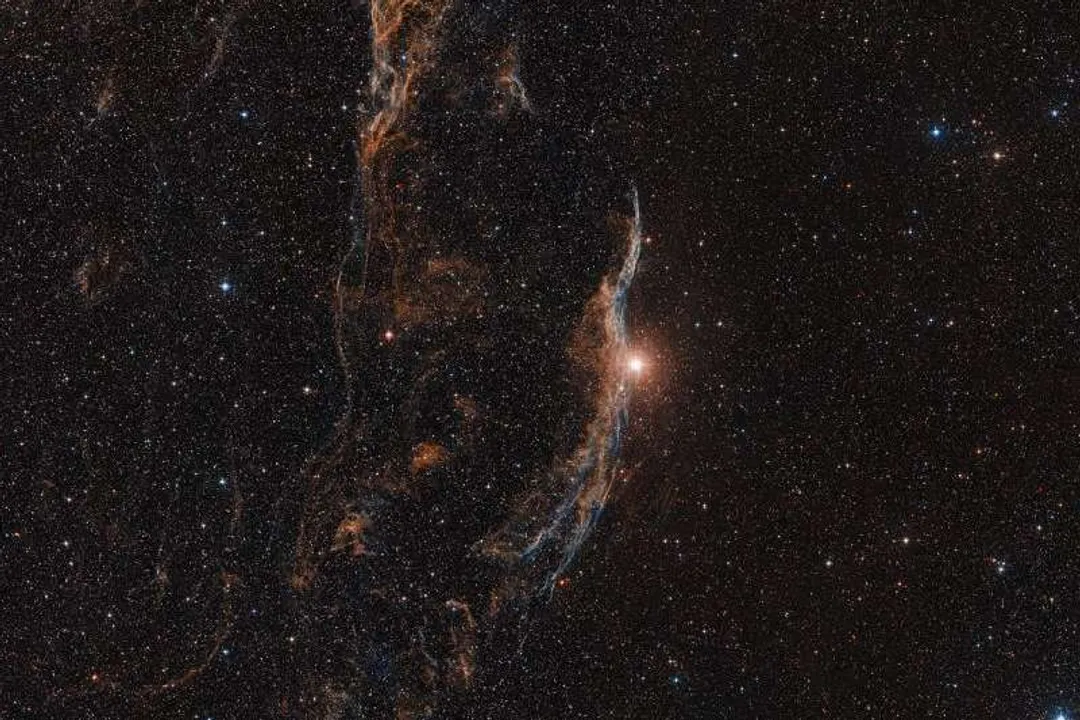
The Western Veil, known formally as NGC 6960, is often the most recognizable part, stretching across a large arc. [8] Its distinct shape, sometimes described as a witch's broom, is a result of how the shockwave interacts with surrounding material, often dictated by the density variations in the ISM along that line of sight. [8] Similarly, the Eastern Veil, comprising NGC 6992 and NGC 6995, presents brighter, more defined structures. [1][5]
These separate appearances are not different events; they are different views of the same expanding, roughly spherical shell of expanding debris. The apparent separation in the sky is simply a matter of perspective as we view the shell's edge-on profile from our vantage point within the galaxy. [5] The structure is immense, spanning several degrees across the sky. [4]
# Spectral Signatures
The physical cause—a hyper-energetic shockwave—is confirmed by the light the nebula emits. When the shockwave heats the surrounding gas, it ionizes the atoms, stripping electrons away. As these electrons recombine or cascade down energy levels, they emit light at very specific wavelengths, which act as a cosmic barcode identifying the elements present. [3]
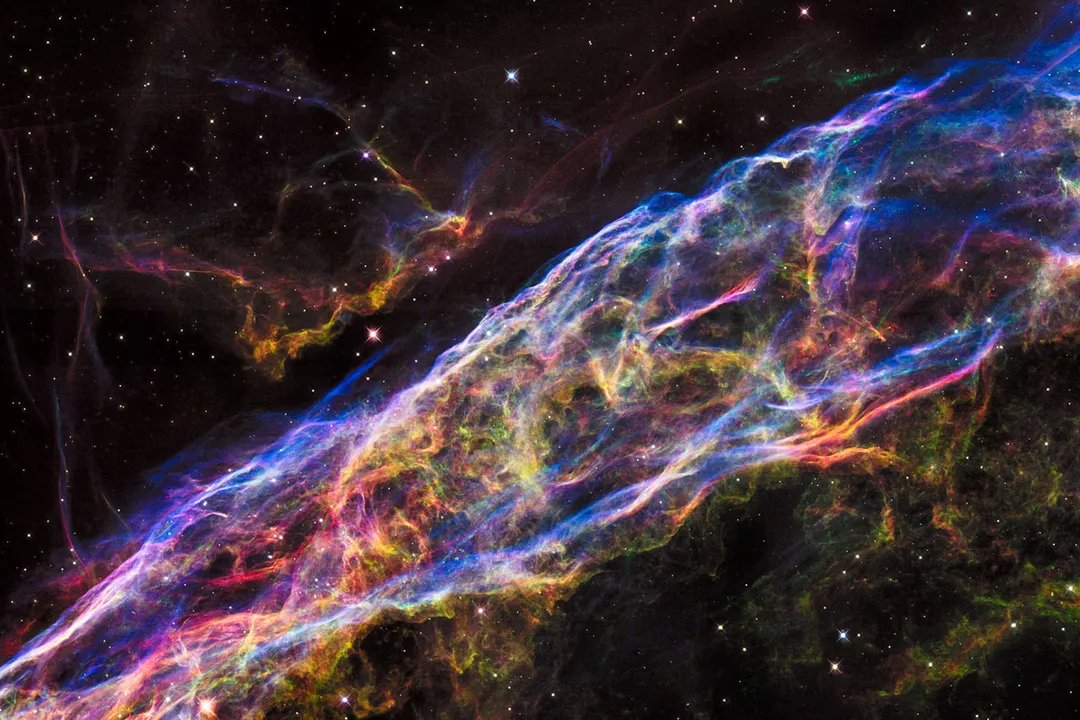
Observations, including those made by instruments like the Hubble Space Telescope and the Far Ultraviolet Space Telescope (FUSE), confirm the presence of highly ionized elements like oxygen, hydrogen, and sulfur. [3][6] The color maps produced by telescopes often assign specific colors to these elements to reveal structure: for instance, red/orange tones might highlight hydrogen-alpha emission, while blues highlight oxygen. [6] The detection of high-energy radiation, particularly in the extreme ultraviolet (EUV) spectrum, is a strong indicator of gas heated to millions of degrees by a powerful shock event, rather than just a standard emission nebula. [3] The gas is so hot that we are seeing emissions from elements that are typically found only in the hottest, most active stellar environments.
If we consider the initial energy released during the supernova, it is staggering. The visible light we see today is the residual glow, but the initial burst was so bright it would have momentarily outshone entire galaxies, though it occurred too far away and too long ago for ancient humans to have recorded it as a "new star" in that location. [4]
When analyzing the material itself, it is interesting to note that the debris cloud is actually mixing with the local environment. The filaments are composed not just of the original star's matter but also the swept-up interstellar gas that the shockwave has compressed and energized. [2] This constant incorporation of new material influences the nebula's appearance over time. Imagine pouring a bottle of highly concentrated ink into a massive, gently flowing river; the initial plume is distinct, but soon it becomes an attenuated, stretched-out part of the river’s overall flow. The Veil Nebula is currently in that attenuated, stretched-out phase of interacting with the Galactic ISM.
The very structure we see—the delicate, thread-like filaments—is a physical representation of the energy dissipation process. The material is rapidly slowing down, cooling, and dropping out of the high-energy X-ray phase into the visible light phase. If we could witness this structure over a span of just a few thousand years, we would see the bright knotty regions gradually diffuse and dim as their kinetic energy is converted into heat and light, eventually fading back into the background ISM. [4]
# Observational Context
To grasp the scale of this event, we must remember the sheer size of the structure. If the 8,000 to 10,000-year-old estimate is correct, and the expansion speed is around , the outer edge of the visible remnant has traveled perhaps 25 to 30 light-years in that time, but the entire shocked volume is much larger. [2] This expansion means that the material, still visibly glowing today, has only had a cosmic blink of an eye to travel across that distance. Considering that a typical star system takes millions of years to travel even a short distance within the Milky Way disk, the speed of this remnant is exceptional.
The enduring visibility of the Veil Nebula, spanning many degrees in the sky, makes it a premier target for astrophotographers. [7] Its appearance varies dramatically based on the equipment used. A standard telescope shows the general shape, but specialized filters—like those targeting the Hydrogen-Alpha (H-alpha) or doubly ionized oxygen ([O III]) lines—are required to bring out the fine detail of the filaments against the dark sky background. [7] The contrast between the bright, defined knots and the vast, nearly transparent structures in between is a testament to the highly non-uniform density of the interstellar clouds the supernova encountered. [4]
Ultimately, what caused the Veil Nebula was a single, monumental stellar collapse. The resulting spectacle—the Cygnus Loop—is an ongoing process of kinetic energy transformation, creating one of the most visually stunning markers of stellar violence in our immediate cosmic neighborhood.
Related Questions
#Citations
Veil Nebula - Wikipedia
Revisiting the Veil Nebula - Phys.org
FUSE Observes a Star Behind the Cygnus Loop Supernova Remnant
The Veil Nebula - Cosmic Pursuits
Caldwell 34 – Western Veil Nebula
HST captures the Veil Nebula in prismatic color - Astronomy Magazine
The Veil Nebula - by Brian Ventrudo - Seeking Starlight
Western Veil Nebula - AstroBackyard
Revisiting the Veil Nebula - ESA/Hubble