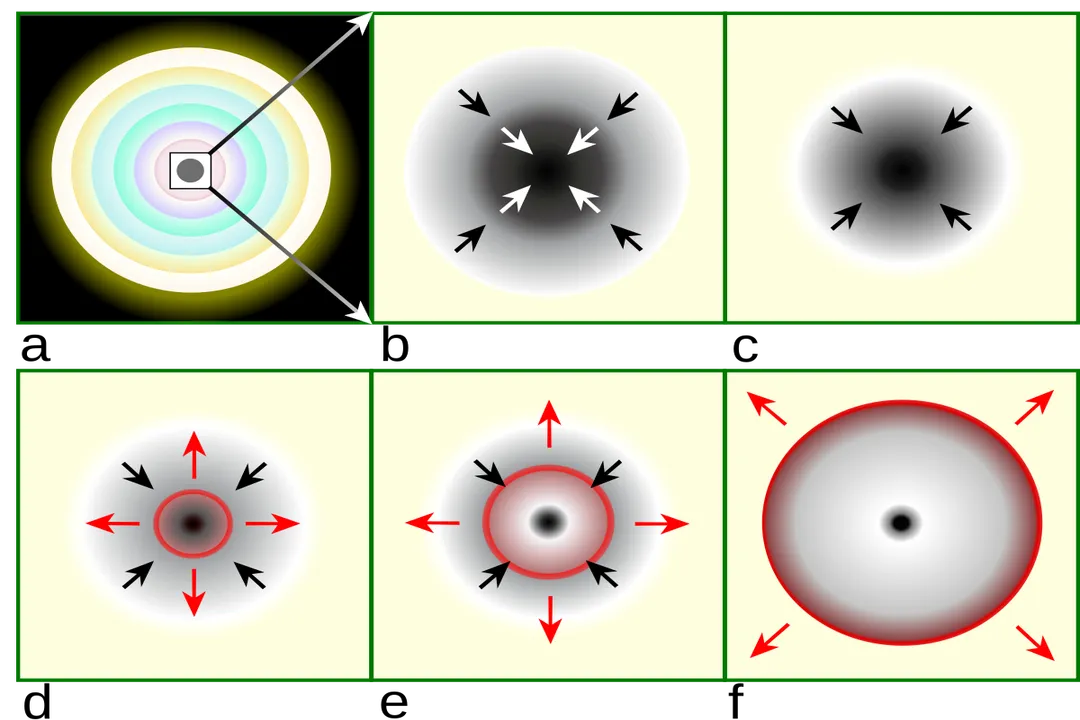
What critical physical threshold must the density of a collapsing core cross to trap radiation and halt the initial free-fall phase?
Answer
The gas becomes opaque to its own radiation
During the very first phase of core collapse, the material is initially low density and transparent, allowing energy generated by compression to escape freely as photons leak out. This prevents pressure from building up, allowing gravity to drive a relentless free-fall inward. This phase ends abruptly when the core density rises high enough that the material achieves an opacity threshold. At this point, the newly generated photons are trapped within the core. This trapping causes the interior temperature to spike dramatically because the energy cannot escape easily, finally allowing internal pressure to accumulate sufficiently to resist the relentless inward pull of gravity.
Related Questions
What is the initial energy source that makes a protostar shine before fusion begins?What two specific forms of equilibrium must be established for a star to officially land on the Zero-Age Main Sequence (ZAMS)?What external event is cited as a potential trigger for initiating gravitational collapse in a Giant Molecular Cloud (GMC)?What critical physical threshold must the density of a collapsing core cross to trap radiation and halt the initial free-fall phase?For stars similar to our Sun, what core temperature is required to ignite the proton-proton (P-P) chain reaction?What stellar objects result if a core never reaches the temperature needed for sustainable hydrogen fusion?According to the Virial Theorem, as gravity compresses a system, what energy component must increase to approach a new state of balance?What provides the powerful, outward-directed thermal pressure that finally counteracts the inward crush of gravity at fusion ignition?How does the timescale for gravitational collapse significantly differ for a high-mass protostar (e.g., $30 M_{ ext{sun}}$) compared to a Sun-like object?What ongoing process causes a stable main sequence star like the Sun to slowly evolve into a red giant later in its life?