What happens when a magnetar collapses?
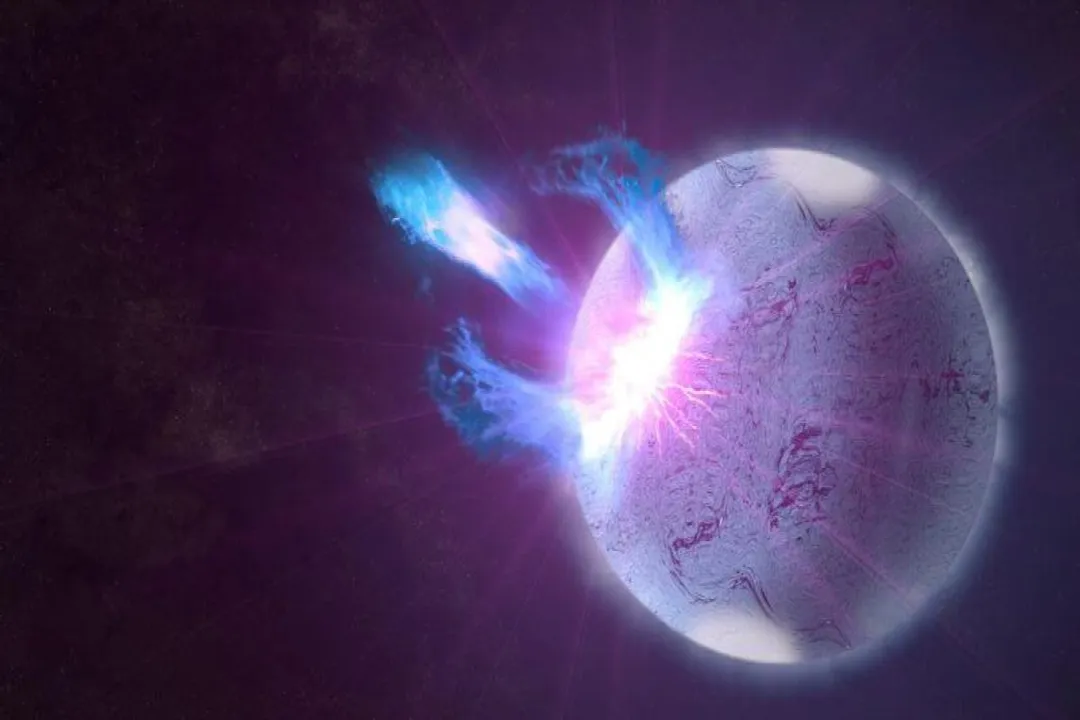
The final destiny of a magnetar, one of the most exotic objects in the cosmos, hinges on a dramatic cosmic race between gravity and magnetic decay. These celestial behemoths represent the extreme endpoint of stellar evolution, remnants born from the crushing collapse of a massive star's core. [6] What distinguishes them from ordinary neutron stars is their staggering magnetic power, fields so intense they defy easy comprehension by terrestrial standards. [5] When the internal pressure holding gravity at bay finally fails, the question isn't if the star collapses, but what remains after the event horizon forms.
# Extreme Magnetism
A neutron star is already mind-bogglingly dense—packing more mass than our Sun into a sphere only about 12 miles across. [4] A magnetar takes this density and adds a magnetic field that can reach intensities up to Gauss. [4][5] To put that into perspective, the strongest magnetic field ever produced in a laboratory on Earth is only about a million times weaker than this. [5] This phenomenal field strength is thought to arise from the differential rotation of the star's interior layers during or shortly after its formation, twisting and amplifying the original magnetic flux. [1]
These fields are so powerful that they stress the crust of the star, causing starquakes that release bursts of high-energy radiation known as soft gamma repeaters or anomalous X-ray pulsars. [5] It is this magnetic tension, rather than just rotational energy, that characterizes the magnetar. [1] The object's entire existence is defined by this magnetic bubble, which extends far into space surrounding it. [1]
# Field Decay Versus Mass Limit
The lifespan of a magnetar is finite, governed by two competing physical processes: the decay of its magnetic field and the object's total mass. [1] The magnetic field, while powerful, is not eternal; it dissipates over time. [1] If the magnetar’s magnetic field decays sufficiently before its mass pushes it over the critical limit, it simply ceases to be a magnetar and becomes a standard, though still incredibly dense, neutron star. [1]
However, if the initial core remnant exceeds a certain mass threshold—the limit beyond which even the pressure exerted by degenerate neutrons cannot resist gravity—then a complete gravitational collapse into a black hole is inevitable. [3]
Consider the interplay: a more massive neutron star might collapse sooner due to gravity, while a less massive one might have time for its magnetic field to weaken significantly before reaching that fatal mass. [1] Imagine two stars reaching the same mass limit simultaneously. If Star A had a much stronger initial field that decayed slowly, its collapse might be accompanied by more violent magnetic restructuring right before the final implosion. Conversely, Star B, with a weaker field that decayed faster, might cross the threshold as a quieter, conventional neutron star, leading to a quieter black hole formation if mass is the only deciding factor. [1]
# The Inevitable Collapse
When a neutron star, magnetar or otherwise, reaches the maximum stable mass—often estimated to be around two or three times the mass of our Sun, though the exact number is debated [3]—the core begins an unstoppable implosion toward infinite density. [3] For a magnetar, this collapse is the final state where the magnetic field can no longer sustain the star against its own gravity. [4]
The physics dictates that once the mass crosses this point of no return, spacetime warps so severely that nothing, not even light, can escape the forming singularity. [3] This transition is often described as the star crossing its own event horizon. [3]
# Swallowed Fields
The most direct answer to what happens to the magnetic field during this final collapse is that it is completely subsumed by the newly formed black hole. [1][3] A black hole, in the classical description, is defined only by its mass, charge, and angular momentum—it possesses no external magnetic field of its own that we can readily detect in the way a magnetar's field is observable. [1]
As the stellar material rushes inward, the entire structure, including the immensely powerful magnetosphere, plunges past the event horizon. [3] The sheer strength of the field, which defined the object for its entire existence, simply vanishes from the observable universe outside the black hole boundary. [1] The resulting object is an unadorned black hole, its violent past hidden behind a veil of darkness. [3]

# Observational Signatures
While the resulting black hole is inherently stealthy, the process leading up to it might leave some detectable scars on the cosmos. The rapid reshaping and compression of matter during the final collapse could generate gravitational waves. [3] These ripples in spacetime, if strong enough, might be detectable by instruments like LIGO or Virgo, providing an indirect but profound way to confirm the demise of a massive, magnetized object. [3] Detecting such an event would be exceptional, as the electromagnetic counterpart—the massive flares typically associated with magnetars—would likely be overwhelmed or cut short by the rapid formation of the horizon. [3]
It is interesting to contrast this quiet end with the violent beginnings discussed in recent astrophysics. Some models suggest that magnetars themselves can be born from colossal collisions between two neutron stars. [9] In that scenario, the event is heralded by an intense kilonova explosion and a burst of gravitational waves. [9] The collapse scenario, however, is the opposite: a final gravitational scream followed by silence, where the energy is momentarily converted into spacetime distortions before being effectively erased from external electromagnetic observation. [3]
We can analyze the observational signature difference: a birth involves massive electromagnetic output and gravitational waves, [9] whereas a collapse might only yield a significant burst of gravitational waves, as the electromagnetic output is truncated by the horizon's formation. [3] This difference in observational echoes could one day allow astronomers to distinguish the end stages of these ultra-dense stars.
# Mass Estimation Context
The precise upper mass limit for a neutron star remains an active area of research, often referred to in the context of the Tolman-Oppenheimer-Volkoff (TOV) limit. [3] While magnetars are generally considered to be relatively low-mass neutron stars, their internal structure, influenced by extreme magnetic pressure, complicates applying standard equations of state. [4] The magnetic pressure acts outwardly, slightly counteracting gravity and potentially allowing the magnetar to temporarily exceed the mass limit that a non-magnetized neutron star of the same internal composition could sustain. [1]
If we hypothesize a core mass that is slightly below the theoretical non-magnetized TOV limit, but the magnetic field stress is significant, the total outward pressure might keep it stable. If the magnetic field decays rapidly, the effective outward pressure drops instantly. Suddenly, the star is effectively heavier than the TOV limit for a non-magnetized star, triggering the collapse. This means the magnetic field acts as a temporary "support beam," which, upon removal, accelerates the descent into black hole territory, even if the mass itself hadn't increased. [1] It's a structural failure hastened by magnetic demagnetization.
This concept implies that the most stable magnetars might be those that are not only close to the mass limit but also possess magnetic fields that decay slowly, giving them more time to potentially shed mass through flares before gravity wins out completely.
# Black Hole Characteristics
Once the collapse is complete, the object is a black hole, inheriting the mass and angular momentum of the collapsed magnetar. [3] The key takeaway is the loss of external magnetic influence. The intense field that caused the starquakes and dominated its radiated energy is gone from view. [1] If the magnetar had a significant spin rate, the resulting black hole will also spin, governed by the conservation of angular momentum during the event. [3] However, the most defining characteristic of the original object—its Giga-Tesla-strength magnetic field—is erased from the observable characteristics of the resulting black hole. [1] The legacy of the magnetar is thus reduced to a mass-energy concentration surrounded by nothing more than the warp in spacetime itself. [3]
#Videos
What If a Magnetar Collided With a Black Hole? - YouTube
What if a Magnetar Came Close to Earth? - YouTube
Related Questions
#Citations
What happens to the magnetic field of a magnetar if it collapses into ...
What If a Magnetar Collided With a Black Hole? - YouTube
What happens if a magnetar collapses into a black hole?
Magnetar - Wikipedia
Powerful magnetars may give way to small black holes
Here's how A magnetar is a type of neutron star—the incredibly ...
Sheer Magnetism: What's a Magnetar? - Museum of Science
Birth of magnetar from colossal collision potentially spotted for first time