What would happen if you were near a magnetar?
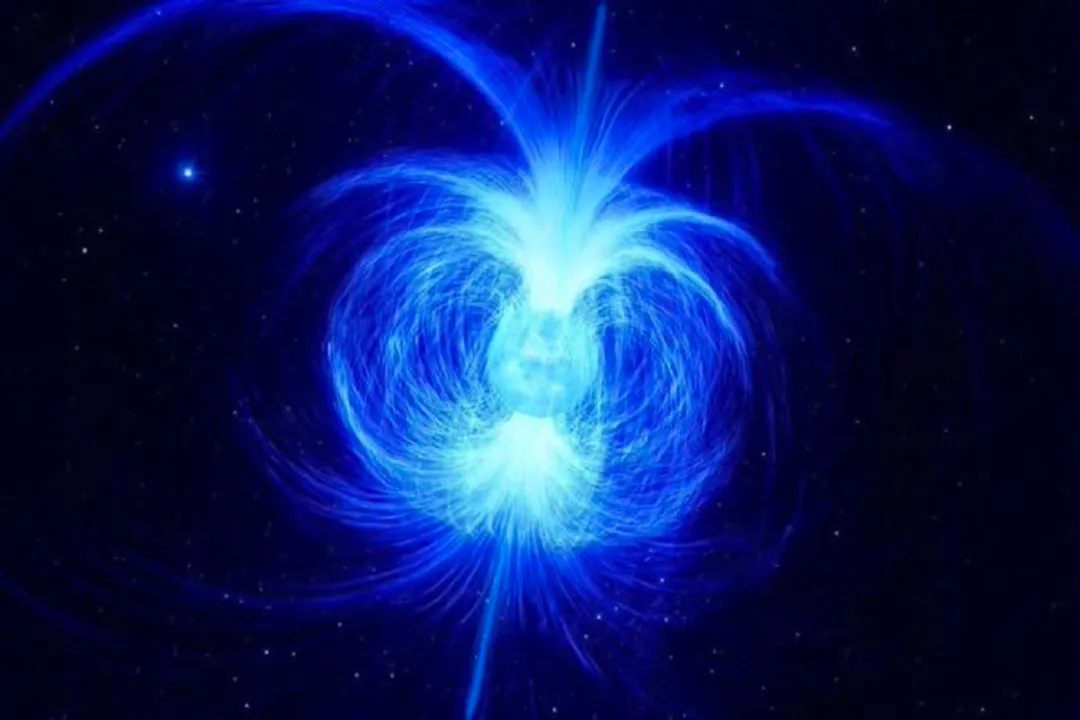
The question of what happens when one encounters an object that pushes the boundaries of known physics is fascinating, and few celestial bodies inspire more immediate dread than the magnetar. These are not just strong magnets; they are the most powerful known magnetic objects in the universe, remnants of supernovae born from the collapse of extremely massive stars. [3][5] If you found yourself drifting toward one, the experience would be swift, violent, and utterly destructive long before you could even register the visual spectacle.
# Stellar Birth
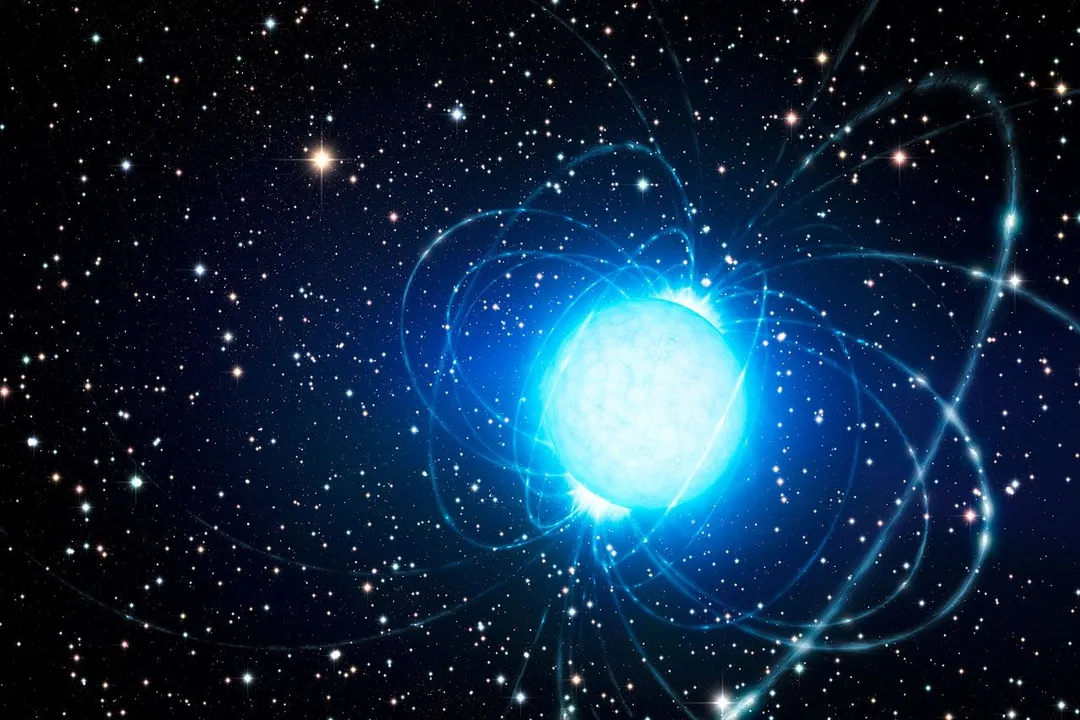
A magnetar is a specific type of neutron star, which itself is the collapsed core of a star perhaps eight to twenty times the mass of our Sun that ended its life in a colossal explosion. [3] When this core collapses, it compresses matter to incredible densities—a teaspoon of neutron star material would weigh billions of tons. [5] Crucially for a magnetar, the original star must have had an unusually high degree of magnetic flux. As the core shrinks from a star many times wider than Earth down to a sphere only about 12 miles across, that magnetic flux gets compressed along with the matter, resulting in an astronomical amplification of the field. [3]
# Field Strength
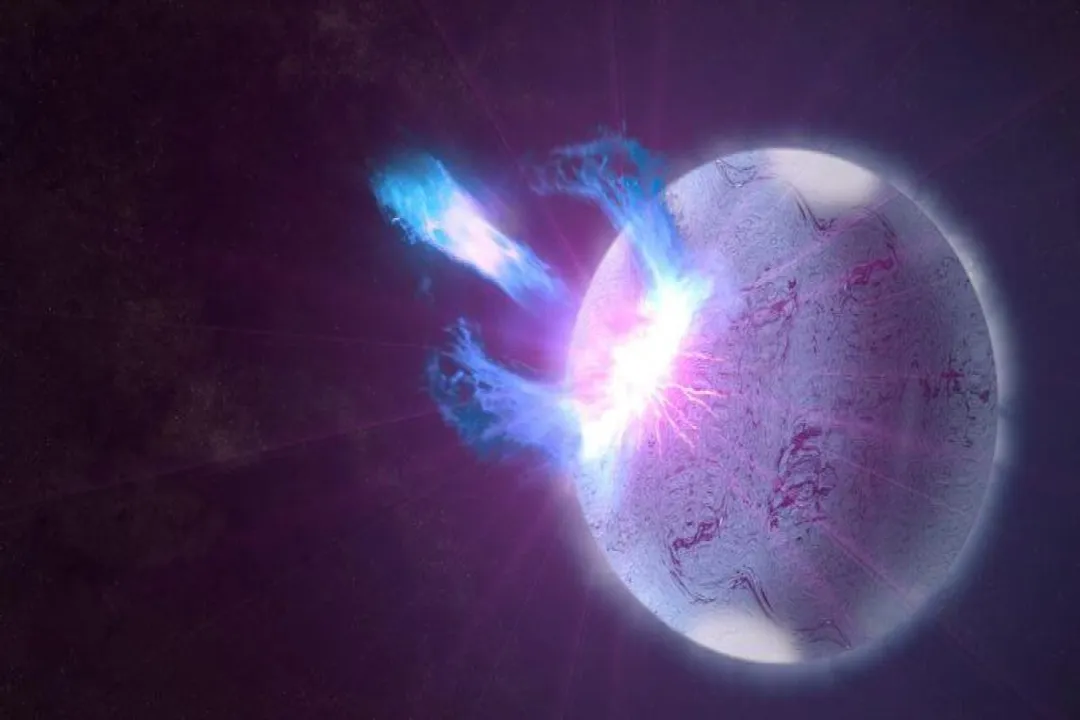
To grasp the scale of the magnetic power involved, consider the strongest magnetic fields we can generate on Earth, which peak around 10 to 45 Tesla (T) in specialized laboratories. [3] A standard refrigerator magnet might pull at a paltry $0.01$ T. [3] Magnetars, in contrast, possess fields ranging from $10^9$ Tesla to a staggering Tesla. [3][5] This immense field is not just a static property; it is constantly shifting, causing flares as the tangled magnetic field lines snap and rearrange themselves. [5]
To put these numbers into a relatable scale, a comparison of field strengths helps illustrate the gulf between everyday experience and a magnetar's reality:
| Object | Approximate Magnetic Field Strength (Tesla) | Effect on Matter |
|---|---|---|
| Refrigerator Magnet | $0.01$ T | Minimal interaction |
| Strong MRI Machine | $3$ T | Affects ferromagnetic materials |
| Earth's Field | $0.00005$ T | Negligible on human scale |
| Strongest Lab Magnet | T | Highly specialized research use |
| Typical Neutron Star | $10^8$ T | Extremely powerful |
| Magnetar Surface | $10^9$ to T | Instantaneous atomic disruption |
| [3][5] |
The magnetic field strength around a magnetar drops off according to the inverse cube of the distance (). While this rapid decay means that magnetars pose no threat across interstellar distances—the field strength at Earth’s orbit from the nearest known candidate would be entirely negligible [4]—the situation changes drastically if you approach the object. For instance, if you were just a few hundred kilometers away, the field strength would be sufficient to overcome the electromagnetic forces holding atoms together. [1][4]
# Near Field
If you were flying toward a magnetar, you wouldn't be crushed by gravity—neutron stars are small, so the gravitational gradient isn't the immediate killer unless you hit the surface. [4] Instead, the magnetic field itself would be the executioner. At a certain proximity, the field becomes so powerful that it overwhelms the electron shells of atoms. This process, sometimes termed "magnetization," means the atomic structure itself begins to deform. [4]
Think about the processes holding you, your spaceship, or even the very air around you together. They rely on electromagnetic forces—the attraction between positive nuclei and negative electrons. [1] A field strong enough, say near the surface of a typical magnetar, would stretch the atoms into long, thin threads aligned with the field lines. [1] If you were approaching such an object, long before you crossed the point where your atoms were perfectly aligned, you would likely pass through a region where the field gradient—the change in field strength over distance—is enough to tear apart complex molecules like DNA and proteins. [4] You would be essentially disassembled at the molecular level. In effect, you would be vaporized into a superheated stream of plasma, perfectly channeled along the local magnetic field lines, long before any light or radiation from a potential flare reached you. [1][4]
# Burst Energy
While the static field ensures instant, agonizing death for any matter that gets too close, magnetars possess another, more widespread threat: their explosive energy releases. [5] These objects are known to emit intense bursts of X-rays and gamma rays, sometimes called Soft Gamma Repeaters (SGRs) or Anomalous X-ray Pulsars (AXPs). [3] These flares are caused by the readjustment of the immensely stressed magnetic field lines. [5]
The energy released in a single, massive flare can be staggering—sometimes equivalent to the Sun's total energy output over centuries released in mere milliseconds. [5] Because these are high-energy electromagnetic waves (gamma rays), they travel at the speed of light and can propagate across vast cosmic distances. If one of these bursts were aimed directly at Earth, even if the magnetar was thousands of light-years away, the consequences would be catastrophic. [4] The high-energy photons would slam into our atmosphere, creating nitrogen dioxide, which would destroy the ozone layer. [4] The subsequent increase in solar ultraviolet radiation reaching the surface would lead to a mass extinction event, potentially sterilizing the surface of the planet. [4][5]
It has been estimated that a flare from a magnetar 50,000 light-years away, if directed our way, could still be powerful enough to significantly impact Earth's magnetosphere and electronics, though perhaps not cause a total extinction. [5]
# Safe Range
The analysis of magnetar dangers reveals a dual safety consideration: distance from the object versus distance from the source of a transient event.
For the static magnetic field hazard, the safe distance is surprisingly vast when compared to the object's physical size, but incredibly small on a cosmic scale. Given the falloff, if a hypothetical magnetar had a physical radius of km, the point where the field strength drops to a manageable, though still highly disruptive, level (say, $10^5$ T, enough to destroy any conventional data storage) might still be only a few thousand kilometers away. However, the lethal zone where atomic structure fails begins almost immediately outside the star's surface. [6] If we consider a highly speculative scenario where a magnetar had shrunk down to a mere 1 cm diameter—purely for illustrative mathematical contrast—the devastating effects of the magnetic field would still extend outward significantly because the starting point for the calculation is so infinitesimally small, meaning the initial field is localized but terrifyingly intense. [6]
The safety margin against flares, however, is governed by the inverse square law for radiation intensity, and the sheer power involved. If a magnetar is known to exist within our galaxy, we are generally safe because the energy required to strip the ozone layer from 50,000 light-years away is huge, and the chances of it being perfectly aimed at us are low. [5]
From a practical standpoint, any spaceship venturing near one needs shielding not just against gravity or radiation, but against the fundamental forces of nature being warped by that object. Unless we discover a method to locally negate or channel these exotic magnetic fields—a concept far outside current physics—the only safe distance from an active magnetar is very far away, likely measured in parsecs rather than astronomical units. Our current best defense against a magnetar threat remains the simple fact that the closest known ones are thousands of light-years away, providing ample buffer time against any sudden burst of energy. [4]
Related Questions
#Citations
How lethal is flying by a magnetar? : r/space
What would happen if you got close to a magnetar?
Magnetar
Sheer Magnetism: What's a Magnetar?
What will happen if a magnetar gets close to Earth?
How close can you get if a magnetar was 1cm diameter ...
Why Magnetars Should Freak You Out