What would happen to Earth if Jupiter didn't exist?
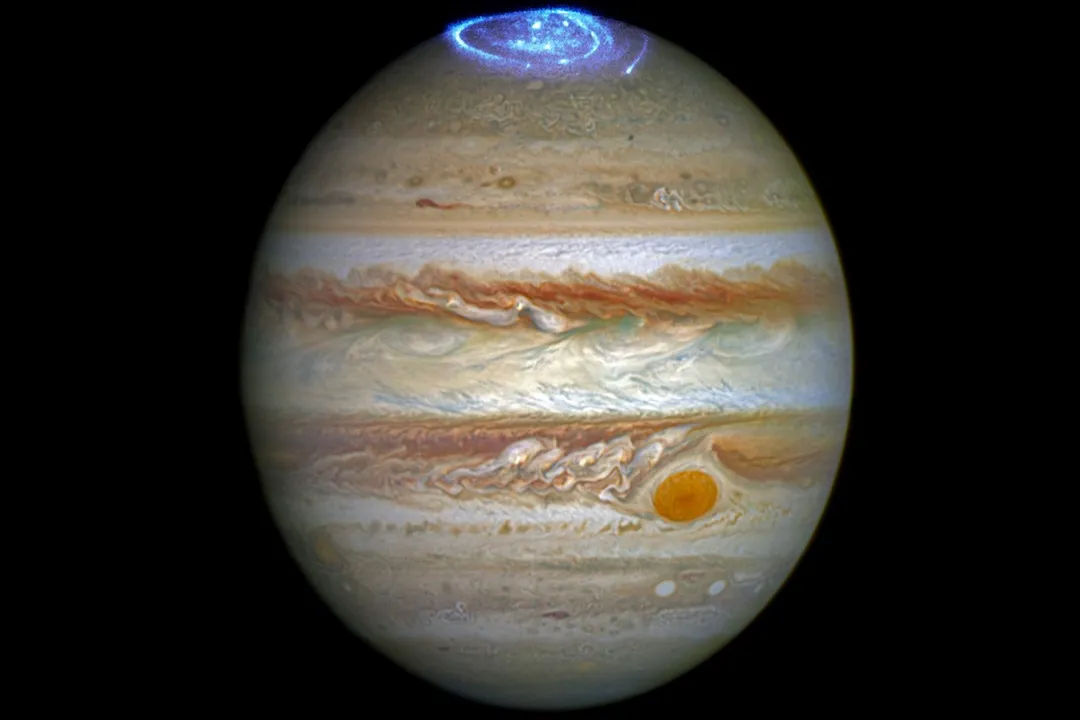
The idea that the solar system could function just as well, or perhaps even better, without its largest member, the colossal planet Jupiter, is a fascinating thought experiment that quickly turns into a stark realization of how dependent we are on its presence. If the giant world simply ceased to be, the consequences for Earth would be immediate and profound, rewriting the history of our solar system's evolution. [6] Jupiter is not just another planet in the lineup; it is the gravitational anchor that has dictated the stability and structure of everything orbiting closer to the Sun for billions of years. [8][9]
# Cosmic Protector
The most commonly discussed role for Jupiter is that of a celestial bodyguard. Because of its enormous mass—it is more than twice the mass of all the other planets combined [6]—Jupiter exerts a powerful gravitational influence across vast distances. [1] This gravity acts as a substantial shield, sweeping up or flinging away hazardous comets and asteroids that might otherwise be on a collision course with the inner solar system, including Earth. [7] Without this constant sweeping action, the rate of major impacts on our world would almost certainly increase dramatically. [1][4]
Imagine the Oort Cloud or the Kuiper Belt as a vast, disorganized shooting gallery aimed inward. Jupiter's gravity effectively deflects a significant portion of these icy and rocky travelers away from the inner orbits where Earth resides. [7] While Earth does experience impacts even with Jupiter present, the frequency of civilization-ending, large-scale events would likely have been much higher without its stabilizing presence. [3] It acts as a kind of massive gravitational net, catching the dangerous debris before it gets too close to the terrestrial planets. [4]
# Orbital Dynamics
The absence of Jupiter would throw the delicate gravitational balance of the inner solar system into chaos. This isn't just about stray comets; it's about the long-term architecture of the planetary orbits themselves. [9] Current models and simulations suggest a terrifying scenario for our home world: without Jupiter’s constant tug and guidance, Earth's orbit might not remain stable over astronomical timescales. [5]
One leading theory posits that Earth, lacking Jupiter's gravitational steering, could have slowly spiraled inward toward the Sun over millions of years. [5] While this seems like a very slow process compared to a catastrophic asteroid strike, it represents a guaranteed long-term extinction event. The slight nudges that keep Earth in its nearly circular, habitable orbit would be absent, allowing the Sun's overwhelming gravity to eventually win the tug-of-war. [8] We owe our relatively constant solar energy input, which allowed life to flourish predictably, to this massive gas giant. [5]
# Asteroid Belt Changes
Another major area of disruption centers on the asteroid belt, which sits between Mars and Jupiter. Jupiter is largely responsible for the very existence and current configuration of the belt itself. [1] Its gravity prevented the material in that region from coalescing into a planet by scattering the planetesimals and forcing them into the eccentric orbits we see today. [1]
If Jupiter vanished, the gravitational clearing mechanism stops. The objects within the asteroid belt would suddenly find their orbits untamed by the giant's influence. [8] Instead of remaining primarily in the belt, these bodies would likely begin to interact more frequently with each other and with Mars and Earth. [1] This instability would mean a massive increase in the influx of rocky material into the inner system, essentially turning the asteroid belt into a far more active and dangerous zone pointed directly at us. [3] The odds of a massive collision, similar to the one that ended the age of the dinosaurs, would become drastically higher, and potentially more frequent, than they are now. [1]
# Mercury's Fate
The gravitational reorganization wouldn't stop at Earth. When examining the entire solar system's stability without Jupiter, some models indicate that other inner planets might also face doom. Mercury, the innermost planet, is particularly vulnerable to perturbations from the other planets, especially the strong influence of the giant planets. [1] If Jupiter were removed, simulations show that Mercury's orbit could become extremely eccentric, potentially leading to it either smashing into the Sun or being ejected from the solar system altogether. [1] This illustrates that Jupiter isn't just protecting Earth; it's regulating the entire neighborhood, keeping the inner orbits neat and tidy. [6]
# Life's Chances
The question of whether life would exist hinges on which destructive mechanism takes precedence in a Jupiter-less solar system: the sudden, frequent bombardment from the belt, or the slow orbital decay toward the Sun. [5] If the initial formation period had been far more volatile, perhaps the sheer number of impacts prevented by Jupiter over the last four billion years meant that complex life on Earth only had the chance to evolve because of the giant’s protective presence. [3]
It is often hypothesized that the early solar system was much more chaotic. The fact that Earth has maintained a relatively stable orbit and a tolerable impact rate for long enough to support evolution is a testament to Jupiter’s work as a system stabilizer. [8] If Jupiter had formed closer to the Sun—a scenario explored in planetary migration theories—the gravitational instability would have been immediate and drastic, likely preventing the formation of terrestrial planets like Earth entirely. [5] The required conditions for life demand a long stretch of relative calm, and Jupiter seems to be the primary source of that necessary stillness in our region of space. [6] This points toward the necessity of where Jupiter is, not just that it is. The current distance of roughly five astronomical units appears to be the sweet spot that allows for both the shielding effect and the orbital stabilization of our particular planet. [5]
# System Structure
Jupiter's influence extends even to the Sun. Its mass subtly affects the center of mass of the entire solar system, the barycenter, around which all bodies orbit. [10] While its sudden removal would cause an immediate shift in this center point, the long-term effect is more about the resonant frequencies of the system. [9] Jupiter's strong resonances act as a set of tuning forks, ensuring that the orbital periods of Mars and Earth do not fall into dangerous alignments that would accelerate orbital decay or increase scattering events over eons. [8] Without these dampening effects, the subtle gravitational interactions between Mars, Earth, and Venus would eventually compound, leading to far more erratic and dangerous orbital paths for all three terrestrial worlds. [9]
# Comparing Planets
While the loss of any major planet would certainly cause shifts, Jupiter’s removal has the most drastic repercussions for Earth. [6] For instance, removing Saturn would certainly destabilize the outer system and alter the distribution of comets, but Jupiter's sheer magnitude—being the largest planet—gives it an unmatched dominance over the inner system's safety profile. [6] Neptune and Uranus have significant influences, but Jupiter sits in the most critical position relative to the main asteroid belt and the orbits of Mars and Earth. [6] Thinking about it from a budget perspective, if we assigned a "stability cost" to each planet, Jupiter's contribution to keeping our corner quiet is by far the largest portion of that overhead. [6]
The reality is that a solar system without Jupiter is almost certainly not a solar system that contains Earth as we know it. The planet we see today, with its oceans, stable seasons, and continuous presence for billions of years, is likely a direct product of the giant’s guardianship. The chaos that would replace its presence—either through immediate asteroid bombardment or slow orbital migration—suggests that the current era of biological development would have been impossible without that great, distant guardian maintaining order on the cosmic scale. [1][5]
#Videos
What If Jupiter Never Existed? - YouTube
What If Jupiter Never Existed? - YouTube
Related Questions
#Citations
Would Earth still host life if Jupiter Didn't Exist? : r/Astronomy - Reddit
What If Jupiter Never Existed? - YouTube
Would we be dead if Jupiter didn't exist? - Quora
What would happen if Jupiter didn't exist? Study says Earth could ...
Which planet, if it disappeared, would affect Earth the most?
What would happen to our solar system if Jupiter suddenly vanished ...