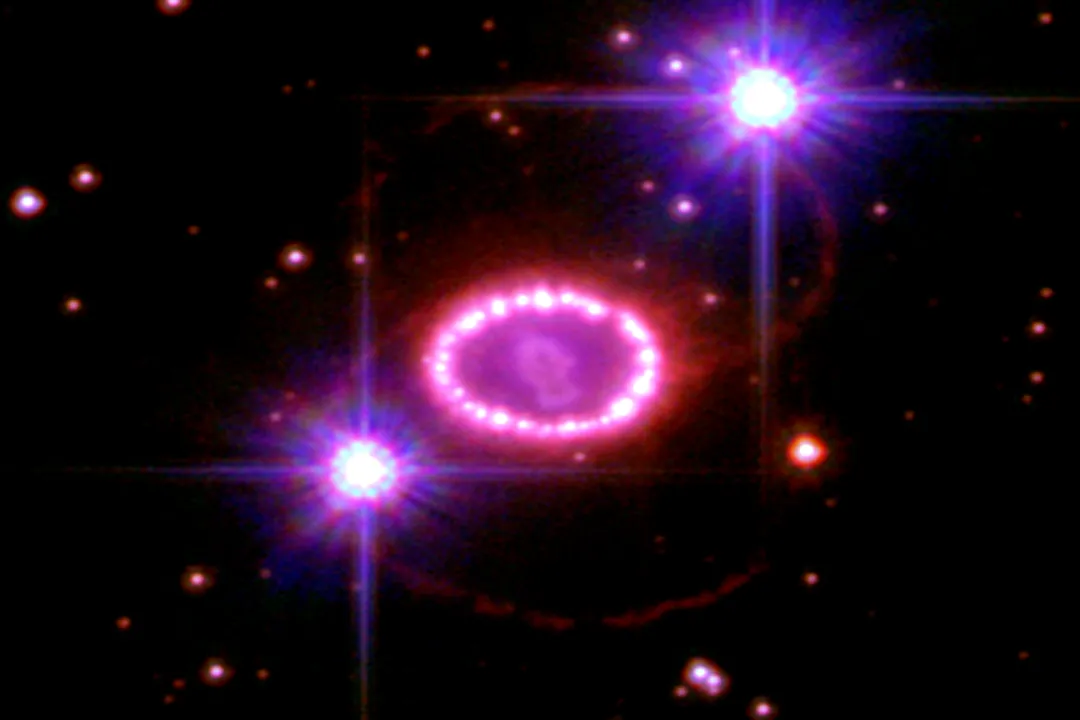
How do gravitational waves assist in studying the core collapse supernova?
They arrive almost instantaneously, probing the inner workings independent of dust.
Gravitational waves are ripples in the fabric of spacetime itself, generated by the violent movement and acceleration of massive, non-spherical objects, such as the collapsing and rebounding core. A significant advantage of observing these gravitational signatures is their propagation speed and nature. Unlike light (electromagnetic radiation) from the supernova, which can be delayed or obscured by thick clouds of intervening dust and gas within the dying star, gravitational waves travel almost unimpeded and arrive nearly instantaneously relative to the light signal. This allows scientists to obtain a direct probe of the immediate, inner mechanics of the core collapse and rebound phase, providing crucial data unobscured by the obscuring stellar layers.