What exponent approximates the scaling for luminosity (L) based on mass (M) for main sequence stars?
Answer
M^3.5
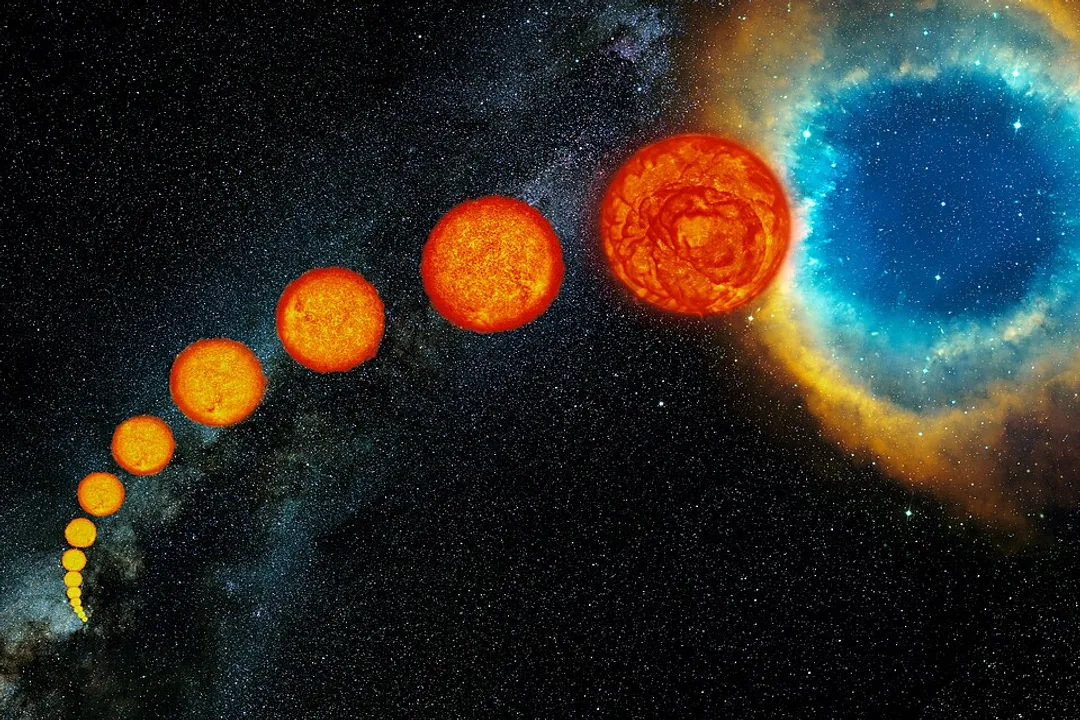
Astronomers have established the Mass-Luminosity Relation to quantify how a star's energy output relates to its mass while it is on the main sequence, the stable hydrogen-fusing phase. This relationship is not linear but expressed as a power law, where luminosity ($L$) scales with mass ($M$) raised to a specific power ($x$). The commonly accepted approximation for this exponent ($x$) is around 3.5. This substantial power dependence means that even small increases in stellar mass result in enormous, disproportionate increases in the star's luminosity, explaining why the brightest visible stars are rare but overwhelmingly luminous.
#Videos
Why Would The Size Of A Star Affect Its Luminosity? - Physics Frontier
Related Questions
What fusion cycle dominates when core temperature surpasses 18 million Kelvin?What exponent approximates the scaling for luminosity (L) based on mass (M) for main sequence stars?How much brighter is a 10 M☉ star expected to be using the M^3.5 relation?What color light do stars exceeding 20,000 Kelvin primarily emit?What direct result of greater mass leads to the higher core temperatures required for extreme fusion?Why is the star Vega, at 2.1 times the Sun's mass, sometimes less dense overall than the Sun?How does the main-sequence lifespan of a star 20 times the Sun's mass compare to the Sun's 10 billion years?Which stars represent the majority of the total star count in the universe, despite their low brilliance?What is the primary hydrogen fusion reaction used by stars similar to our Sun?To what factor is the reaction rate of the CNO cycle fiercely sensitive?What opposing force balances the inward pull of gravity in a stable star?