What is the final stage of a very massive star?
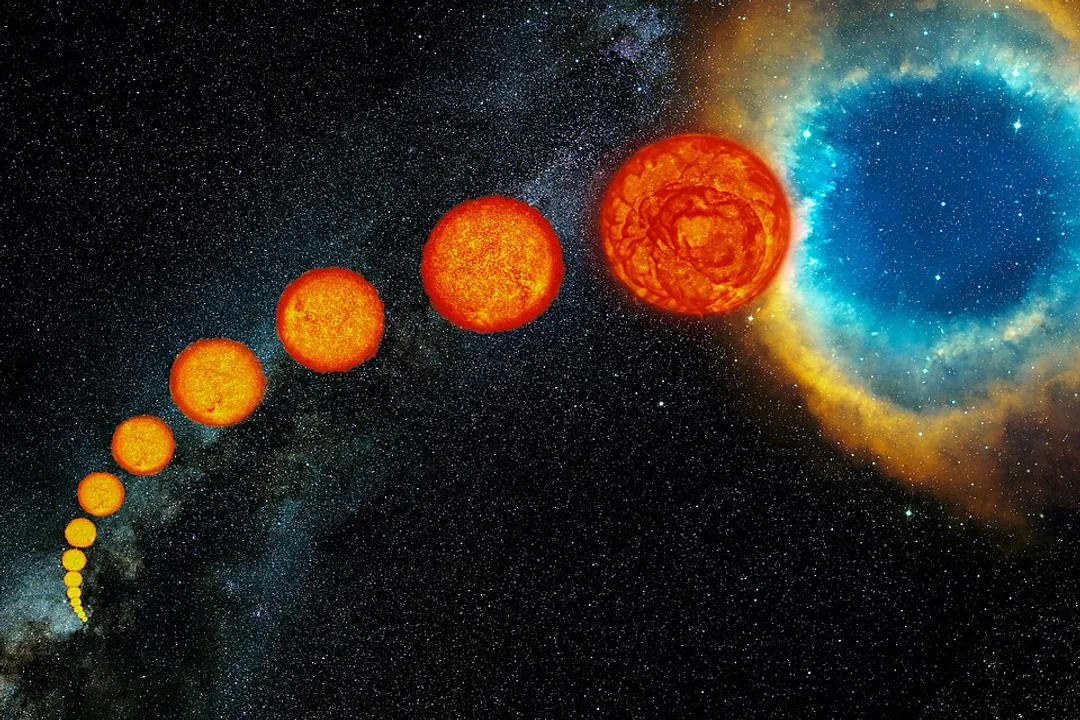
The life cycle of a star is a magnificent story dictated almost entirely by its initial mass, and when that mass is truly immense—far exceeding that of our own Sun—the ending is anything but quiet. For these stellar titans, the final stage is not a gentle fade but a catastrophic, universe-altering explosion that leaves behind one of the densest objects known to physics. [1][4] The processes leading up to this dramatic conclusion involve nuclear transformations occurring at an unimaginable scale and speed, fundamentally different from the fate awaiting smaller, Sun-like stars which typically end as cooling white dwarfs. [7]
# Stellar Size
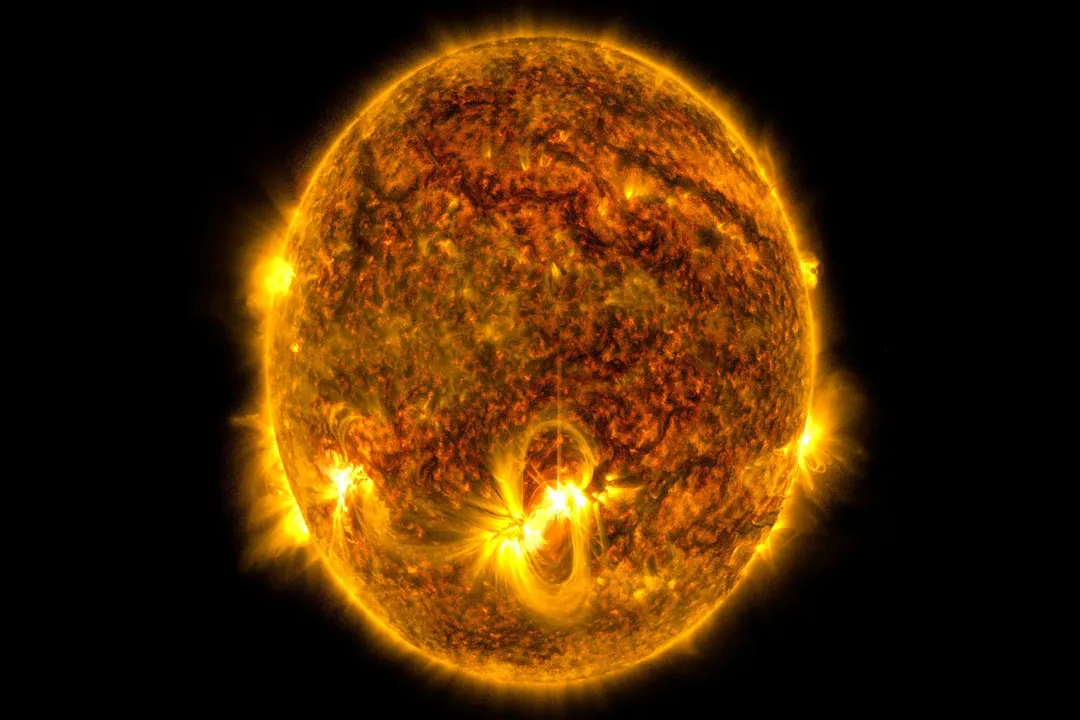
When astronomers classify a star as "massive," they are generally referring to objects with core masses significantly greater than about $8$ times the mass of the Sun (). [4] These stars burn through their fuel at prodigious rates due to the immense gravitational pressure squeezing their cores, giving them incredibly short, luminous lives when measured against cosmic timescales. [3][8] This furious pace of nuclear burning accelerates the evolutionary timeline, pushing them rapidly through stages that take billions of years for a star like ours. [1]
# Layered Fusion
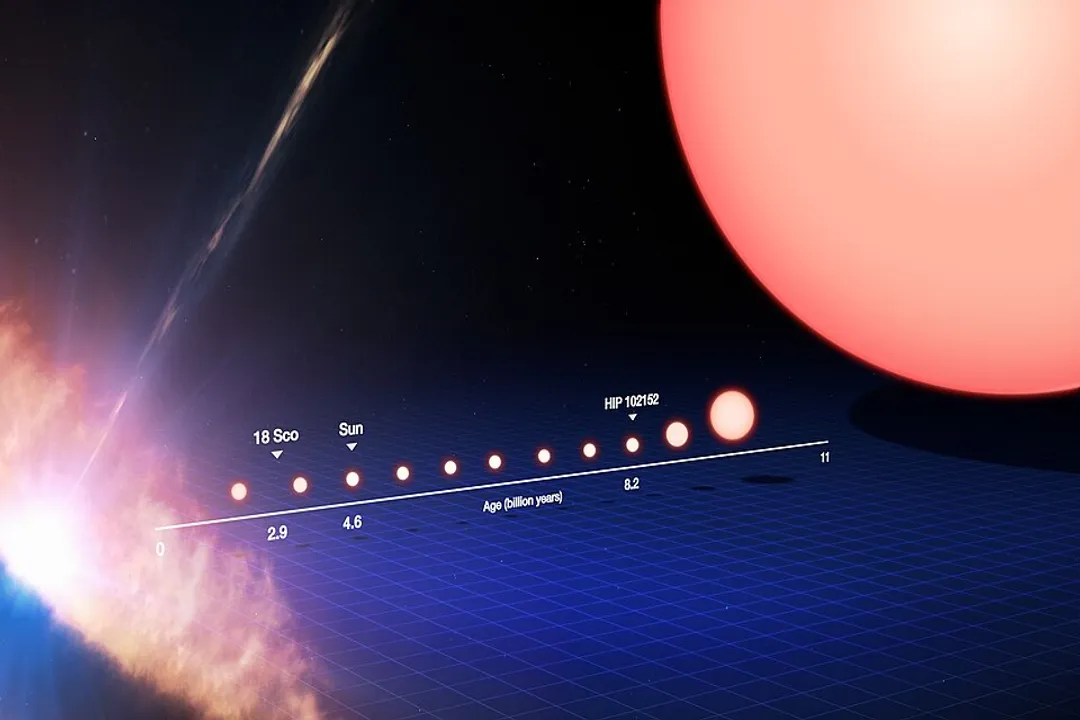
As the star ages, its internal structure becomes less like a uniform furnace and more like an intricate, layered onion. [8] In the center, the star fuses hydrogen into helium, as it did throughout its main sequence existence. [1] However, once hydrogen is depleted in the core, contraction begins, raising temperatures enough to ignite helium fusion, creating carbon. [8] For massive stars, this process doesn't stop there. The gravitational squeeze continues to force fusion of heavier and heavier elements in nested shells surrounding the core: carbon fuses to neon, neon to oxygen, oxygen to silicon, and so on. [1][9] Each subsequent fuel source burns faster and hotter than the last, driving the star outward into the red or blue supergiant phase. [2]
The critical factor here is energy generation. Each successive fusion stage releases less net energy than the previous one, meaning the star must constantly squeeze harder to maintain hydrostatic equilibrium—the balance between the outward pressure from fusion and the inward pull of gravity. [8]
# Iron Core Crisis
The onion-skin structure continues until the core is composed primarily of iron (). [1][8] This is the cosmic dead end for standard nuclear fusion. Unlike lighter elements, fusing iron does not release energy; instead, it requires an input of energy to proceed. [5][8] When the core becomes pure iron, the star loses its primary energy source instantly. [5] Without the thermal pressure generated by fusion pushing outwards, gravity wins the long-fought battle, and the star collapses inward with terrifying speed. [8]
The speed of this collapse is staggering. While a sun-like star sheds its outer layers gradually as a planetary nebula, the core of a massive star, perhaps $1.4$ to $3$ times the Sun's mass, can collapse from the size of the Earth down to a sphere only tens of kilometers across in mere milliseconds. [5][8] If one considers the timeline, the contrast between the slow cooling of a white dwarf over eons and this near-instantaneous implosion demonstrates just how extreme the physics become at this final boundary. [7]
# Supernova Event
The implosion phase is violent and brief. As the core is crushed, it reaches an incredible density, forcing protons and electrons together to form neutrons. [8] This collapse continues until the core reaches nuclear density, at which point the core essentially becomes incompressible, halting the inward motion. [5] The outer layers of the star, still falling inward at a significant fraction of the speed of light, suddenly strike this incompressible, newly formed neutron core, creating a powerful rebound shockwave. [2][8]
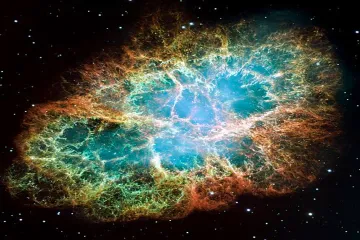
This shockwave blasts outward through the star's mass, heating the material to billions of degrees and causing the star to explode in a Type II Supernova. [2][9] For a short period, this single stellar explosion can outshine an entire galaxy, releasing more energy than our Sun will produce over its entire ten-billion-year lifetime. [3][9] It is during the final moments of this explosion that the elements heavier than iron—such as gold, uranium, and lead—are synthesized through rapid neutron capture processes, seeding the interstellar medium with the building blocks for future generations of stars, planets, and life. [1]
# Final Remnants
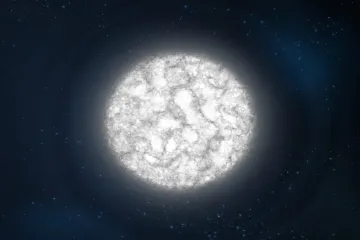
What remains after the spectacular supernova blast depends entirely on the mass of the original core that collapsed. [1] The ejected material forms a remnant cloud, but the central object settles into one of two exotic states: a neutron star or a black hole. [7]
# Neutron Stars
If the remnant core mass is less than roughly three solar masses, the powerful neutron degeneracy pressure—a quantum mechanical resistance to further compression—is sufficient to halt the collapse. [8] The result is a neutron star, an object of unimaginable density. [1] A teaspoon of this material would weigh billions of tons. [8] These stars are typically only about $20$ kilometers across, packing more mass than the Sun into the volume of a city. [1] They often spin rapidly and possess extremely strong magnetic fields, sometimes appearing as pulsars that sweep beams of radiation across space. [8]
# Black Holes
If the remnant core mass after the explosion exceeds the maximum stable mass for a neutron star—a value close to about three solar masses, though complex modeling is required—even neutron degeneracy pressure cannot resist the crushing gravity. [1][7] In this scenario, gravity overwhelms all known forces, and the core collapses completely to an infinitely dense point called a singularity, forming a black hole. [1] Nothing, not even light, can escape the event horizon defining the boundary of this ultimate stellar demise. [3]
The stark physical reality is that these final remnants—neutron stars and black holes—represent the most extreme gravitational environments in the universe, born from the complete gravitational defeat of the star's internal furnace. [1] This entire sequence, from the onset of silicon burning to the final remnant, is the destiny reserved for the very most massive stars, marking a violent but necessary contribution to galactic chemical evolution. [9]
Related Questions
#Citations
Stellar evolution - Wikipedia
What is the end stage of a massive star? | CK-12 Foundation
Star Basics - NASA Science
Massive Star | Definition & Life Cycle - Lesson - Study.com
What happens to a massive star's iron core before it collapses?
The Final Stages of Massive Star Evolution and Their Supernovae
What are the three end stages of stars? - Quora
Lecture 19: The Fate of Massive Stars
Evolution of Massive Stars: An Explosive Finish | Astronomy