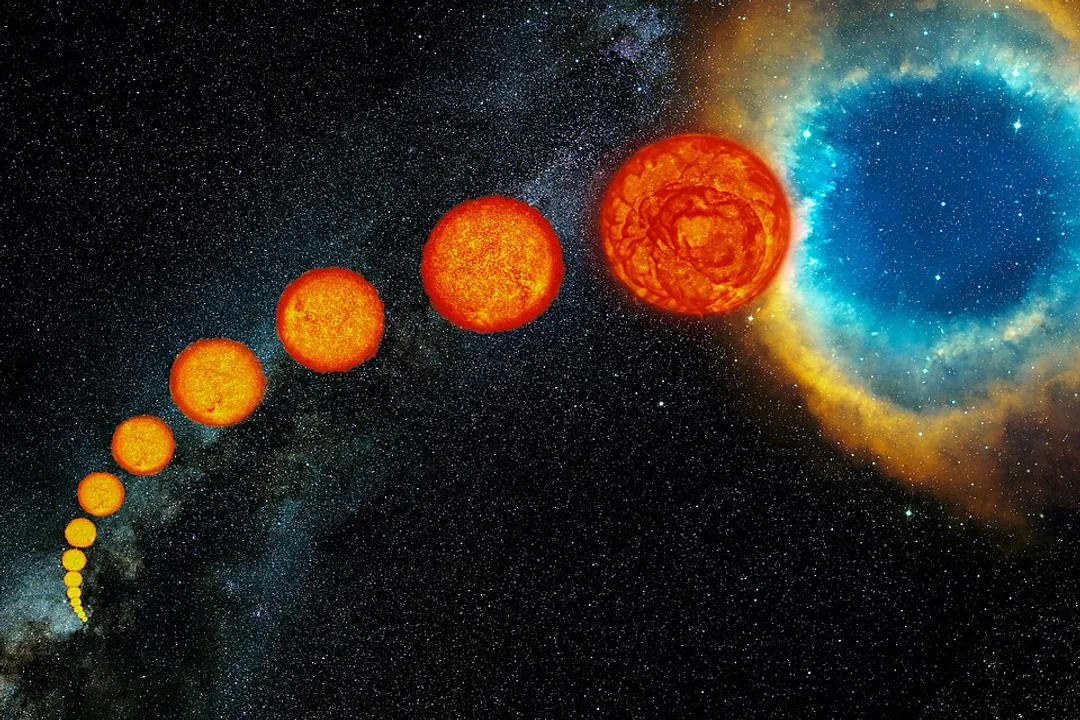
How do Sun-like stars typically end their lives compared to massive stellar titans?
Cooling white dwarfs
The life cycle and ultimate demise of a star are fundamentally determined by its initial mass. Massive stars, those exceeding eight solar masses, follow the dramatic path of layered fusion culminating in an iron core crisis, subsequent gravitational collapse, and a supernova explosion, leaving behind either a neutron star or a black hole. In stark contrast, stars comparable in mass to our Sun follow a much gentler evolutionary track. After exhausting core hydrogen, they expand, shed their outer layers relatively slowly to form a planetary nebula, and the remaining core contracts and cools over immense spans of time, eventually becoming a dense, fading stellar remnant known as a white dwarf. This difference illustrates the vastly different physics governing the final stages of low-mass versus high-mass stars.