How do massive stars end their life?
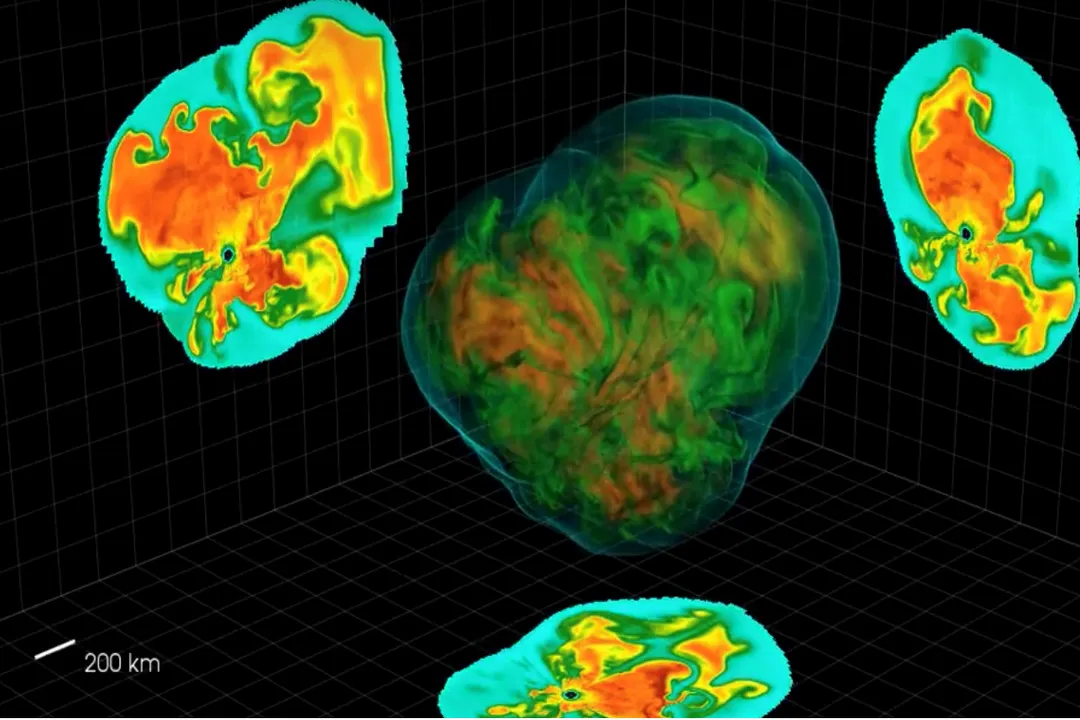
The grand finale for a star is inextricably linked to its initial size; while small stars like our Sun fade gently, stars born with significantly more mass face a far more dramatic end. Defining "massive" is the first step in understanding this cosmic demise. Generally, a star is considered massive if it begins its life with more than about eight times the mass of the Sun, a threshold often cited for when a star will run out of fuel and collapse to form a neutron star or black hole. Stars with masses exceeding perhaps 25 to 30 solar masses can expect the most violent conclusions. The lifespan of these giants is surprisingly short when compared to their smaller cousins; a star eight times the Sun’s mass might only survive for a few tens of millions of years, burning through its fuel at a ferocious rate due to the immense pressure generated by its gravity.
# Fuel Burning
The internal engine of a star is a continuous battle between the outward pressure generated by nuclear fusion and the inward crush of gravity. For the first few million years, these massive stars fuse hydrogen into helium in their cores, just like any main-sequence star. However, due to their greater mass, the core temperatures and pressures are much higher, allowing them to fuse heavier elements after the hydrogen is exhausted.
This process continues sequentially, creating an "onion-skin" structure in the star's later life. Once helium fusion slows, the core shrinks until it is hot enough to fuse helium into carbon and oxygen. This cycle repeats, fusing heavier and heavier elements—carbon, neon, oxygen, and silicon—in shells around the progressively denser core. Each subsequent stage of fusion is faster and releases less net energy than the last, meaning the time spent fusing lighter elements shortens dramatically.
# Iron Core
The process stops abruptly when the core begins producing iron. Iron is a uniquely stable element; fusing iron does not release energy; instead, it consumes energy. When the core becomes pure iron, it has reached a terminal state. There is no further fusion pathway to generate the thermal pressure needed to resist the star's colossal gravitational pull. The core, now weighing more than $1.4$ times the Sun's mass (the Chandrasekhar limit for white dwarfs), can no longer support itself against its own weight.
# Gravitational Collapse
Once the iron core forms, the stellar death sequence happens with terrifying speed. Gravity overwhelms the core’s internal pressure, causing it to implode. This collapse takes mere seconds. As the core material plunges inward, the density soars to unimaginable levels, squeezing electrons and protons together to form neutrons and releasing a flood of ghostly particles called neutrinos.
The collapse halts only when the core reaches the density of an atomic nucleus, packing about $1.4$ to $2.5$ solar masses into a sphere only tens of kilometers across. The core becomes incredibly rigid, composed almost entirely of neutrons, effectively becoming a nascent neutron star.
# Shockwave Formation
When the infalling outer layers of the star slam into this newly formed, incredibly dense neutron core, they rebound violently. This generates a powerful outward-moving pressure wave—the supernova shockwave. It is this shockwave, propelled and energized by the immense torrent of neutrinos escaping the core, that blasts the star’s outer material into space. The sheer energy released in this brief event can outshine an entire galaxy.
# Supernova Types
The spectacular explosion that marks the end of a massive star's life is classified as a Type II supernova, characterized by the presence of hydrogen lines in its spectrum. However, the exact outcome can vary based on the star's initial mass, leading to a spectrum of possible terminal events.
A typical core-collapse supernova, for stars perhaps $8$ to $25$ times the Sun's mass, produces a tremendous display, seeding the cosmos with heavy elements created during the explosion itself. For instance, elements heavier than iron, like gold and uranium, are synthesized during the chaotic, neutron-rich environment of the supernova.
# Direct Collapse
For the most massive stars, those perhaps exceeding $25$ or $30$ solar masses, the core collapse might bypass the explosive supernova stage entirely. In these cases, the sheer mass of the collapsing core is so great that even the immense pressure exerted by the degenerate neutron matter is insufficient to stop gravity. Instead of rebounding to form a shockwave, the core continues to collapse past the neutron star density threshold, leading directly to the formation of a black hole. This process may still involve some material escaping, perhaps accompanied by an enormous burst of neutrinos, but it won't necessarily result in the bright, visible supernova event seen in less massive progenitor stars. In some scenarios, this direct collapse can trigger an even more energetic explosion known as a hypernova.
Consider the implications of this mass threshold: a star that begins life at, say, $15$ solar masses has a very high probability of leaving behind a neutron star, an object that rotates rapidly and possesses a magnetic field millions of times stronger than Earth's. Yet, a progenitor star at $35$ solar masses is almost guaranteed to vanish behind an event horizon, leaving behind only the gravitational distortion of spacetime. The fate of the star is therefore determined by a relatively narrow margin of initial mass.
# Stellar Remnants
The core that survives the explosion (or the entire collapsed core in a direct collapse) dictates what is left behind. The remnants of these cataclysmic events are among the most exotic objects in the universe.
# Neutron Stars
If the remnant core mass is between about $1.4$ and $2.5$ solar masses, the result is a neutron star. These objects are almost entirely composed of neutrons, packed so tightly that a single teaspoon of their material would weigh billions of tons. The incredible density is maintained because the neutrons resist being compressed further by Pauli exclusion principles. Many neutron stars are observed as pulsars, rapidly spinning objects that emit beams of radiation detected as regular pulses from Earth.
# Black Holes
If the mass of the collapsing core exceeds the upper limit for a neutron star—often estimated to be around $2.5$ to $3$ solar masses, though precise limits are still under investigation—nothing can halt the collapse. The core shrinks to an infinitely dense point called a singularity, surrounded by an event horizon from which nothing, not even light, can escape. These black holes represent the final, complete victory of gravity over all known forces. The study of massive star deaths is essential for understanding the cosmic distribution of both neutron stars and black holes, which dictate gravitational dynamics in galaxy clusters.
The distribution of these remnants across the galaxy gives us insight into the initial mass function of stars and the physics governing extreme matter, information that cannot be gleaned solely from observing main-sequence stars. For instance, if we observe an unexpectedly high number of massive black holes in a specific region, it might suggest the original population of progenitor stars in that area was consistently on the very high end of the initial mass spectrum, possibly exceeding $30$ solar masses.
# Cosmic Recycling
The death of a massive star is not just an ending; it is a profound act of creation for the next generation of cosmic structures. The ejected material—the stellar envelope blasted away by the supernova—is rich in heavy elements forged both during the star's lifetime (like oxygen and silicon) and during the explosion itself (like gold and iron). This enriched cloud of gas and dust mixes with existing interstellar medium. Stars born later from this enriched material will have the necessary building blocks for rocky planets, water, and eventually, life. The calcium in your bones, the iron in your blood, and the silicon in the ground were all, at one time, part of a star that ended its life in a spectacular burst of light billions of years ago. The life cycle of massive stars is, therefore, the primary engine for chemical evolution in the universe.
Related Questions
#Citations
The Death of a Star - How Stars Work - Science | HowStuffWorks
How Massive Single Stars End Their Life - NASA ADS
WMAP- Life and Death of Stars - NASA
How Do Stars Die and How Long Do Stars Live? - Sky & Telescope
How Do The Most Massive Stars Die: Supernova, Hypernova, Or ...
How do stars die? - BBC Science Focus Magazine
How Massive Single Stars End Their Life - IOPscience
Lecture 19: The Fate of Massive Stars
DOE Explains...Supernovae - Department of Energy
Stellar Evolution - | The Schools' Observatory