What is the approximate upper mass limit for a collapsing core to form a stable neutron star?
Answer
Around 2.5 to 3 solar masses
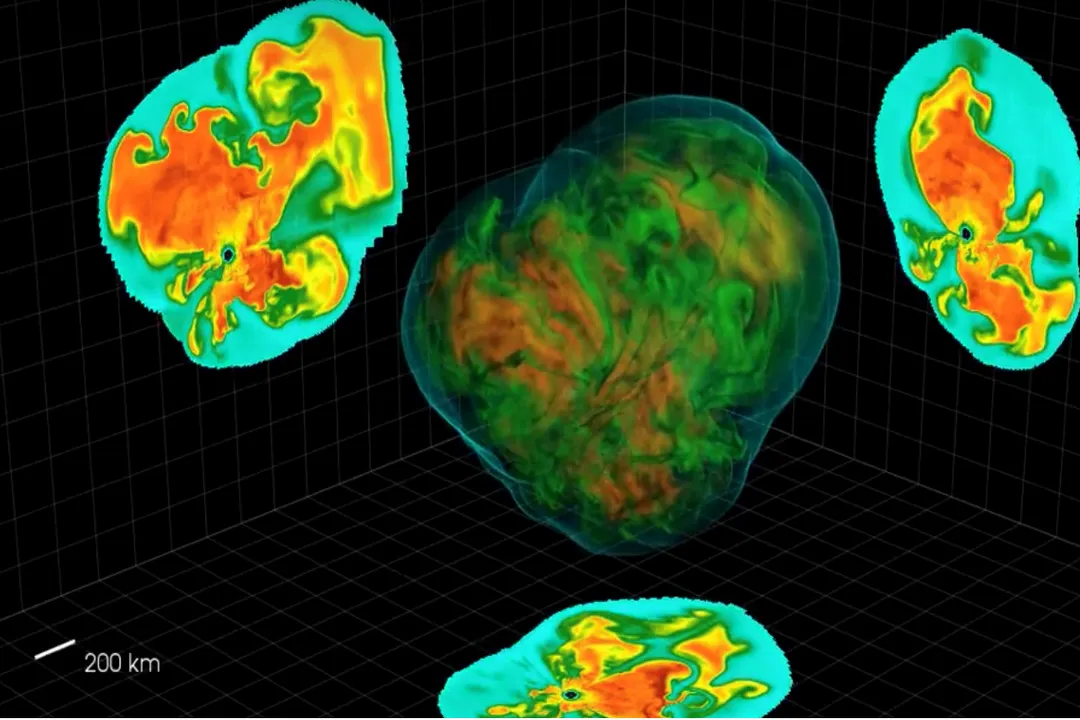
While the Chandrasekhar limit (about 1.4 solar masses) marks the point where a white dwarf collapses, the upper bound for a core to stabilize as a neutron star is significantly higher, often estimated to be between 2.5 and 3 solar masses. If the mass of the remnant core formed from the implosion exceeds this higher threshold, the pressure exerted by the densely packed neutrons is insufficient to counteract gravity. In this scenario, the collapse continues unimpeded until a singularity forms, resulting in the creation of a black hole where no known force can halt the gravitational dominion.
Related Questions
What is the minimum mass threshold for a star to be considered massive?Why does nuclear fusion stop abruptly when a massive star's core produces iron?How quickly does the gravitational collapse occur once the iron core forms?What density level does the collapsing core reach before halting to form a nascent neutron star?What particle torrent propels and energizes the supernova shockwave during rebound?What classification is given to the spectacular explosion marking the end of a massive star's life?What is the likely outcome for stars exceeding 25 to 30 solar masses during core collapse?What is the approximate upper mass limit for a collapsing core to form a stable neutron star?What phenomenon causes many neutron stars to be observed as rapidly spinning objects emitting regular pulses?Which elements, heavier than iron, are synthesized in the neutron-rich environment of a supernova explosion?