What is the likely outcome for stars exceeding 25 to 30 solar masses during core collapse?
Answer
Direct collapse leading to a black hole, bypassing supernova
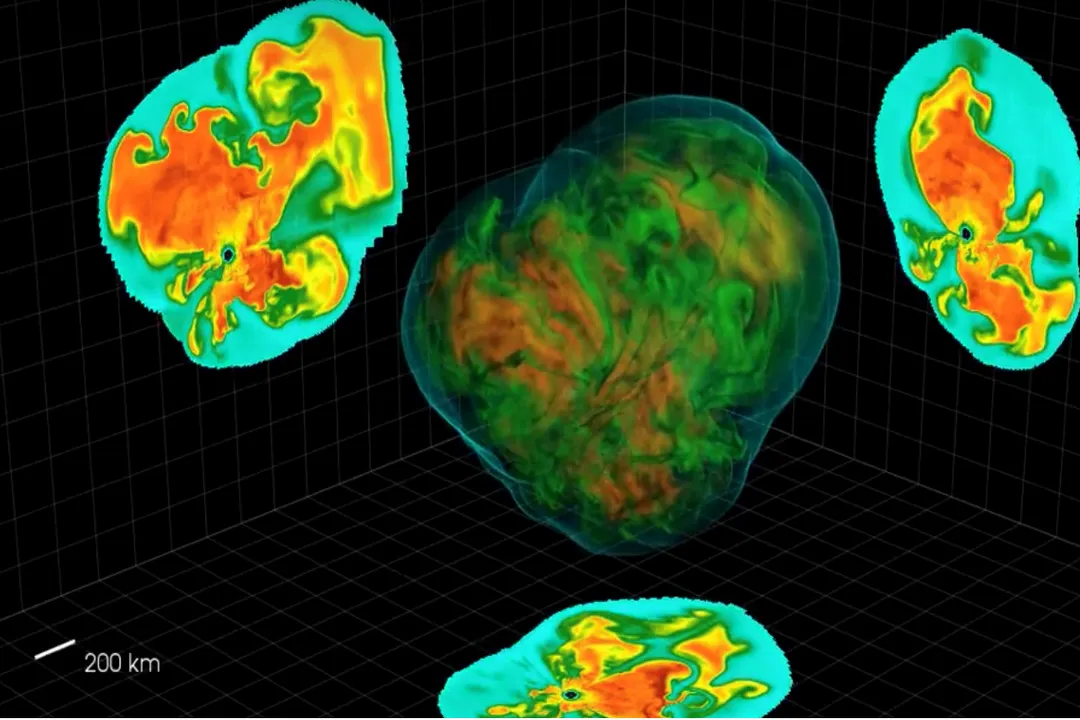
Stars that begin their lives with extremely large initial masses, typically exceeding 25 or perhaps 30 solar masses, face a fate where gravity is simply too powerful to overcome, even by the pressure of degenerate neutron matter. In these most massive cases, the core collapse proceeds without generating a successful, visible supernova rebound shockwave. Instead, the core continues its inexorable shrinkage past the neutron star density threshold, collapsing completely to form a singularity surrounded by an event horizon—a black hole. Although some material might escape or neutrino bursts occur, the characteristic bright, visible supernova event is often absent.
Related Questions
What is the minimum mass threshold for a star to be considered massive?Why does nuclear fusion stop abruptly when a massive star's core produces iron?How quickly does the gravitational collapse occur once the iron core forms?What density level does the collapsing core reach before halting to form a nascent neutron star?What particle torrent propels and energizes the supernova shockwave during rebound?What classification is given to the spectacular explosion marking the end of a massive star's life?What is the likely outcome for stars exceeding 25 to 30 solar masses during core collapse?What is the approximate upper mass limit for a collapsing core to form a stable neutron star?What phenomenon causes many neutron stars to be observed as rapidly spinning objects emitting regular pulses?Which elements, heavier than iron, are synthesized in the neutron-rich environment of a supernova explosion?