What two main factors make F-type stars less suitable for long-term biological development?
Answer
F-type stars burn fuel fast, resulting in a short lifespan and intense radiation.
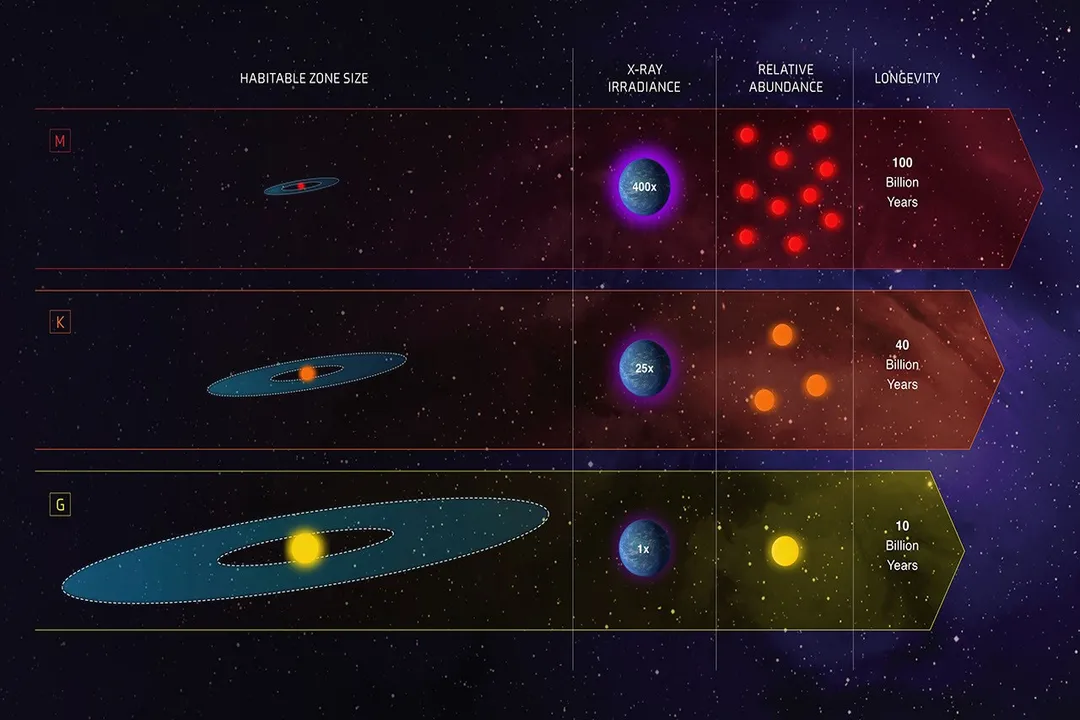
F-type stars, which are hotter and more massive than the Sun, have significant drawbacks for long-term habitability. First, their high mass causes them to consume their fuel supply much more rapidly, granting a comparatively brief window—estimated between one and three billion years—for complex evolution to take hold before the star evolves off the main sequence. Second, their higher energy output means that their habitable zones, while positioned farther out, are much narrower in terms of stable orbital distances, and the intense radiation output itself poses a challenge to surface biology compared to the gentler outputs of K-dwarfs.
Related Questions
Why are K-type stars considered superior to M-dwarfs regarding stellar temperament?What is the primary evolutionary constraint associated with a G-type star like the Sun?What two main factors make F-type stars less suitable for long-term biological development?What primary environmental hurdles do planets face within the habitable zones of M-dwarfs?How long can the main-sequence lifespan of a K-type orange dwarf potentially extend beyond that of the Sun?What critical trade-off makes K-dwarfs the most balanced candidates for habitability?Why do astronomers still prioritize observing G-type stars, even if K-dwarfs show better potential?What non-lifespan factor related to a K-star's history is necessary for terrestrial planet formation?What specific orbital consequence affects planets located very close to M-dwarfs?What characteristic differentiates the habitable zone of F-type stars from that of G-type stars?