What characteristic differentiates the habitable zone of F-type stars from that of G-type stars?
Answer
The habitable zone for F-stars is farther out, but the range of stability is narrower.
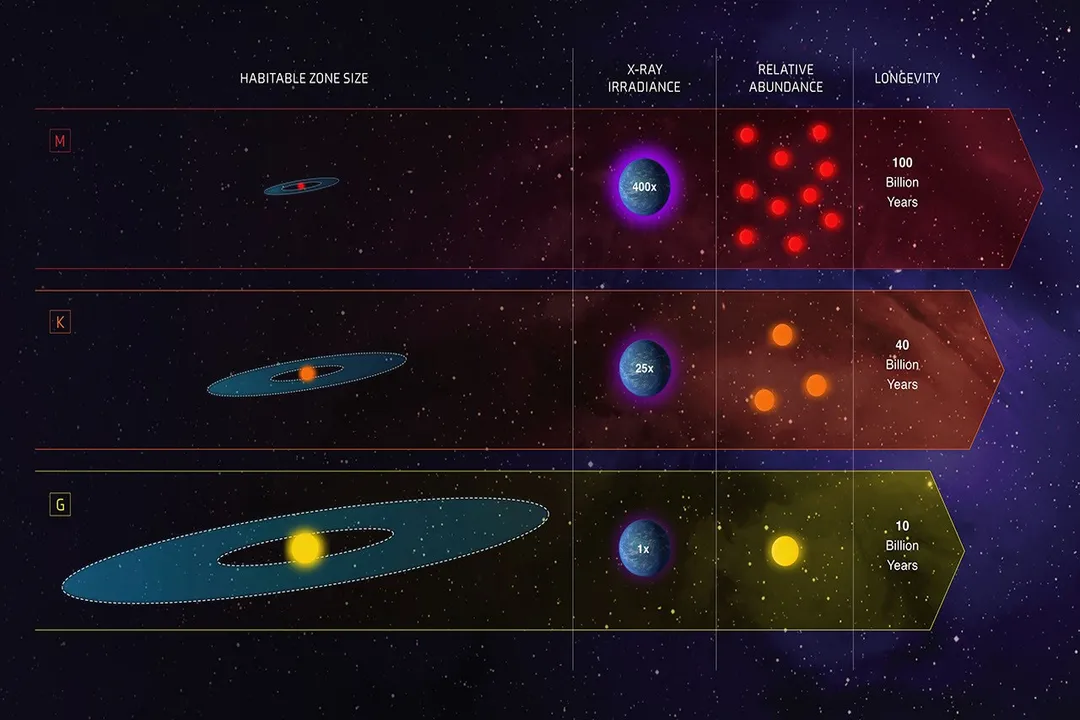
F-type stars are significantly hotter and more massive than the Sun (G-type). This higher energy output dictates a shift in the location of the habitable zone, pushing it farther away from the star than the Sun's moderate distance. Crucially, this increased energy output also shrinks the margin for error; the range of orbital distances where liquid water could stably exist—the habitable zone itself—is much narrower for F-stars compared to G-stars. This narrow margin, combined with the star's short lifespan, reduces the suitability for long-term biological development.
Related Questions
Why are K-type stars considered superior to M-dwarfs regarding stellar temperament?What is the primary evolutionary constraint associated with a G-type star like the Sun?What two main factors make F-type stars less suitable for long-term biological development?What primary environmental hurdles do planets face within the habitable zones of M-dwarfs?How long can the main-sequence lifespan of a K-type orange dwarf potentially extend beyond that of the Sun?What critical trade-off makes K-dwarfs the most balanced candidates for habitability?Why do astronomers still prioritize observing G-type stars, even if K-dwarfs show better potential?What non-lifespan factor related to a K-star's history is necessary for terrestrial planet formation?What specific orbital consequence affects planets located very close to M-dwarfs?What characteristic differentiates the habitable zone of F-type stars from that of G-type stars?