What critical trade-off makes K-dwarfs the most balanced candidates for habitability?
Answer
They maximize lifespan while minimizing extreme environmental volatility like flares.
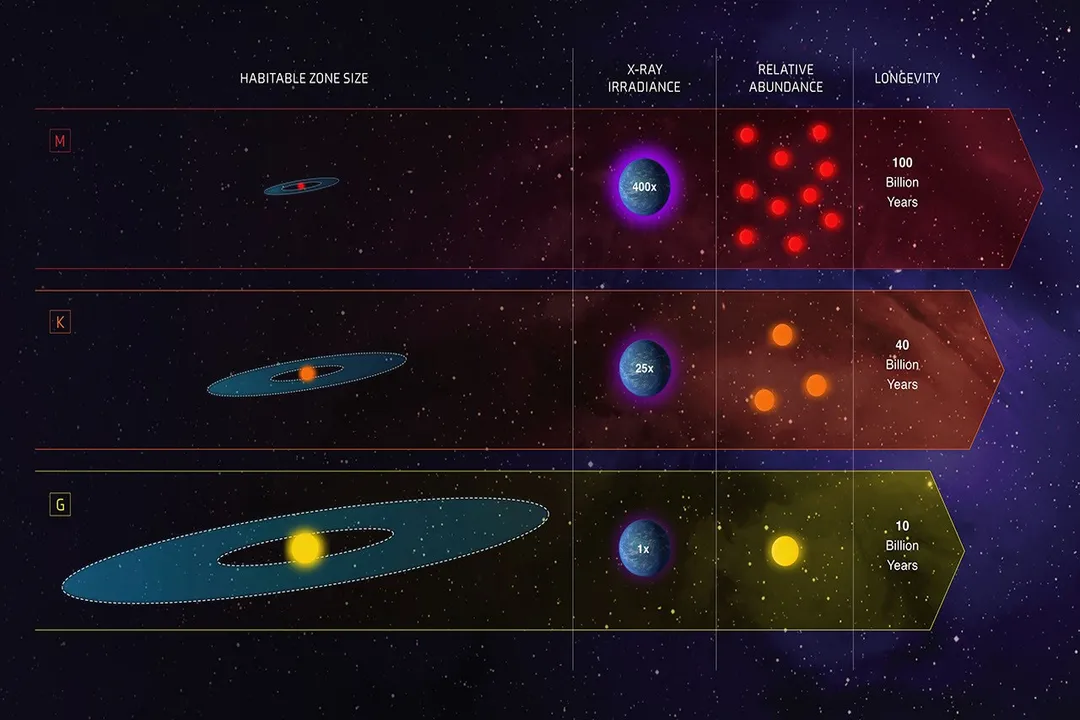
The compelling argument for K-type stars centers on achieving an optimal balance between two critical metrics: time and temperament. They offer a massively extended lifespan compared to F and G types, providing the maximum evolutionary runway. Simultaneously, they possess favorable temperaments, being far more stable than their smaller M-dwarf neighbors, specifically experiencing fewer catastrophic stellar flares. This combination allows for long-term stability—a crucial feature for the development of complex life—without the severe risks associated with either the rapid burnout of F-stars or the volatility of M-stars.
Related Questions
Why are K-type stars considered superior to M-dwarfs regarding stellar temperament?What is the primary evolutionary constraint associated with a G-type star like the Sun?What two main factors make F-type stars less suitable for long-term biological development?What primary environmental hurdles do planets face within the habitable zones of M-dwarfs?How long can the main-sequence lifespan of a K-type orange dwarf potentially extend beyond that of the Sun?What critical trade-off makes K-dwarfs the most balanced candidates for habitability?Why do astronomers still prioritize observing G-type stars, even if K-dwarfs show better potential?What non-lifespan factor related to a K-star's history is necessary for terrestrial planet formation?What specific orbital consequence affects planets located very close to M-dwarfs?What characteristic differentiates the habitable zone of F-type stars from that of G-type stars?