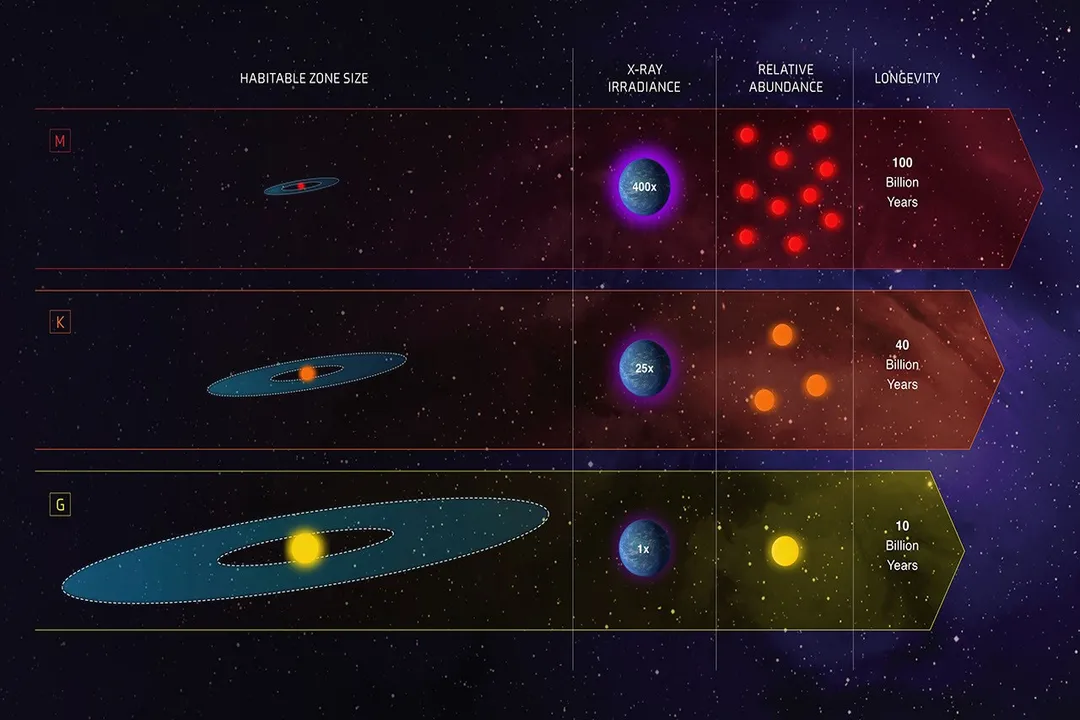
What non-lifespan factor related to a K-star's history is necessary for terrestrial planet formation?
The star's metallicity must be high enough, meaning it formed recently enough in cosmic history.
Beyond the star's spectral type and its main-sequence lifespan, the history of the star, particularly its metallicity, is paramount for habitability. Metallicity refers to the abundance of elements heavier than hydrogen and helium. These heavier elements are the raw materials required for the initial formation of rocky, terrestrial planets. A K-star that formed extremely early in the universe might have inadequate metallicity, lacking the necessary building blocks for a world like Earth, despite its incredible potential longevity. Thus, the ideal candidate must be old enough to have accumulated necessary metals but young enough to remain on the main sequence for trillions of years.