What is the inverse scaling relationship governing the contraction timescale ($ au$) for high-mass stars based on mass ($M$)?
Answer
The timescale scales roughly as $M^{-1.5}$
The contraction timescale ($ au$) is highly sensitive to mass, governed by the interplay between the energy generated and the efficiency of its release. For high-mass stars, where luminosity ($L$) scales steeply as $M^{3.5}$, the resultant contraction timescale exhibits a steep inverse relationship with mass. Specifically, $ au$ scales roughly as $M^{-1.5}$. This inverse relationship implies that as mass increases, the time required to reach the Zero-Age Main Sequence (ZAMS) decreases significantly, explaining why massive stars finish forming so much faster than low-mass stars.
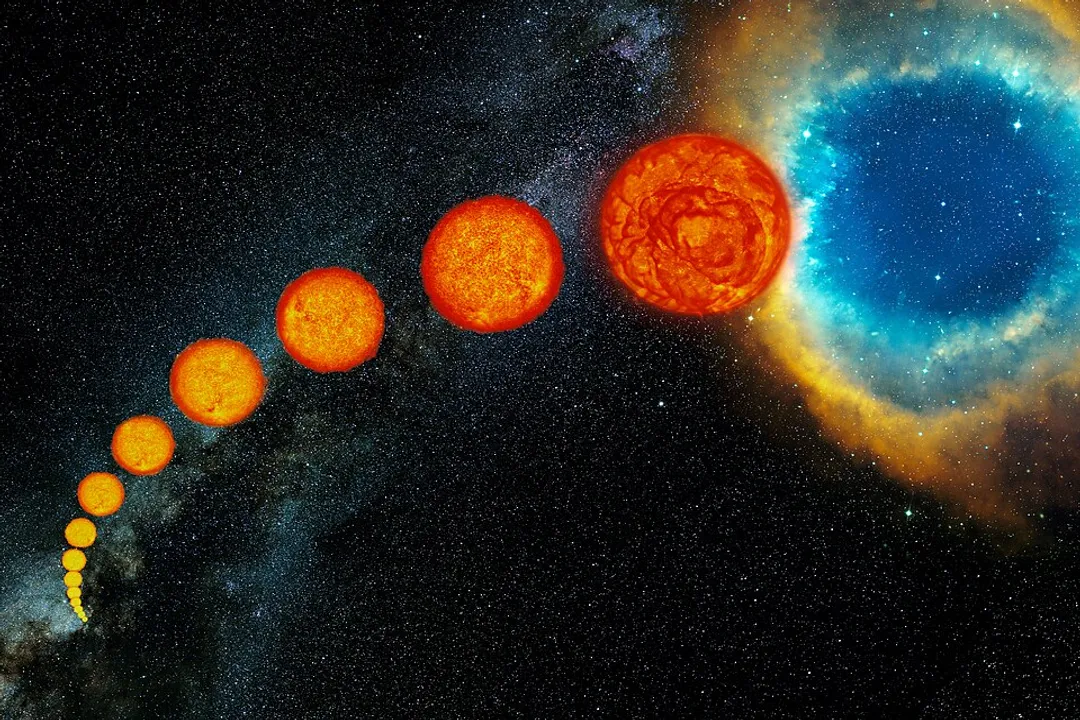
#Videos
Why Massive Stars Form Faster Than Low Mass Stars - YouTube
Related Questions
What is the approximate assembly time for a star fifteen times the Sun's mass during pre-main sequence contraction?What is the primary physical driver accelerating the assembly of high-mass protostars?For high-mass protostars, what mechanism allows energy to escape during contraction, leading to rapid core stabilization?During contraction, what is the approximate luminosity scaling relationship for high-mass stars relative to their mass ($M$)?What is the inverse scaling relationship governing the contraction timescale ($ au$) for high-mass stars based on mass ($M$)?In contrast to high-mass stars, what limits energy transport outwards in cooler, low-mass protostars?What is the approximate main-sequence lifespan for a star with ten solar masses, classified as an O-type star?The relationship quantifying faster fuel consumption in massive stars is known by what specific term?What is the duration of the carbon-burning phase in the post-main sequence evolution of high-mass stars?What observational consequence arises because high-mass stars are built fast and live short, spectacular lives?