What solar mass threshold typically separates K-type stars from the less massive M-type red dwarfs?
Answer
The main sequence mass range for K-type stars typically begins around 0.5 solar masses ($M_ ext{sun}$).
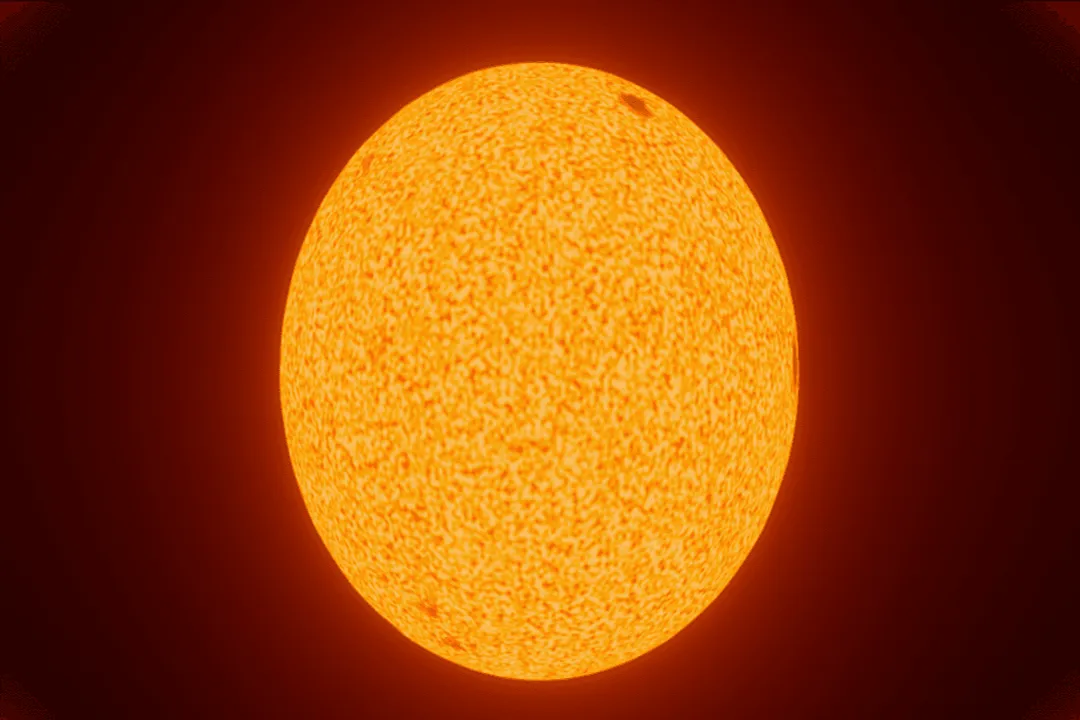
Stellar classification based on mass is crucial for determining stellar evolution paths. For K-type stars, their lower boundary is explicitly set relative to the smallest main sequence stars. Stars possessing masses below approximately 0.5 solar masses ($0.5 M_ ext{sun}$) are conventionally classified as M-type red dwarfs. Therefore, K-type stars begin their classification range starting at this $0.5 M_ ext{sun}$ point, meaning they are significantly more massive than the absolute smallest stars in the galaxy, although they are still considered low-mass relative to solar-type stars.
Related Questions
What is the typical effective surface temperature range for K-type main-sequence stars?What solar mass threshold typically separates K-type stars from the less massive M-type red dwarfs?What specific spectral features distinguish K-type stars from hotter, earlier spectral classes?What primary nuclear process are K-type main-sequence stars performing in their cores?How do the typical diameters of K-type stars compare to the Sun's diameter ($1.39$ million kilometers)?What makes the main sequence lifespan of a K-type star dramatically longer than the Sun's expected duration?How is the categorization of K-type stars described when compared to the most common, smallest stars in the galaxy?What fundamental property links a star's mass to its resulting characteristics like luminosity and temperature?Why are K-type stars considered favorable targets for long-term study or potential interstellar colonization compared to M-dwarfs?How does the energy output of a K-type star with $0.7 M_ ext{sun}$ compare to a G-type star with $1.0 M_ ext{sun}$?