How do the typical diameters of K-type stars compare to the Sun's diameter ($1.39$ million kilometers)?
Answer
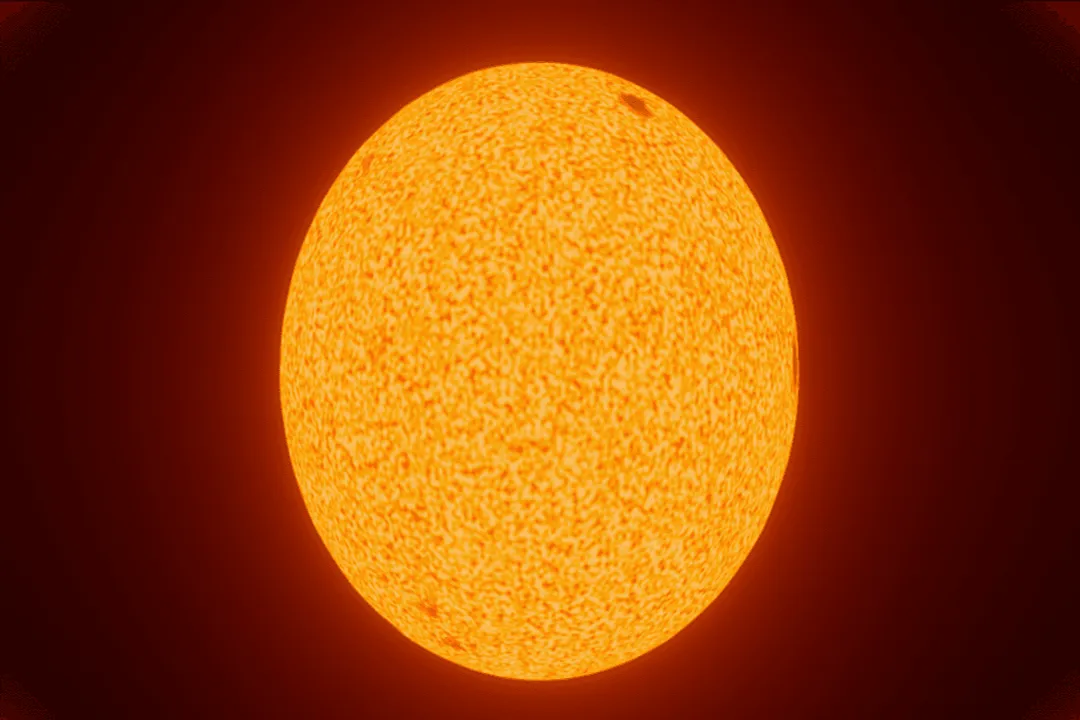
They are generally smaller, potentially exhibiting a radius 60 to 85 percent of the solar radius.
The physical dimensions of a star are fundamentally linked to its mass and evolutionary stage. Since K-type stars are less massive than G-type stars like the Sun ($1.0 M_ ext{sun}$), their physical size is consequently smaller. While the exact diameter varies depending on the precise spectral subtype (e.g., K0 versus K7), the general range cited indicates that their radius falls between 60 percent and 85 percent of the Sun's radius. This reduction in physical scale is a direct consequence of having less material undergoing fusion pressure.
Related Questions
What is the typical effective surface temperature range for K-type main-sequence stars?What solar mass threshold typically separates K-type stars from the less massive M-type red dwarfs?What specific spectral features distinguish K-type stars from hotter, earlier spectral classes?What primary nuclear process are K-type main-sequence stars performing in their cores?How do the typical diameters of K-type stars compare to the Sun's diameter ($1.39$ million kilometers)?What makes the main sequence lifespan of a K-type star dramatically longer than the Sun's expected duration?How is the categorization of K-type stars described when compared to the most common, smallest stars in the galaxy?What fundamental property links a star's mass to its resulting characteristics like luminosity and temperature?Why are K-type stars considered favorable targets for long-term study or potential interstellar colonization compared to M-dwarfs?How does the energy output of a K-type star with $0.7 M_ ext{sun}$ compare to a G-type star with $1.0 M_ ext{sun}$?