How can you tell if a star is moving towards you?
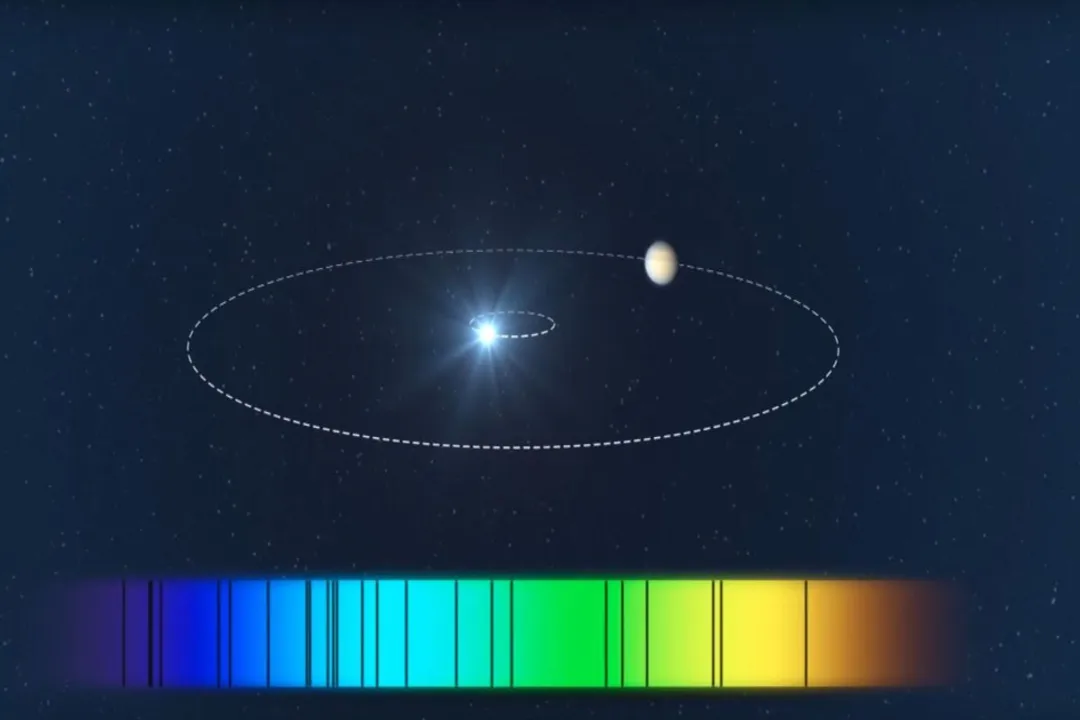
The way astronomers determine if a distant star is racing toward us or receding into the void relies not on estimating its brightness or size, but on capturing the subtle fingerprints left in its light. This knowledge isn't gleaned from a simple shift in color that the human eye can easily perceive, but from analyzing the precise wavelengths of light emitted by the star's constituent elements. Fundamentally, the answer lies in an effect we experience every day with sound: the Doppler Effect. [3][9]
# Wave Behavior
When an ambulance speeds past, the pitch of its siren drops abruptly as it passes by. This change in pitch happens because the sound waves are compressed when the source is approaching and stretched when it is moving away. [9] The same principle applies to light waves, which travel much faster than sound waves, yet behave according to the same physical laws. [3] If a star is moving towards an observer on Earth, the light waves it emits are effectively "squashed" together, causing their wavelength to shorten. [1][5] Conversely, if the star is moving away, the light waves are stretched, increasing their wavelength. [1][3]
# Stellar Fingerprints
To observe this effect in starlight, scientists cannot rely on simply looking at the star's overall color. While a star moving very rapidly toward us would appear slightly bluer (a blueshift), and one moving away would appear slightly redder (a redshift), [5] these color changes are far too subtle to detect visually for all but the fastest-moving celestial objects. [1] Instead, astronomers turn to spectroscopy. [3][5]
A star’s light, when passed through a prism or a spectrometer on a telescope, separates into a continuous spectrum, much like a rainbow. [3] However, superimposed on this rainbow are dark, fine lines. These dark lines, known as absorption lines, are the star's unique spectral fingerprint. [3][5] They occur because cooler gases in the star's outer atmosphere absorb light at very specific wavelengths that correspond to the energy transitions of those particular elements, such as hydrogen or helium. [3]
In a laboratory setting here on Earth, the precise location—the exact wavelength—of every spectral line for a given element is known with extreme accuracy. [3][5] For instance, we know exactly where the characteristic hydrogen-alpha line should appear in a static light source.
# Shifting Signatures
When astronomers capture the spectrum of a distant star, they compare the pattern of its absorption lines to the known, established pattern recorded in the lab. [3][5] If the star is moving relative to us, the entire pattern of dark lines will be shifted slightly along the spectrum. [3][9] This measurement of how far the pattern has shifted is how we calculate the star’s radial velocity—its speed directly toward or away from Earth. [5]
When a star is moving towards us, its spectral lines are shifted toward the shorter, higher-energy end of the spectrum, which we call the blue end. [1][5] Therefore, observing a blueshift in a star's spectrum is the definitive indicator that it is approaching our solar system. [5]
It is important to recognize that this shift measurement is not a simple matter of observing a color change; it is a highly precise measurement of the location of established spectral features. [3] The fractional change in wavelength is calculated as the difference between the observed wavelength () and the rest wavelength (), divided by the rest wavelength: . [1] This fraction is then equated to the radial velocity () divided by the speed of light (): . [1]
# Precision Requirements
The magnitude of this shift is directly proportional to the star's velocity. [1] For stars in our immediate stellar neighborhood, even those moving quite quickly toward or away from us, the blueshifts or redshifts are often incredibly small. Consider a star moving toward Earth at 20 kilometers per second. Since the speed of light is about 300,000 kilometers per second, the fractional shift in wavelength would be approximately , which is about $0.000067$, or $67$ parts per million. [1] This level of precision demands extremely high-resolution spectrographs mounted on powerful telescopes, as visual inspection would yield no useful data whatsoever.
# Cosmic Versus Local Motion
The measurement of blueshift is one of the most significant findings in 20th-century astronomy, but its interpretation depends heavily on distance. For very distant galaxies, the predominant observation is a redshift, which is the primary evidence that the universe is expanding, causing nearly everything outside our local gravitational cluster to move away from us. [1][2]
However, when we detect a blueshift from a nearby galaxy, such as our closest large neighbor, the Andromeda Galaxy, it carries a specific, local significance. [6] Andromeda is moving toward the Milky Way at about 110 kilometers per second. [1] This velocity is significant because it means that Andromeda's gravitational pull is strong enough to overcome the general outward expansion of the universe on that local scale. Detecting a blueshift in an extragalactic object immediately flags it as a member of our local group, gravitationally bound to us, and destined for a future collision rather than perpetual separation. [1] If we find a star within our own galaxy exhibiting a blueshift, we know its local orbit is carrying it inward toward the galactic center, or that it has a high velocity component directed toward the Sun. [6]
# Beyond Approach
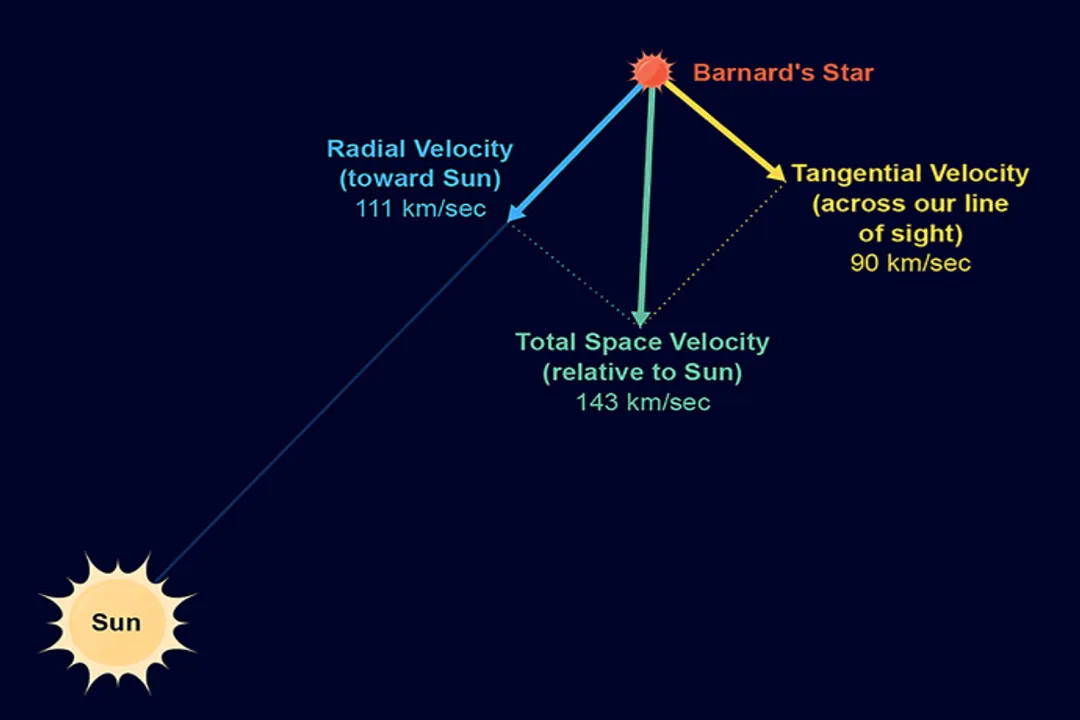
While determining if a star is moving towards us is a critical part of understanding its motion, it only captures half the story. The Doppler effect measures only the radial velocity, which is motion directly along the line of sight connecting the star and the observer. [5] A star could theoretically be moving extremely fast across our field of view, perpendicular to our line of sight, and still show no Doppler shift if its distance remains constant. [6]
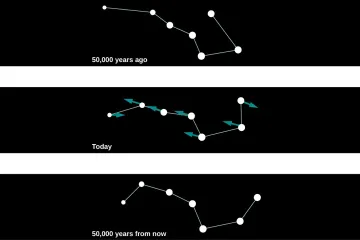
This sideways motion is called proper motion. [6] Measuring proper motion requires observing the star's position against the background stars over many years, sometimes decades or even centuries, to track its minuscule angular drift across the sky. [6] Combining the radial velocity (from the Doppler shift) with the proper motion allows astronomers to calculate the star's complete, three-dimensional velocity vector in space.
# Interpreting Light Compression
The detection of a blueshift confirms that the space between the star and Earth is decreasing. This is not merely an observational curiosity; it informs our understanding of stellar dynamics and stellar populations. For example, stars in a cluster that are all moving toward us with a similar, slight blueshift might indicate that the entire cluster is orbiting the galactic center in a way that brings it temporarily closer to our location within the Milky Way, or that the cluster itself is collapsing slightly.
Furthermore, the analysis of blueshifts helps confirm stellar masses through the Radial Velocity Method, used extensively in exoplanet hunting. [5] When a star has an orbiting planet, the star also wobbles slightly in response to the planet's gravity. As the star wobbles toward us, we see a minute blueshift; as it wobbles away, we see a redshift. Although this wobble is far smaller than the motion of a star approaching or receding due to its own orbital path around the galaxy, the periodic nature of the shift betrays the presence of an unseen companion. [5] Even in this context, the fundamental indicator that the star is currently approaching is the presence of that characteristic spectral line shift toward the blue wavelengths.
In summary, telling if a star is moving toward us is a matter of precise measurement of its light spectrum. Astronomers look for a blueshift, where the spectral absorption lines are systematically shifted to shorter wavelengths compared to their known static positions. [1][5] This spectral shift is the direct, quantitative consequence of the star closing the distance between itself and our observatory, demonstrating that the light waves have been compressed by its approach. [3][9]
#Videos
Light and Motion: the Doppler Effect - YouTube
Related Questions
#Citations
Redshift - Las Cumbres Observatory
How does Doppler effect help to find out a distance to the star?
The Doppler Effect in Astronomy - British Astronomical Association
Light and Motion: the Doppler Effect - YouTube
Color-Shifting Stars: The Radial-Velocity Method
How can we determine if an object (such as a star) is moving ...
Inner Workings: Astronomers uncover new way to measure the ... - NIH
Doppler Effect in Light Ever wondered how scientists know if a star is ...
The Doppler Shift - Stanford Solar Center