Do all stars move east to west?
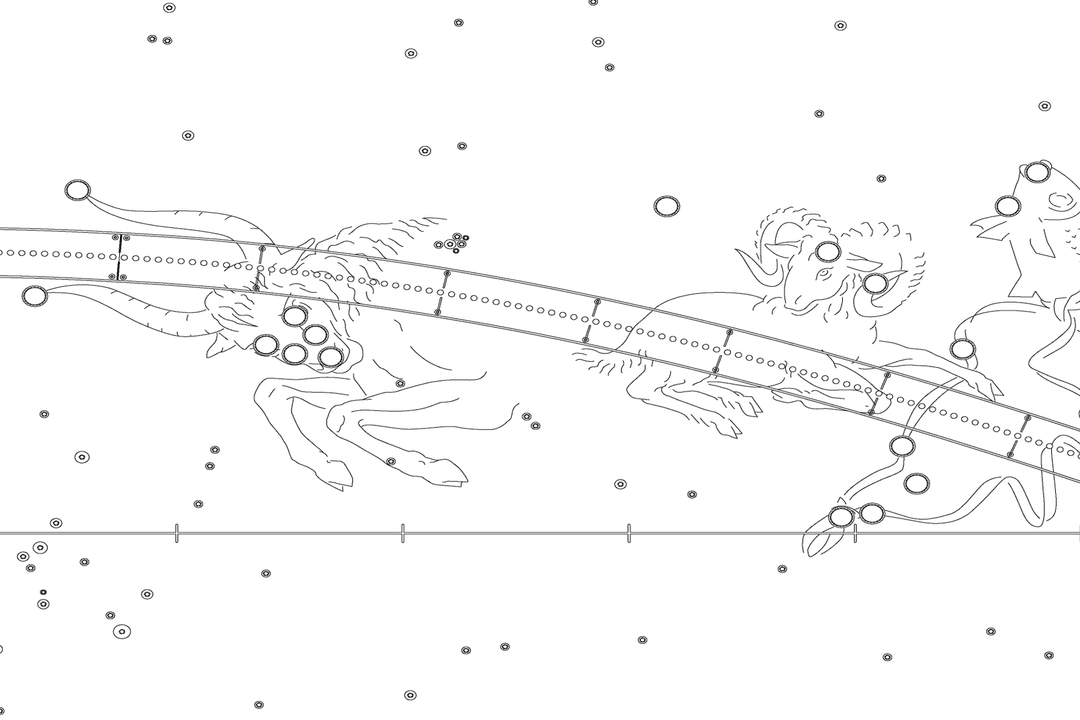
The initial observation made by anyone looking up at the night sky is that the stars, much like the Sun and Moon during the day, traverse the heavens from east to west. This universal apparent motion is not because the stars are physically moving across the sky in a massive coordinated sweep, but rather a direct consequence of our own planet’s movement. [4][5] The Earth spins on its axis, completing a rotation roughly every 24 hours, and this spin is directed toward the east. [6] Because we are standing on a rotating platform, the stationary celestial objects appear to swing in the opposite direction—westward—across our field of view. [2][6]
# Celestial Rotation
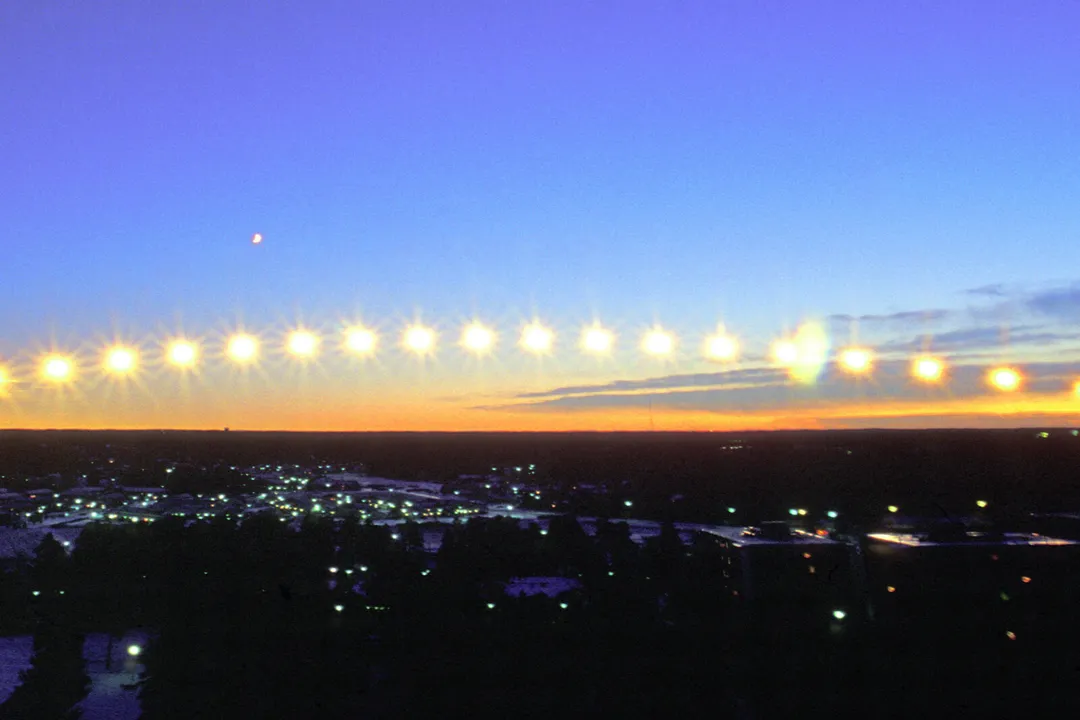
To properly understand this daily parade, it helps to picture the Celestial Sphere, an imaginary, vast sphere surrounding the Earth onto which all stars are projected. [7] When we observe the stars, we are essentially watching them move along paths on this sphere. [7] The Earth’s rotational axis points almost directly toward a specific point in space, which defines the Celestial Poles. [7] In the Northern Hemisphere, this point is very close to the star Polaris, the North Star. [4]
The apparent paths of the stars trace out circles that are parallel to the Celestial Equator. [4] If an observer were positioned exactly on the Earth’s equator, the celestial sphere would appear to rotate directly overhead, with stars rising perpendicularly in the east and setting perpendicularly in the west. [7] This scenario presents the clearest demonstration of the east-to-west movement where every star visible eventually crosses the horizon. [4]
# Paths Traced
The exact path a star takes across the sky, and whether it is visible all night, depends entirely on its declination—its celestial latitude—relative to the observer's latitude on Earth. [4][7] Stars are not all moving the same way relative to the observer; their paths form a specific pattern based on their distance from the celestial pole. [8]
There are three main categories of stellar paths visible from a given location:
- Circumpolar Stars: These are stars located close enough to the celestial pole that they never dip below the horizon for that observer. [4][8] For a fixed observer in the Northern Hemisphere, these stars circle the North Star in small paths, appearing to move counter-clockwise when viewed from above the North Pole. [9] They are always visible.
- Stars that Rise and Set: The vast majority of stars fall into this category. They rise above the eastern horizon, arc across the sky over the course of the night (moving generally east to west), and then sink below the western horizon. [5][8]
- Stars that Never Rise: For an observer in the Northern Hemisphere, stars that are too far south—those close to the South Celestial Pole—will never be visible, remaining perpetually below the southern horizon. [8]
This dependence on location is crucial. For an observer in the Southern Hemisphere, the view is inverted relative to the North Star; they see the South Celestial Pole, marked near Sigma Octantis. [6] Stars in their sky move in paths around that pole, and the stars familiar in the north are permanently below their horizon. [6]
# Observer Latitude Effects
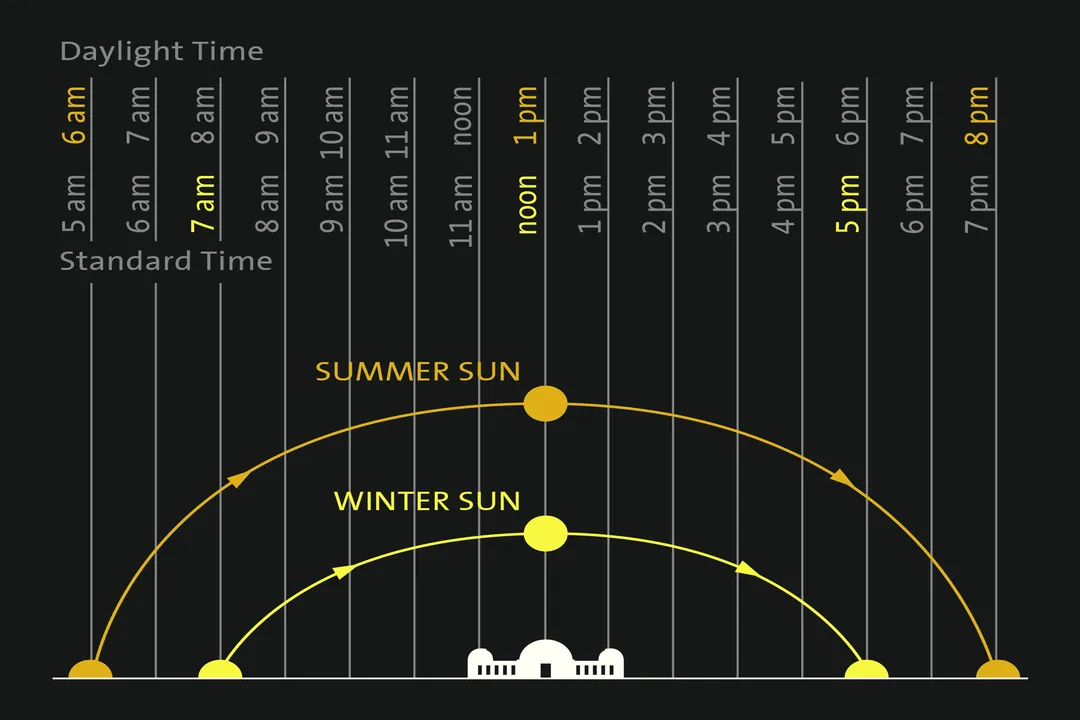
The altitude at which stars appear to cross the meridian (the highest point in their daily arc) and the length of time they remain visible are dictated by the observer’s latitude. [4] For instance, stars appear to trace large circles high in the sky for observers near the equator, where the celestial equator passes directly overhead. [7] Conversely, for an observer at the North Pole, the celestial sphere appears to rotate parallel to the ground, meaning every star that is visible circles the zenith without ever rising or setting. [7]
Consider two observers separated by a significant distance north to south. An observer in Anchorage, Alaska, might see many stars circling overhead throughout the night, never setting, due to their high latitude. [7] Meanwhile, an observer closer to the equator in Quito, Ecuador, sees virtually all stars rise and set over a roughly 12-hour period, following the dome of the sky almost directly overhead. [7] The direction of apparent motion remains consistently east to west across the sky dome, but the shape of the apparent path traced on the horizon changes dramatically based on where you stand on Earth. [4][7]
A helpful way to visualize this difference in experience is by comparing the time stars spend above the horizon. At the equator, the angle between the horizon and the celestial equator is , meaning stars cross the sky along the shortest possible path, spending about half their visible time above the horizon. If you travel further north, say to North latitude, stars near the celestial equator rise at a shallower angle and spend more than half the night above the horizon, provided they don't become circumpolar. [7]
# Temporal Repetition
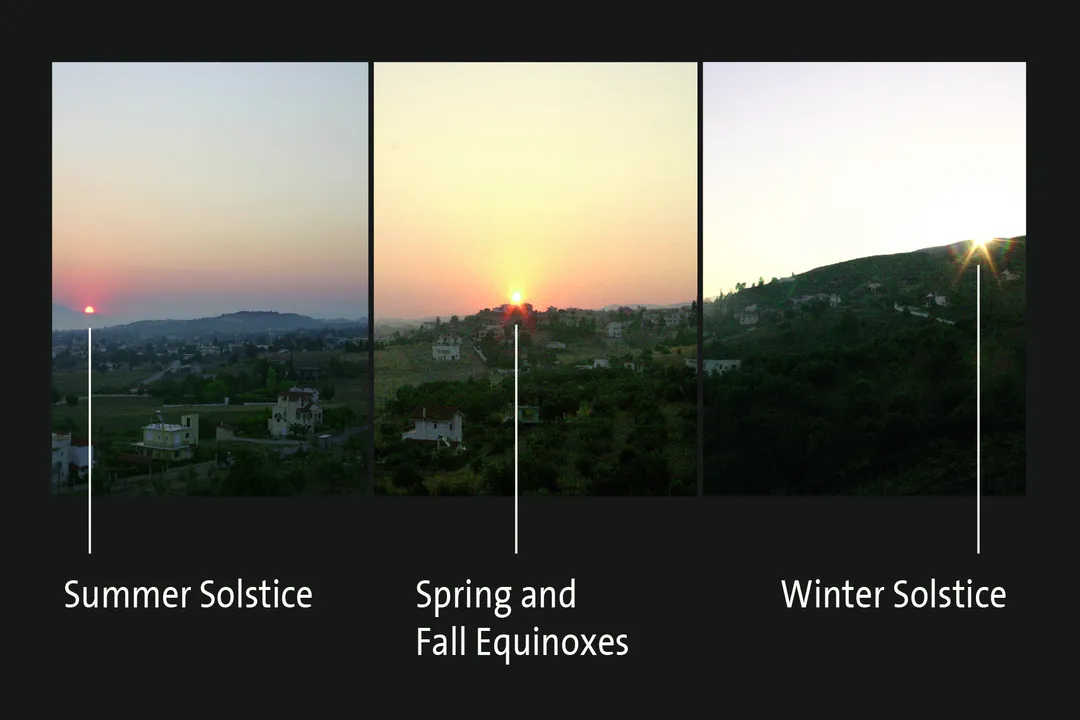
While the stars appear to move east to west daily, the question of when the entire sky configuration exactly repeats itself relative to a fixed point, like the Sun, involves a more complex cycle tied to our orbit around the Sun. [1] The Earth’s rotation dictates the daily apparent movement, taking approximately 23 hours, 56 minutes, and 4.09 seconds for the stars to return to the same position relative to the Earth’s axis—this is the sidereal day. [1] This is why a specific star crosses the meridian at a slightly earlier time each solar day. [1]
If we measure star positions relative to the Sun, the cycle is much longer. Since the Earth is also revolving around the Sun over the course of a year, the alignment of the Earth, Sun, and distant stars changes gradually. [1] For the stars to return to the exact same position in the sky as seen at a specific time of day (e.g., 9 PM local time), a full sidereal year is required, which is about 365.256 solar days. [1]
This annual repetition is a fundamental consequence of our orbit. To illustrate the daily shift, imagine locating a prominent constellation, say Orion, at its highest point (culmination) tonight at exactly 10:00 PM. Tomorrow night, for Orion to reach that same exact position in the sky (the meridian), you would only have to wait until approximately 9:56 PM solar time. [1] Over the course of a few months, this daily shift of about four minutes earlier accumulates, meaning the seasonal constellations we associate with summer versus winter are simply those that are visible when the Sun is on the opposite side of the sky—a direct result of our planet's annual orbit. [1]
# Understanding the Baseline
It is important to ground these concepts with a simple observational baseline. The Earth's rotation eastward is the single cause for the apparent westward motion of all celestial objects, including the Sun, Moon, and every star. [2][5][6] The fact that a star rises in the east and sets in the west is a fundamental observable truth for nearly every observer on Earth, barring those living extremely close to the poles where setting/rising is replaced by circling the horizon. [5][7]
When an observer sets up a camera for a long exposure, the resulting image captures this apparent movement as arcs of light, with the center of the arc being the point toward the celestial pole. [9] The length of the arc traced during a set exposure time is directly proportional to the star's distance from the pole; stars closer to the pole trace shorter arcs over the same time frame than stars near the celestial equator. [9] This practical application in astrophotography provides tangible evidence of the rotational effect we experience daily. If you were to take a 12-hour exposure from the mid-latitudes, the stars would trace nearly half a circle across the sky, a direct mapping of the Earth's rotation during that interval relative to the distant stars.

# Synthesizing Apparent and Actual Motion
While the apparent motion is governed by Earth’s rotation, it is worth noting that the stars themselves are indeed moving through space, but on vastly different scales and timescales. [3] The apparent westwards drift we see in a few hours is due to an Earth rotation speed of about $1,000$ miles per hour at the equator. [6] The actual motion of stars, however, is measured in thousands of miles per second across the galaxy, but because they are incredibly distant—often hundreds or thousands of light-years away—their true transverse motion is imperceptible over human timescales. [3] This immense distance renders their actual proper motion negligible compared to the immediate, visible effect of our planet spinning beneath them. Therefore, for all practical observational purposes, every star does move east to west throughout the night. [5] The nuances lie only in how that east-to-west arc is presented to the eye, depending on latitude and time of year. [4][7]
Related Questions
#Citations
How often do star position exactly repeat w.r.t same lat-long - Reddit
Why Do Stars Appear to Move in the Night Sky?
Why do stars rotate differently at the poles and equator? - Facebook
Sun & Stars Paths - Southern California's gateway to the cosmos!
In which direction do stars appear to move in the sky? - Quora
The Motion of the Sky at Different Latitudes
The Sun and Stars in the Celestial Sphere - UC Berkeley Astronomy w
Paths of the Stars - The Rotating Sky - NAAP - UNL Astronomy
Lecture 1: The Stars - Astronomy at Durham