What is the big star on the west side?
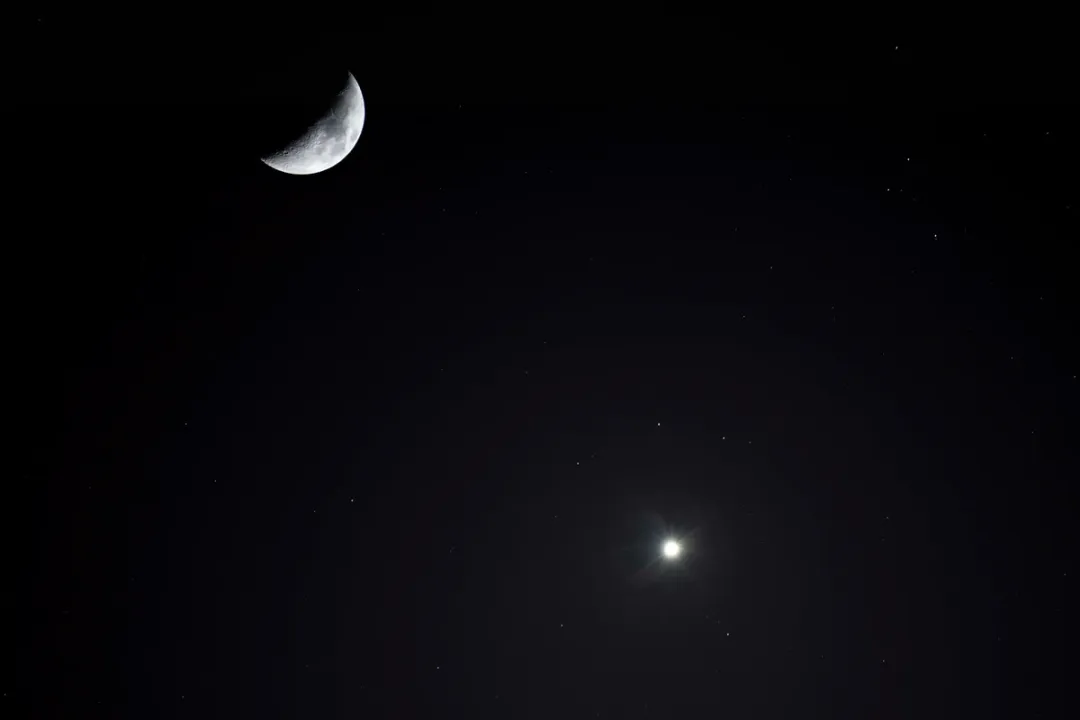
The exceptionally bright object hanging low in the western sky shortly after the Sun dips below the horizon often sparks curiosity, prompting people to look up and wonder what celestial body is shining with such intensity. It is a common question that floods online forums and local astronomy groups: what is that huge, steady light near where the sun just set? For the vast majority of recent observations across the globe, the answer is almost certainly the planet Venus.
This planet earns its reputation as the "Evening Star" when it appears in the west after sunset, or the "Morning Star" when it graces the eastern sky before sunrise. It is not a star at all, but our sister planet, and its appearance is so striking that it can easily outshine every true star in the night sky combined, sometimes even being visible before the Sun has completely disappeared. Its brilliance is a direct result of its unique physical characteristics and its current orbital geometry relative to Earth.
# Planetary Sheen
The sheer luminosity of Venus is what sets it apart from genuine stars. Stars produce their own light through nuclear fusion; Venus only reflects sunlight, yet it can shine with an apparent magnitude as bright as $-4.6$. To put that into perspective, the brightest star in the night sky, Sirius, typically shines at about $-1.46$. This difference is staggering; Venus appears roughly 30 to 40 times brighter than Sirius when it is at its peak visibility.
This overwhelming brightness stems from two primary factors: its distance from us and its reflective surface. Venus is the second planet from the Sun, meaning it orbits closer to us than Earth does, making it our nearest planetary neighbor. When it is in its best viewing position—a period known as greatest elongation—it is relatively close to us in its orbit. The second, and perhaps more crucial, factor is its atmosphere. Venus is shrouded in thick, highly reflective clouds composed primarily of sulfuric acid droplets. These clouds reflect about 70 to 75 percent of the sunlight that hits them, giving Venus an extremely high albedo—the measure of how much light a surface reflects. No other planet in our solar system possesses such a brilliant, reflective exterior.
# Orbital Motion
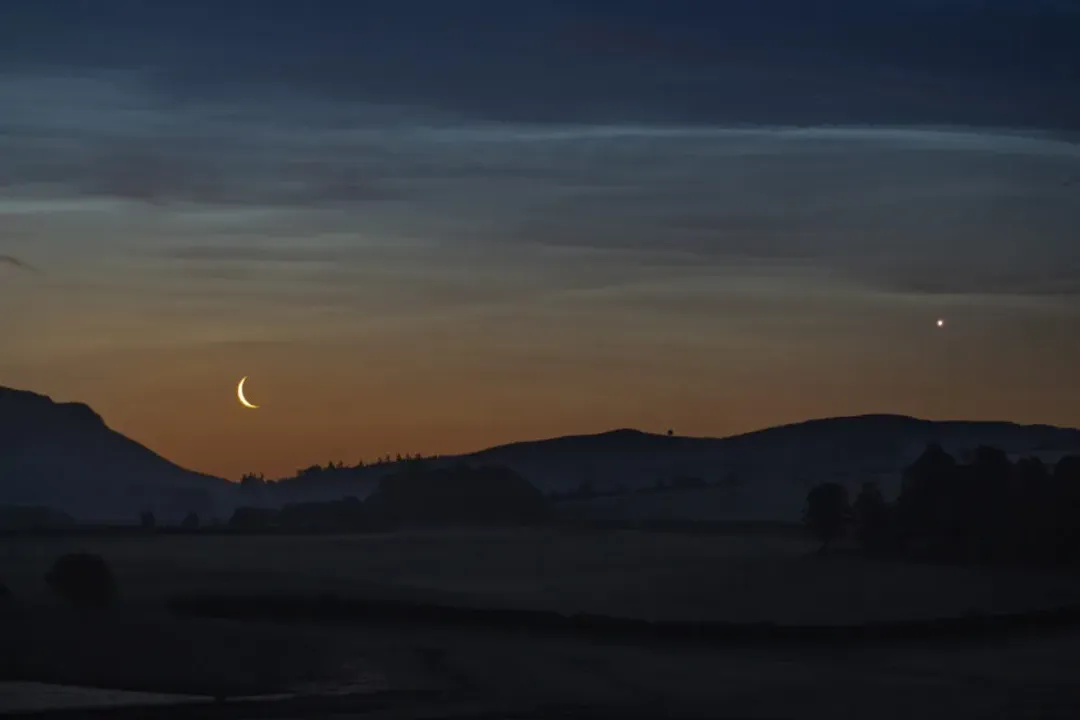
Understanding when this bright object appears in the west requires understanding Venus's path around the Sun. Because Venus orbits inside Earth’s orbit, it never appears in the midnight sky, as Jupiter or Mars might. It is always relatively close to the Sun in our sky, which is why it is only visible for a few hours immediately after sunset or before sunrise.
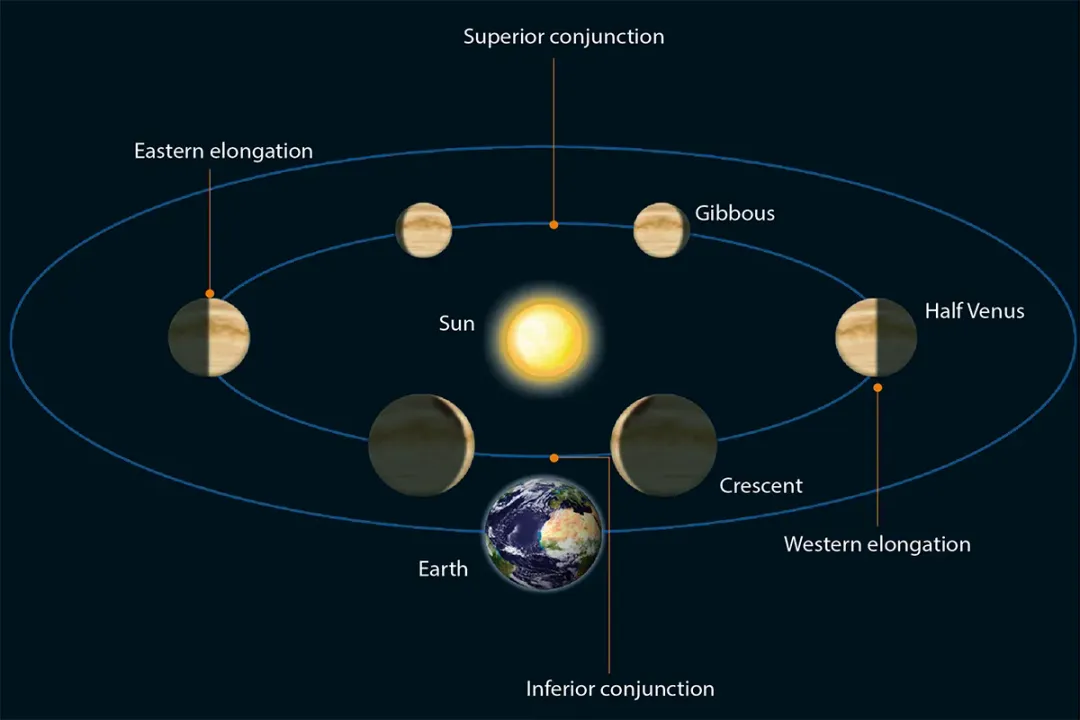
The term "Evening Star" applies specifically when the planet is visible in the west following sunset. This happens during the time when Venus is moving away from the Sun in the sky, heading toward its farthest separation—a configuration known as greatest western elongation if it’s a morning star, or greatest eastern elongation if it’s an evening star. When the planet reaches its maximum angular distance from the Sun as viewed from Earth, that is when it hangs longest in the twilight sky, making it an ideal target for casual observers.
It is important to note that Venus goes through phases, much like our Moon, because we view the sunlit side of the planet from different angles as it orbits. When it is fullest (fully illuminated from our perspective), it is farther away and appears smaller and less bright; when it appears as a bright crescent, it is closest to Earth and appears largest, though this phase is harder to spot without optical aid.

# Distinguishing Planets
For the casual stargazer, a common confusion arises between the brightest planet and the brightest star. True stars, being immensely far away, always appear as pinpricks of light. Planets, being relatively close, appear as tiny discs, even though you need a telescope to resolve the disc shape.
There are two main observational clues to tell them apart:
- Twinkling: Stars twinkle noticeably due to the turbulence in Earth's atmosphere passing their point-like light source. Planets, appearing slightly larger in apparent size, are less affected by this atmospheric blurring, resulting in a much steadier, non-twinkling light. If the bright object is beaming steadily, it strongly suggests a planet like Venus.
- Location: Planets generally follow the ecliptic, the path the Sun appears to trace across the sky throughout the year. While some bright stars also lie near this path, the combination of steady light and proximity to the horizon shortly after sunset usually points toward Venus.
When one looks at the sky and sees a dazzlingly bright, non-twinkling light near the horizon in the west shortly after sunset, the object is likely Venus, provided the date aligns with one of its recent periods of greatest eastern elongation. For instance, observers in May 2023 noted an exceptionally bright Venus in the west after sunset, perfectly aligning with the planet being near its greatest eastern elongation that month.
# Orbital Mechanics

To truly appreciate why we see Venus where and when we do, considering its orbit relative to Earth’s is key. Venus takes about 225 Earth days to orbit the Sun, whereas Earth takes 365. This difference in orbital speed causes the planet to lap Earth periodically. When Venus passes between the Earth and the Sun (inferior conjunction), it is hidden by the Sun's glare. When it is on the far side of the Sun from Earth (superior conjunction), it is too small and dim to observe easily.
The most spectacular displays occur when Venus is at its maximum angular separation from the Sun—about 47 degrees—which is what determines the timing of the Morning and Evening Star phenomena. A fascinating consequence of this geometry is that the brightest phases (when Venus is a distinct crescent) occur when it is closest to Earth, while the brightest overall appearance is when it is slightly farther away, appearing gibbous (more than half-lit), but before the distance shrinks its overall apparent size too much. The maximum brightness occurs when the combination of its apparent size and illumination percentage maximizes the light reaching our eyes.
If you were to track the exact time the "big star" sets each evening, you would notice that over several weeks, it sets progressively later and later, moving higher in the sky, until it reaches its peak evening altitude before starting its inevitable slide back toward the Sun’s glare, eventually becoming the Morning Star in the east.
# Predicting Viewing Windows
For those who wish to regularly observe this phenomenon, understanding the cycle is practical. Venus is visible as the Evening Star for a period of time, then it passes behind the Sun from our viewpoint, making it invisible for several weeks or months, before reappearing as the Morning Star. Observing the planet near its greatest elongation offers the longest and most comfortable viewing window in the twilight.
An interesting side note for the dedicated observer relates to the speed of its motion across the background stars during these visibility periods. Because Venus is moving in a tight, fast orbit relative to us, its position against the distant stars changes more rapidly than that of, say, Mars or Jupiter. If you were to track its position nightly against a fixed background object like a distant chimney or a specific tree line, the change in its bearing would be noticeable over a week, something invisible for the slower-moving outer planets. This change in angular position is a subtle marker of its rapid transit through the inner solar system.
Furthermore, since the visibility period is tied directly to the planet's elongation angle, the best time to spot it is always when the Sun sets behind the planet in the sky—which is why it is seen in the West after sunset. If you find the object rising in the east before sunrise, you are looking at the same planet, but now it is leading the Sun across the sky. The switchover happens when Venus passes between the Earth and the Sun.
# Observing Experience
When you locate the "big star," take a moment to simply appreciate the view. While the naked eye sees a brilliant light, even a simple pair of binoculars can reveal a slightly non-point source of light, and a small telescope will clearly show its phase. The visual contrast between the gentle, steady glow of Venus and the sharp, glittering light of nearby stars often confirms the identification immediately. It is a reliable feature of our night sky, appearing year after year, though its exact position and visibility time shift based on its orbital cycle.
For instance, imagine setting up a viewing session in the evening. If you wait until 9 PM local time and the object is still prominently visible, that places it far from the Sun in our sky, suggesting it is still a good candidate for evening viewing. However, if you see it at 5:30 AM, rising in the east, you are witnessing the Morning Star phase. Knowing that its orbital period is less than three-quarters of an Earth year means that the time between its brightest evening appearance and its next brightest morning appearance might only be a matter of months, creating a dynamic show for sky watchers.
The consistency of Venus’s appearance, coupled with its dazzling magnitude, makes it one of the most frequently noticed, yet often misidentified, celestial objects for those who are not dedicated astronomers. It serves as an excellent, bright anchor point in the twilight for anyone wishing to begin learning the paths of the solar system residents across our celestial sphere.
#Videos
What's That Bright Star in the Sky? It's Not a Star, It's Venus - YouTube
Related Questions
#Citations
What's That Bright Star In The West After Sunset? When And Where ...
Venus - Wikipedia
What's That Bright Star in the Sky? It's Not a Star, It's Venus - YouTube
What's in the Night Sky? Abnormally bright star thing : r/sandiego
Why Venus Is So Bright Right Now | Scientific American
What is the bright planet/star in the western evening sky these last ...
Why Venus is called the morning star or the evening star
The brightest planets in December's night sky: How to see them (and ...
Why is Venus so bright in the night sky? - Cool Cosmos