How does a big star die?
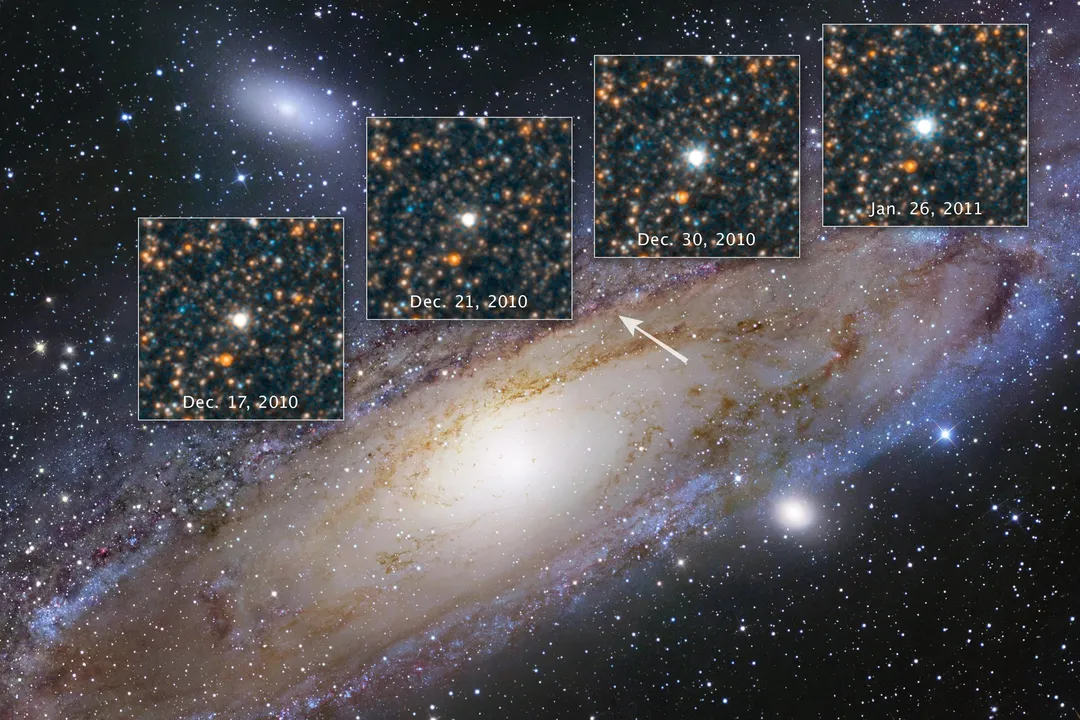
The life of a star, no matter how brilliant, is a finite process governed by the relentless interplay between gravity trying to crush it inward and the outward pressure generated by nuclear fusion in its core. [4][5] When we talk about a star "dying," the narrative drastically changes depending on its initial mass; small stars, like our Sun, fade away gently over eons, but the truly big stars meet a far more spectacular and violent end. [4][9] These massive stellar behemoths, often beginning their lives with masses many times that of the Sun, exhaust their fuel reserves at a ferocious pace, ultimately culminating in one of the universe's most cataclysmic events. [1][4]
# Lifespan Scales
The difference in stellar lifespan is stark and directly proportional to mass, though not in the way one might intuitively expect. [9] A star like the Sun, which is considered low-to-intermediate mass, is expected to live for about ten billion years, steadily converting hydrogen to helium in its core. [9] Big stars, however, burn through their nuclear fuel much faster because the extreme gravity in their cores demands a significantly higher rate of fusion to maintain equilibrium. [4][5] While exact numbers vary based on the star's precise initial mass, stars significantly larger than the Sun might only survive for a few million years. [9] This is an incredibly short cosmic blink of an eye when compared to the age of the universe. [9]
# Fuel Burning
The engine driving any star is nuclear fusion, the process where lighter atomic nuclei combine to form heavier ones, releasing vast amounts of energy. [5][6] For the vast majority of a massive star's life, this is the conversion of hydrogen into helium in the core, creating the outward pressure that balances the inward pull of gravity. [5][6] However, the sheer scale of a big star means it burns hotter and faster, allowing it to progress through subsequent fusion stages far more rapidly than its smaller cousins. [4]
Once the initial hydrogen supply in the core is depleted, the star's fate hinges on its mass. For a large star, gravity is powerful enough to compress the core until temperatures and pressures trigger the fusion of the newly formed helium into carbon. [4][5] This process doesn't stop there for the giants. As layers of heavier and heavier elements accumulate, the star develops an "onion-skin" structure, with successive shells fusing different elements. [1][4] Hydrogen fuses in the outermost layer, then helium, then carbon, oxygen, neon, silicon, and so on, moving progressively closer to the center. [4][6]
# Iron Core
This layered burning continues until the fusion process creates iron in the star's very center. [1][4][6] Iron marks the definitive end of a star's ability to generate energy through conventional fusion. [4][5] Unlike the lighter elements, fusing iron atoms consumes energy rather than releasing it. [4][6] This is a critical, irreversible turning point in the star’s existence. [5] When the core becomes pure iron, the furnace goes out, and the outward pressure that has supported the star for millions of years vanishes almost instantly. [4][6]
Imagine a multi-story building suddenly losing the structural integrity of its basement floor—the entire structure becomes unstable under its own weight. [3] For a massive star, once the iron core forms, the gravitational collapse is inevitable and happens with terrifying speed, taking only a fraction of a second. [4][6]
# Collapse and Rebound
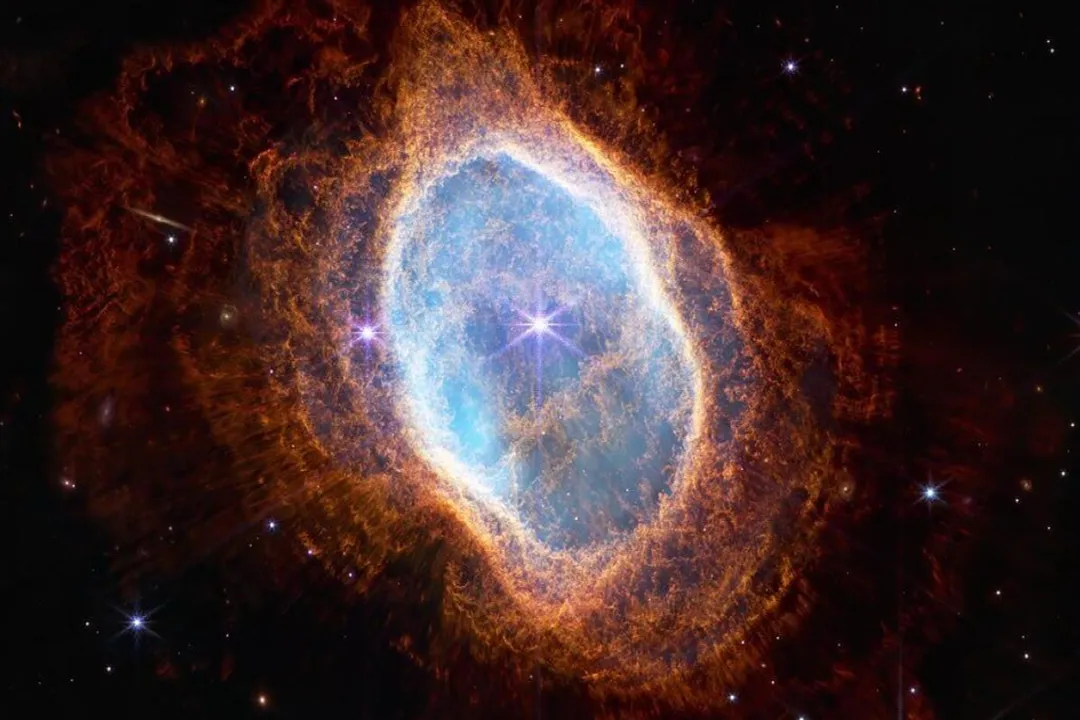
With the fusion pressure gone, the immense weight of the star's outer layers crashes down onto the inert iron core. [4][5] This implosion compresses matter to incredible densities, far exceeding that of an atomic nucleus. [6] The collapse is halted only when the core reaches nuclear density, a point where the subatomic particles, primarily neutrons, resist further compression due to a quantum mechanical effect known as neutron degeneracy pressure. [4][6]
The core essentially becomes an incredibly rigid ball of neutrons. [6] When the infalling stellar material strikes this newly formed, incompressible neutron core, it essentially bounces off. [4][6] This sudden rebound generates a massive outward-moving shockwave. [1][4] This shockwave, coupled with a massive flood of neutrinos streaming out from the core, rips through the rest of the star, blasting its material into space at tremendous speeds. [1][2][4] This violent expulsion is what we observe as a Type II Supernova. [1][4]
A key factor that determines the sheer power of this explosion, and what happens next, is the initial mass of the star and, more importantly, the mass of that remaining iron core. For stars that are significantly massive—roughly exceeding eight to ten times the Sun's mass—the explosion is guaranteed. [9]
As an interesting aside for context, the energy released in just a few seconds during a supernova explosion can briefly outshine an entire galaxy, yet this explosive energy is only about one percent of the total gravitational binding energy released during the core collapse itself. The vast majority of the energy—around 99 percent—escapes in the form of neutrinos, which are faint, nearly massless particles that barely interact with matter [2].
# Stellar Remnants
What remains after the blinding flash of the supernova depends entirely on how much mass is left behind in that ultra-dense core. [6] The original star's mass dictates the final outcome, though the exact mass boundary for the two primary remnants is not always sharply defined across all astronomical models, given the complexities of the explosion itself. [9]
# Neutron Stars
If the remaining core mass is less than about two to three times the mass of the Sun (the precise limit is known as the Tolman–Oppenheimer–Volkoff limit, though the exact value is a topic of ongoing research), the neutron degeneracy pressure is sufficient to hold the core up against gravity. [6] The result is a neutron star. [1][6] These objects are incredibly compact; a stellar mass object, perhaps packing more mass than the Sun, is squeezed into a sphere only about 10 to 20 kilometers across—the size of a small city. [1][6] A teaspoon of neutron star material would weigh billions of tons. [5] These rapidly spinning remnants can sometimes emit beams of radiation, observed as pulsars. [1]
# Black Holes
If the mass of the collapsing core exceeds the limit that neutron degeneracy pressure can support—generally estimated to be around three solar masses—then nothing can stop the collapse. [6] Gravity overwhelms all known forces, and the core collapses indefinitely until it shrinks to an infinitely dense point called a singularity. [4][6] This creates a black hole. [4] The gravitational pull near this point becomes so intense that nothing, not even light, can escape its grasp once it crosses the boundary known as the event horizon. [4]
It is fascinating to consider that the elements essential for life—the carbon in our bodies, the oxygen we breathe, the iron in our blood—were forged in the intense pressures of these dying stars or during the supernova explosions themselves. The very matter that constitutes our planet and ourselves is literally recycled stellar debris, making these violent deaths the ultimate source of chemical enrichment for the cosmos [2][7].
# Cosmic Legacy
The death of a big star is not merely an ending; it is a profound act of cosmic dissemination. [7] The supernova blast is crucial because it is the primary mechanism for spreading the heavy elements created during the star's life and the explosion itself out into the interstellar medium. [2][7] Elements heavier than iron, such as gold, silver, and uranium, are thought to be created primarily during the explosive event itself, during the rapid neutron-capture process (r-process) that occurs as matter is ejected. [2]
These ejected gases and dust, now enriched with the building blocks of rocky planets, future stars, and complex chemistry, mix with existing interstellar clouds. [7] Eventually, this enriched material will coalesce under gravity to form the next generation of stars and planetary systems—systems that can potentially host life. [7] Without the spectacular death throes of these massive stars, the universe would remain mostly hydrogen and helium, devoid of the elements necessary for terrestrial worlds. [7] Their violent final moments ensure the continuing chemical evolution of the universe. [2][7]
#Videos
How Stars Die - YouTube
Related Questions
#Citations
The Death of a Star - How Stars Work - Science | HowStuffWorks
The Death Throes of Stars - NASA Science
ELI5: What is a dying star? : r/explainlikeimfive - Reddit
How do stars die? - BBC Science Focus Magazine
[PDF] Death of a star - University of Western Australia
[PDF] Death of Stars
Death of a Star: What Happens When Things Go Dark
How Stars Die: The Big Ones - Discovery Channel
How Do Stars Die and How Long Do Stars Live? - Sky & Telescope
How Stars Die - YouTube