Is iron made from dying stars?
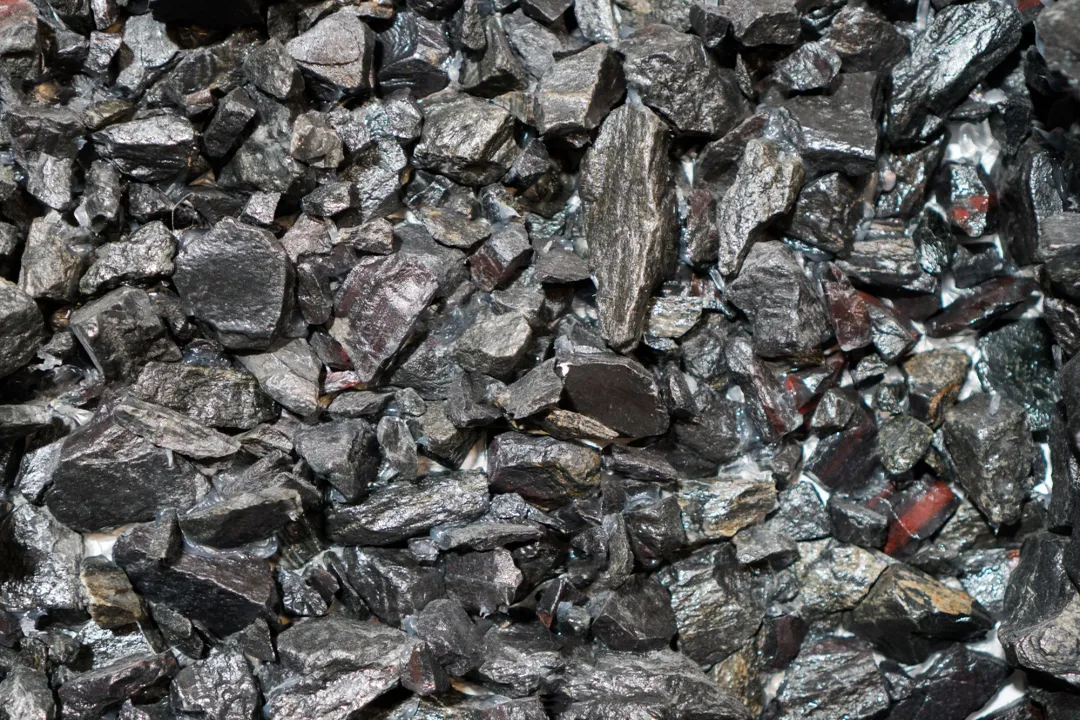
The elements that compose our bodies and the ground beneath our feet are truly ancient, forged in the extreme crucibles of collapsing and exploding stars long before our Sun ever ignited. Among these cosmic leftovers, iron holds a special, somewhat grim significance. It is not just another heavy metal; it represents a fundamental tipping point in the life cycle of massive stars, marking the inevitable path toward stellar demise. [1][4]
# Cosmic Furnaces
Stars spend the vast majority of their existence in a delicate, ongoing battle between gravity, which seeks to crush them inward, and the outward pressure generated by nuclear fusion in their cores. [6] For stars like our Sun, this fusion process is relatively gentle, turning hydrogen into helium. [6] When the hydrogen fuel runs low, the star contracts, heats up, and begins fusing the resulting helium into heavier elements, primarily carbon and oxygen. [6]
In more massive stars—those many times the mass of the Sun—the core temperatures and pressures become sufficient to continue this process through successive stages. [6] These stars build an onion-like structure, with lighter elements fusing in outer shells and progressively heavier elements fusing deeper inside. [6] Carbon fuses to neon, neon to oxygen, oxygen to silicon, and so on. [6] This chain reaction proceeds until the core begins producing silicon, which fuses into a very specific element: iron. [6]
# Fusion Wall
The production of iron () in the core of a massive star is the final act of stellar burning because iron sits at a unique peak on the chart of nuclear binding energies. [4] Binding energy relates to the stability of an atomic nucleus; the more energy released when two lighter nuclei combine, the more stable the resulting nucleus is. [4] Up until iron, every step of fusion releases net energy that supports the star against its own crushing gravity. [1][7]
This energy release is what keeps the star inflated and stable. [7] Think of it like burning fuel in an engine—it pushes outward. [4] However, the iron nucleus is so tightly bound that fusing iron atoms together does not release energy; instead, it consumes energy, requiring an input of heat to proceed. [1][7] Once the core becomes primarily iron, the star's primary energy source is cut off. [4] It's akin to the furnace suddenly requiring more energy to run than it produces, causing the entire system to stall. [7]
Imagine this energy curve as a mountain pass. All fusion reactions leading up to iron are like rolling a ball downhill, gaining speed (energy). Iron is the very peak of that mountain. To go past iron, you must expend significant effort (energy) to push the ball over the top, which the star simply cannot afford because its gravitational weight demands constant energy output. [7] This realization—that the core is now a non-fusing mass of iron—is the definitive sign that the star's life is about to end abruptly. [1]
# Iron Star State
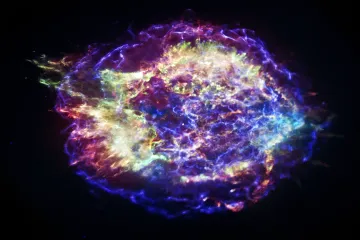
When the iron core can no longer produce the thermal pressure needed to counteract gravity, the collapse begins with terrifying speed. [4] The core shrinks rapidly, often reaching speeds of 70,000 kilometers per second, or about 23% of the speed of light. [4] This extreme compression leads to a concept sometimes referred to as an "iron star" or, more accurately, the immediate precursor to a supernova. [5][8]
This theoretical "iron star" is a transient, unstable phase where the core has fused all possible fuel into iron and is just moments away from the catastrophic implosion that triggers the supernova explosion. [8] The core collapses until the density becomes so extreme that the protons and electrons are squeezed together to form neutrons, a process called inverse beta decay. [4] When the collapse finally halts—stopped only by the incredibly stiff resistance of nuclear matter—the core rebounds, sending a massive shockwave outward that blows the star apart in a Type II supernova. [4]
# Heavier Elements
If iron is the end of the line for standard stellar fusion, where do the heavier, truly massive elements like gold, lead, and uranium come from? They are forged in the violence following the iron core's collapse. [1][4]
The tremendous energy released during the core collapse and rebound powers the creation of elements heavier than iron through rapid neutron capture, known as the r-process. [1][4] During the supernova shockwave, atomic nuclei are bombarded with an intense flux of neutrons. [4] These nuclei rapidly absorb many neutrons before they have time to radioactively decay, building up very heavy elements in a matter of seconds. [1] While supernova explosions are the primary mechanism suggested for this rapid creation, newer research also points to the collision of neutron stars as another significant—and perhaps even dominant—source for these ultra-heavy elements. [4]
The crucial difference is that these heavier elements are made not by fusion (which generates energy), but by rapid capture of free neutrons in a highly energetic, non-equilibrium environment. [4] Therefore, while the iron core itself is the trigger for the explosion that makes gold, the iron atoms themselves are generally the product of slower, internal stellar burning. [1]
# Our Iron Core
The presence of abundant iron throughout the universe, and especially in dense accumulations like the Earth's core, is a direct testament to this stellar lifecycle. [9] Earth formed from a cloud of gas and dust that contained the debris left over from previous generations of stars that had already lived and died. [9]
When the early Earth accreted, the massive amount of iron present—originating from ancient supernovae—sank toward the center due to its high density, creating the planet's iron-nickel core. [9] This geological reality means that every piece of iron we interact with, from the steel in a building to the iron in our blood, owes its existence to the death throes of stars that existed billions of years before our solar system formed. [9]
Considering the sheer amount of iron found in terrestrial planets, it provides an interesting point of comparison for astrophysical yields. While the fusion process in a massive star reliably produces iron up to the binding energy peak, the subsequent supernova explosion, which makes elements like gold, is less efficient for total yield of the heaviest elements compared to the consistent production of iron throughout the star's final million years. [4] The iron core itself might weigh more than the Sun, but only a tiny fraction of that mass is immediately converted into the heaviest elements during the explosion; the vast majority of the mass processed into iron simply remains as the seed for a neutron star or black hole. [5]
# Stellar Lifespan and Mass
The mass of a star dictates whether it ever reaches the iron-producing stage. A star like the Sun will never produce iron; it will gently shed its outer layers and end its life as a white dwarf after burning up to carbon or oxygen. [6] Only the most massive stars, those beginning their lives at perhaps eight times the Sun's mass or greater, possess the necessary gravitational power to compress their cores enough to sustain fusion all the way to iron. [4][6]
This distinction highlights the scale of cosmic creation. Stars that die softly just pollute the galaxy with carbon and oxygen. Stars that die violently, after creating that iron core, seed the cosmos with the building blocks for rocky planets, biological life, and every element on the periodic table beyond calcium. [4]
| Final Stellar Core | Final Stage Element | Stellar Fate | Energy Generation |
|---|---|---|---|
| Low Mass (Sun-like) | Carbon/Oxygen | White Dwarf | Endothermic (stops releasing energy) |
| High Mass | Iron () | Core Collapse/Supernova | Endothermic (consumes energy) [4][6] |
The transition from silicon burning to iron production in a massive star is remarkably fast. Once silicon ignition begins in the core, the star may only have a week or two left before the iron core forms and collapse is imminent. [6] This means that the final, critical step leading to the creation of iron happens on a timescale far shorter than the star's main sequence lifetime, emphasizing the rapid, terminal nature of this process. [6] This short final phase is crucial because it gives little time for radioactive decay processes to significantly alter the newly synthesized iron before the entire structure gives way.
#Videos
Can You Kill A Star With Iron? Why Iron Isn't Poison to Stars - YouTube
Related Questions
#Citations
ELI5: Why is the production of iron atoms a sign that a star is dying?
Is my body really made up of star stuff? - StarChild - NASA
Can You Kill A Star With Iron? Why Iron Isn't Poison to Stars - YouTube
Why is iron the heaviest element that can be produced in stars?
What are iron stars? - Astronomy Stack Exchange
Elements like carbon, nitrogen, iron, and calcium originate from star ...
Q: Why does iron kill stars? | Ask a Mathematician / Ask a Physicist
Iron star - Wikipedia