Which factor is most important in explaining the way a star dies?
The trajectory of a star, from its fiery birth in a nebula to its final, dramatic demise, is one of the universe’s grand narratives. While many factors play a part in the cosmic drama—like the star's rotation or whether it has a close companion—one characteristic stands above all others in determining how that star will ultimately cease to shine. That single, most critical determinant is the star's initial mass. This seemingly simple measurement, set at the moment of formation, dictates everything that follows: the speed of its life, the intensity of its final moments, and the nature of the stellar corpse it leaves behind.
# Mass Dictates Fate
A star spends the vast majority of its existence in a state of hydrostatic equilibrium. This balance is a constant, silent tug-of-war between two colossal forces: the relentless inward crush of gravity and the immense outward push generated by thermonuclear fusion occurring in the core. Gravity, fueled by the star's own mass, seeks to collapse the star into the smallest possible volume. Fusion, which converts lighter elements like hydrogen into heavier ones like helium (and later, heavier elements in massive stars), generates the thermal and radiation pressure necessary to counteract that collapse.
When the star exhausts the usable fuel in its core—typically iron cannot be fused to release energy—the outward pressure ceases abruptly. At this point, the star's fate is sealed by its starting mass. The greater the mass, the stronger the initial gravitational pull, and consequently, the more violent the resulting collapse when the fusion engine sputters out. This mass threshold effectively separates the gentle departures from the catastrophic explosions.
# Low Mass Endings
For stars that begin their lives with a mass less than about eight times the mass of our Sun, the end is relatively quiet and drawn out. Our own Sun falls squarely into this category. When a low-mass star runs out of hydrogen fuel, it begins fusing helium, swells into a Red Giant, and eventually sheds its outer layers into space, forming a beautiful, expanding shell of gas known as a Planetary Nebula.
What remains at the center is the exposed, incredibly dense, and extremely hot core—a White Dwarf. This remnant is primarily composed of carbon and oxygen, supported against further collapse not by fusion, but by electron degeneracy pressure. This is a quantum mechanical effect where electrons resist being squeezed into the same energy state, providing a rigid barrier against gravity. A White Dwarf is essentially a stellar ember, slowly cooling down over billions, perhaps trillions, of years until it theoretically becomes a cold, dark Black Dwarf—a process so slow that no black dwarfs are thought to exist yet in the universe's current age. The crucial takeaway here is that the mass was just enough to exhaust the fuel, but not enough to ignite the next, more violent stages of collapse.
# High Mass Explosions
The drama unfolds very differently for stars born significantly heavier than the Sun, generally those exceeding eight solar masses. These behemoths live fast and die young because their greater mass translates directly into higher core temperatures and pressures, causing them to burn through their nuclear fuel at a prodigious rate. Instead of stopping at carbon or oxygen, these massive stars can continue fusion processes all the way up to iron.
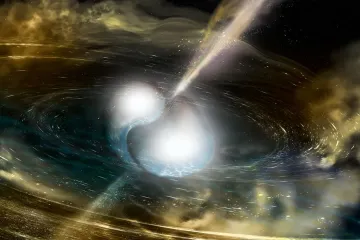
Iron is the cosmic dead end; fusing it consumes energy rather than releasing it. Once the core is iron, the outward pressure vanishes instantly, and gravity takes over completely. The core collapses catastrophically in mere milliseconds, crushing matter to incredible densities. This implosion reverses violently, creating a Type II Supernova explosion that briefly outshines entire galaxies. The exact nature of the remnant left behind after this spectacular death depends on how massive the core was before the supernova.
# Remnant Density Comparison
The sheer density of the final object is what separates the high-mass death scenarios from the lower-mass ones. We can see this stark difference in the resulting stellar corpses:
| Initial Star Mass (Solar Masses) | Final Remnant Type | Supporting Pressure | Key Density Factor |
|---|---|---|---|
| White Dwarf | Electron Degeneracy Pressure | Stable remnant | |
| to | Neutron Star | Neutron Degeneracy Pressure | Extreme core compression |
| (or higher core mass) | Black Hole | None (Singularity forms) | Gravity overcomes all known forces |
This table illustrates that the key differentiating factor, mass, creates distinct physical states. For instance, a star that leaves behind a Neutron Star is one where the core's mass fell between roughly $1.4$ and $3$ solar masses after the outer layers were blown away. If the remnant core exceeds the Tolman-Oppenheimer-Volkoff limit—the theoretical maximum stable mass for a neutron star, generally estimated to be around $2$ to $3$ solar masses—then nothing can stop the collapse, and a Black Hole is formed. The black hole represents gravity achieving total victory, warping spacetime so severely that not even light can escape its pull.
# The Collapse Mechanism
Understanding the difference in the collapse process helps explain why the mass threshold is so absolute. In a White Dwarf scenario, the core material is supported by electrons resisting being too close together. When the mass of the core pushes the White Dwarf past the Chandrasekhar Limit (about $1.4$ solar masses), electron degeneracy pressure fails, triggering a runaway collapse into a neutron star or leading to a Type Ia supernova if carbon fusion ignites explosively in a binary system. Though not the primary end state for a single low-mass star, the failure of electron degeneracy is a critical threshold in stellar evolution generally.
In contrast, the collapse leading to a neutron star involves gravity overcoming even the resistance of electrons being forced into protons, creating neutrons. This results in an object where a teaspoon of material would weigh billions of tons. If the core is even slightly more massive, the pressure forces neutrons together, overcoming neutron degeneracy pressure—the final stand before the formation of a singularity.
# Secondary Influences
While mass is the undisputed champion factor, it is important to acknowledge that the story isn't entirely one-dimensional. Consider a star born with exactly $7.9$ solar masses; it's destined for a quiet end. However, if that star resides in a close binary system and transfers a significant portion of its mass to its companion before it runs out of fuel, the dynamic changes completely. The companion might then exceed the threshold, while the original star might die quietly. The current mass of the core when fusion ceases, which is a function of initial mass minus mass lost during its main-sequence life, is the immediate trigger, but initial mass sets the potential for that loss.
This leads to an interesting thought experiment: If two stars have the exact same initial mass, say , but one is a pristine Population III star (composed almost entirely of hydrogen and helium) and the other is a metal-rich Population I star like our Sun, their exact end points can differ slightly. The presence of heavier elements ("metals") affects opacity and how efficiently the star can shed mass during its giant phases. A star that can shed mass more effectively might fall below a critical threshold just before its final collapse, thereby avoiding a black hole for a neutron star. In essence, mass sets the blueprint, but the chemical composition subtly influences the construction progress and demolition cost.
# Timescales and Perspective
Another insightful way to frame the importance of mass is through the lens of time. Mass doesn't just change the way a star dies; it dictates when. A star ten times the mass of the Sun might live for only a few tens of millions of years, whereas the Sun has a projected lifespan of about $10$ billion years. This accelerated timeline is a direct consequence of the immense pressure forcing a faster fuel burn.
Think of it like a chemical reaction: higher temperature (driven by greater mass/gravity) drastically increases the reaction rate. Therefore, a massive star completes its nuclear phases in the blink of an eye, cosmically speaking, leading to an immediate, cataclysmic end, leaving behind highly exotic remnants like neutron stars or black holes. Low-mass stars, burning coolly and slowly, have lifespans comparable to the current age of the universe, allowing for billions of years of stable existence before their gentle fade to a white dwarf. The factor that is most important is thus also the factor that controls the schedule of cosmic events.
# The Inevitability of Collapse
Ultimately, every star in the universe is fighting a losing battle against gravity. The different mechanisms of stellar death—the quiet puffing away of envelopes in low-mass stars versus the core-implosion supernova of massive stars—are merely different ways that gravity eventually gains the upper hand when the internal furnace shuts down. The initial mass determines the strength of the force fighting gravity (fusion pressure) and the strength of gravity itself. When the fuel runs out, the larger the initial mass, the more extreme the final state must be to resist the overwhelming inward force. Whether it settles into a stable, diamond-hard white dwarf or collapses completely into a singularity, the initial mass was the blueprint for that final destination.
#Videos
What Factors Determine A Star's Final Lifecycle? - Physics Frontier
Related Questions
#Citations
What are the various ways a star 'dies', and what are the factors that ...
The Life And Death Of Stars
The Death of a Star - How Stars Work - Science | HowStuffWorks
[PDF] Death of Stars Teacher Guide - Science and Mathematics Education
What Factors Determine A Star's Final Lifecycle? - Physics Frontier
WMAP- Life and Death of Stars - NASA
[PDF] Death of a star - University of Western Australia
Dying Stars and the Formation of Black Holes | Encyclopedia.com
Star Death - Cool Cosmos - Caltech