What does it mean when a star is big and bright?
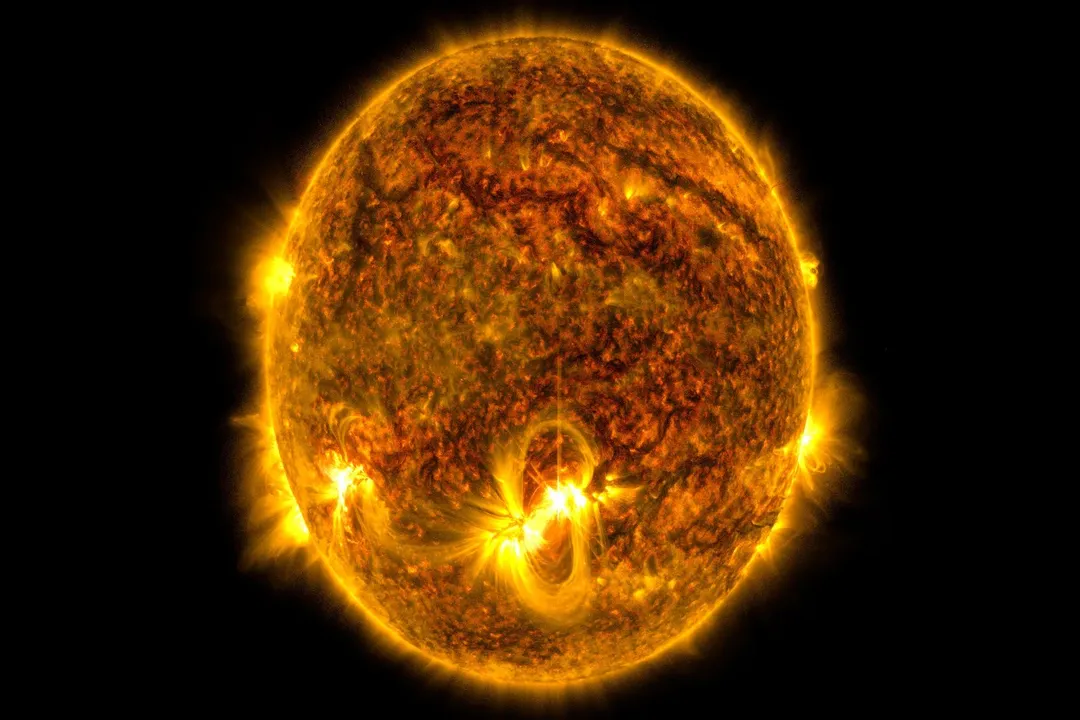
The appearance of a star that seems overwhelmingly bright and noticeably larger than its neighbors in the night sky is one of the most immediate, yet often misleading, observations an amateur stargazer can make. It suggests a cosmic behemoth, perhaps a star right next door. However, what you are actually seeing is a complex interplay of three fundamental properties: the star’s intrinsic power, its stage in the life cycle, and, most importantly, its distance from our eyes on Earth.
When we look up, we are not measuring reality directly; we are measuring the light that reaches us. This perceived brightness is quantified using the astronomical system of magnitude. If you notice one star dominating the field, it means its light has successfully navigated the vast gulfs of space to excite your retina more strongly than the light from dimmer neighbors. The "big" part, however, is almost certainly an illusion created by the physics of your own eye.
# Magnitude Scale
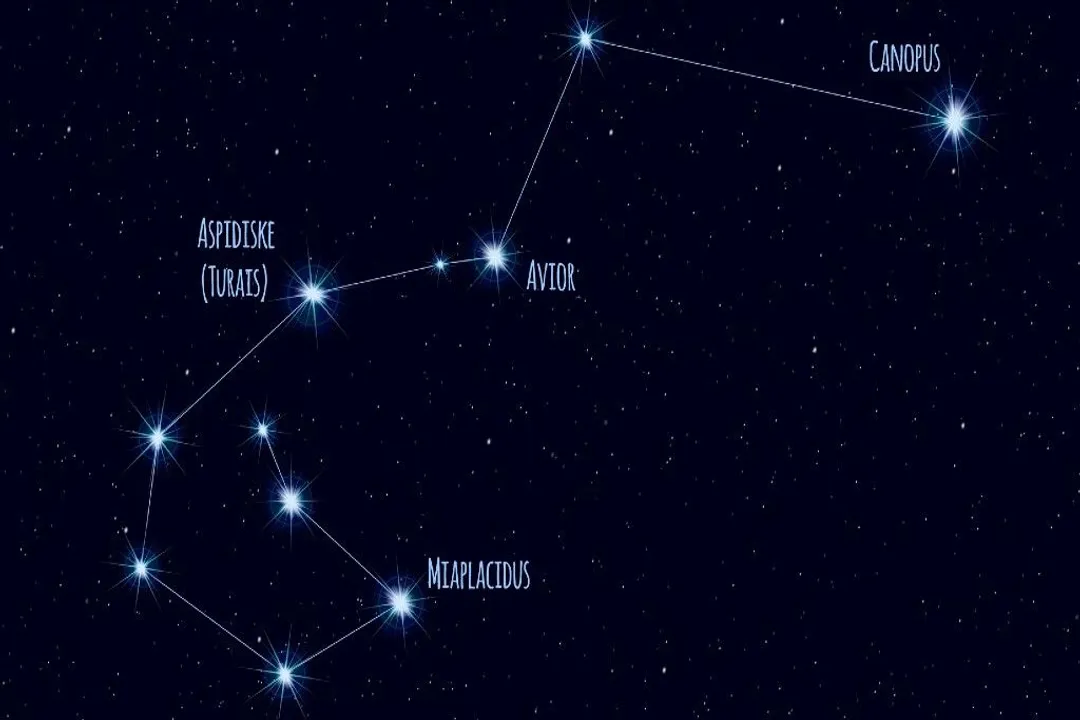
To begin unraveling this celestial puzzle, we must understand how astronomers rank stellar brightness. The system of magnitude originated in antiquity, where stars were categorized into classes ranging from first magnitude (brightest) down to sixth magnitude (faintest visible to the naked eye).
Astronomers refined this scale into the precise, logarithmic system used today, where the relationship is inverted: a lower or more negative magnitude number indicates a brighter object. For context, our own Sun is blindingly bright at an apparent magnitude of approximately $-26.78$. Following that, the brightest star visible, Sirius, shines at $-1.46$ magnitude. Stars that appear dimmer have higher positive numbers; for example, a star at magnitude $+6.0$ is nearing the limit of visibility under perfect, dark conditions.
# Distance Bias
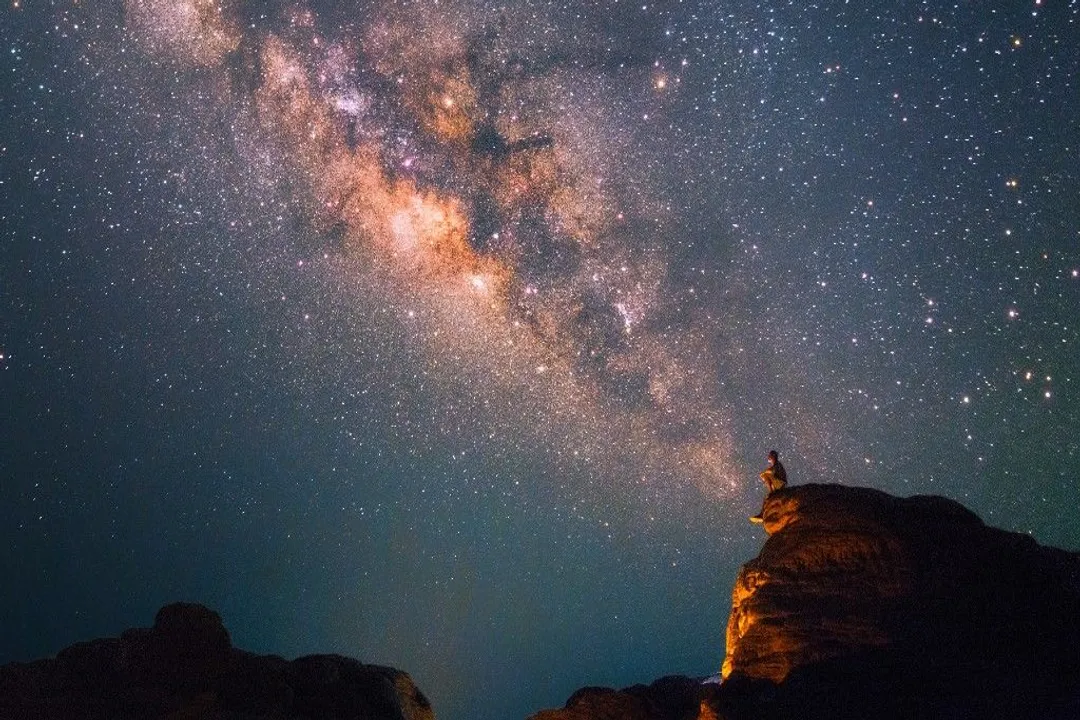
The single biggest factor determining which star wins the apparent brightness contest is usually its proximity. The closer a star is, the brighter it appears to us, regardless of how much energy it actually produces. This concept separates apparent magnitude (how bright it seems here) from absolute magnitude (how bright it truly is).
When we compile a list of the brightest stars visible from Earth—like Sirius, Canopus, Arcturus, and Vega—we are heavily biased toward stellar neighbors. A look at the top contenders confirms this: Sirius, the brightest, is only about $8.7$ light-years away. The vast majority of the top twenty brightest stars are found within a few hundred light-years.
However, the rule is not absolute. Some very close stars, such as the faint red dwarfs that are common neighbors to the Sun, are too dim to be seen without magnification because they are intrinsically low-powered. Conversely, a star incredibly far away must be genuinely phenomenal in its output to still make our top list.
# Size vs. Closeness
To appreciate this balancing act, consider the contrast between a star that shines brightly due to proximity and one that shines due to sheer scale, even when both rank highly in apparent brightness:
| Star Name | Apparent Magnitude () | Approximate Distance (light-years) | Spectral Type / Life Stage | Key Reason for Brightness |
|---|---|---|---|---|
| Sirius A | $-1.46$ | $8.7$ | A0 / Main Sequence | Proximity (It is the closest bright star) |
| Rigel | $+0.13$ | $860$ | B8 / Blue Supergiant | Extreme Intrinsic Luminosity (Approx. 10,000x Sun) |
Sirius is the brightest because it is right next door, relatively speaking. Rigel, on the other hand, has to overcome a distance nearly 100 times greater than Sirius, yet still shines as the 7th brightest because its intrinsic luminosity is about ten thousand times that of our Sun. The star that appears brightest is always close, or truly powerful, or, most commonly, a combination of both.
# Intrinsic Power and Stellar Size
If distance is one determinant of apparent brightness, the star's actual physical nature—its size and temperature—determines its luminosity, which is its absolute brightness. A star's size is deeply connected to its age and mass.
Stars are giant balls of hot gas, primarily fusing hydrogen into helium in their cores during their long "main sequence" phase. A star's mass dictates how fast it burns this fuel; high-mass stars burn hotter, brighter, and faster, living only a few million years, while low-mass stars burn slowly for trillions of years.
When a star exhausts its core hydrogen, its life cycle shifts, often leading to dramatic size increases that drastically inflate its luminosity. A low-mass star like our Sun will eventually become a red giant, swelling up to perhaps 25 times its current diameter. This expansion makes it much brighter, as seen with Arcturus (a K-type red giant), which is 113 times more luminous than the Sun despite being cooler.
For the truly massive stars, the end stages are even more spectacular. They swell into supergiants. Betelgeuse, an M-type red supergiant, is roughly 760 times the diameter of the Sun and boasts a luminosity exceeding 100,000 times that of our Sun, yet it only ranks around 10th in our sky due to its great distance of about 550 light-years. Blue supergiants, like Rigel, are hotter and extremely luminous, making them visible across incredible distances. Therefore, when a star is "big" (a giant or supergiant), it is generally an older star that has expanded significantly, becoming a powerful beacon in the sky, though its visibility still depends on how far away that event is occurring.
# Visual Size Illusion

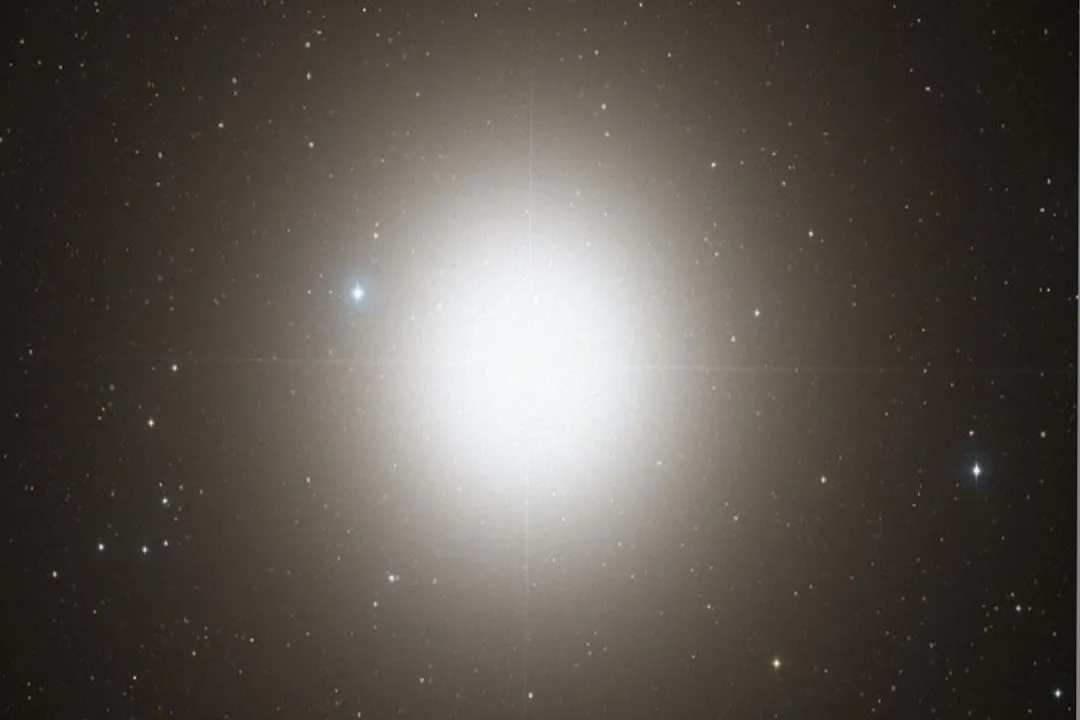
You noted that a very bright star often looks physically larger than dimmer stars. This is a fascinating and nearly universal optical effect, not an accurate representation of the star's angular size.
The actual angular diameter of even the largest visible stars is minuscule, as they are distant point sources of light. The perception of size arises from how the light interacts with the optics of the human eye—specifically, the pupil and the retina.
# The Airy Disc Effect
The light gathered by your pupil—which acts like a small aperture in a camera—does not focus into a perfect, infinitesimally small dot. Instead, due to the physical laws of diffraction, the image of the star on your retina is broadened into a characteristic pattern called an Airy disc.
For a faint star, the light intensity might only trigger the most central photoreceptor cells, resulting in a perceived tiny dot. For an extremely bright star, like Sirius, the light floods the center and, crucially, its fainter outer wings trigger the surrounding retinal cells. Because the brain interprets any signal spread across a wider area of the retina as a physically larger object, the bright star appears to swell into a disk or orb. This is why visual representations in planetarium software often artificially inflate the size of brighter stars—they are mimicking how our own visual system interprets high light flux. It is a real physical effect upon detection, even if the star itself remains an angular point source.
# Interpreting Star Appearance
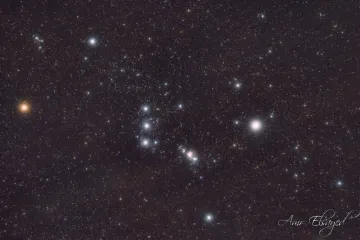
When you observe a star that is both big-looking and bright, you are seeing the cumulative result of distance, age, and visual processing. To gain a deeper appreciation, try to mentally decompose the appearance based on color, which provides the best clue to its true nature.
If the very bright star is intensely blue or white (like Sirius or Rigel), you are seeing either a very massive, young star very close by, or a massive, luminous star relatively far away.
If the bright star appears distinctly orange or red (like Betelgeuse or Arcturus), you are almost certainly looking at a star that is intrinsically enormous—a giant or supergiant that has swelled up at the end of its life, compensating for its age and distance with sheer physical bulk.
Here is one way to apply this knowledge to refine your viewing experience: notice that the brightest stars are typically not the visibly reddish ones. The top few brightest stars (Sirius, Canopus, Vega) are white or blue-white, indicating they are likely main-sequence stars or young giants whose brightness is heavily reliant on closeness. A truly massive, old red supergiant like Betelgeuse appears lower on the list because, astronomically speaking, 550 light-years is a significant gulf to bridge, even for a star 100,000 times as luminous as the Sun. The fact that it still breaks into the top 10 visible stars is a testament to its gargantuan size.
For the observer, this means that perceived size is not a reliable indicator of actual size. If you see a star that seems slightly bloated but is visually white, its apparent size is likely due to the Airy disc effect combined with its relative closeness. If you see a star that is visibly larger and colored orange/red, you are seeing an old giant that is succeeding in being both physically large and sufficiently near to outshine thousands of smaller, dimmer, main-sequence stars that reside in the nearer galactic neighborhoods.
Ultimately, when a star seems "big and bright," it means its light stream has overcome the odds—either by being a stellar neighbor making a brief, bright appearance on the cosmic stage, or by being a truly immense, evolved giant whose fiery death process is only now reaching our ancient eyes. The light that reaches you is a combination of its mass, its age, and the simple, unyielding tyranny of the distance between it and your telescope.
#Videos
STAR BRIGHTNESS EXPLAINED - YouTube
What Determines the Brightness & Size of Stars? - YouTube
Related Questions
#Citations
STAR BRIGHTNESS EXPLAINED - YouTube
When viewing the night sky, are the brightest stars usually the ones ...
The brightest stars in the sky: A guide - Space
Why do brighter stars/planets appear physically larger?
Star Basics - NASA Science
List of brightest stars - Wikipedia