What bright star is in the west from Earth?
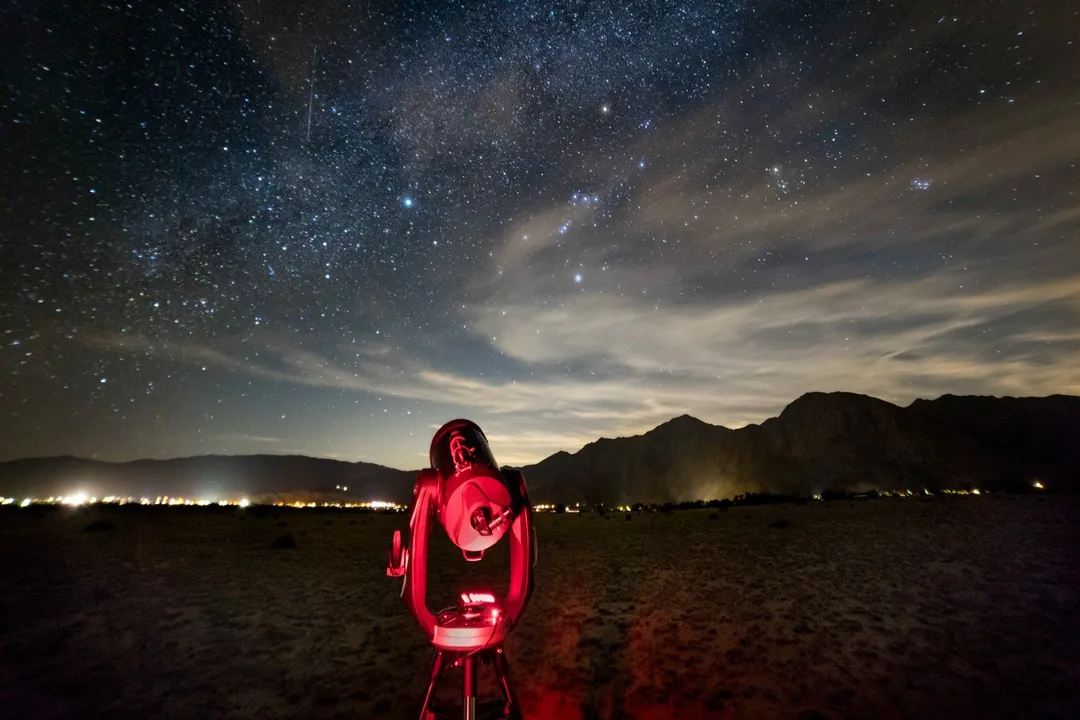
The brilliant, steady light appearing in the western sky shortly after the sun dips below the horizon often causes wonder, leading many to ask what this intense "star" is. If you have noticed an object shining with a consistent, unwavering brilliance that outshines every true star in its vicinity, you are most likely witnessing the planet Venus. While commonly called the "Evening Star," this celestial beacon is not a star at all but our neighboring planet, renowned for its spectacular visibility from Earth.
# Brightest Object
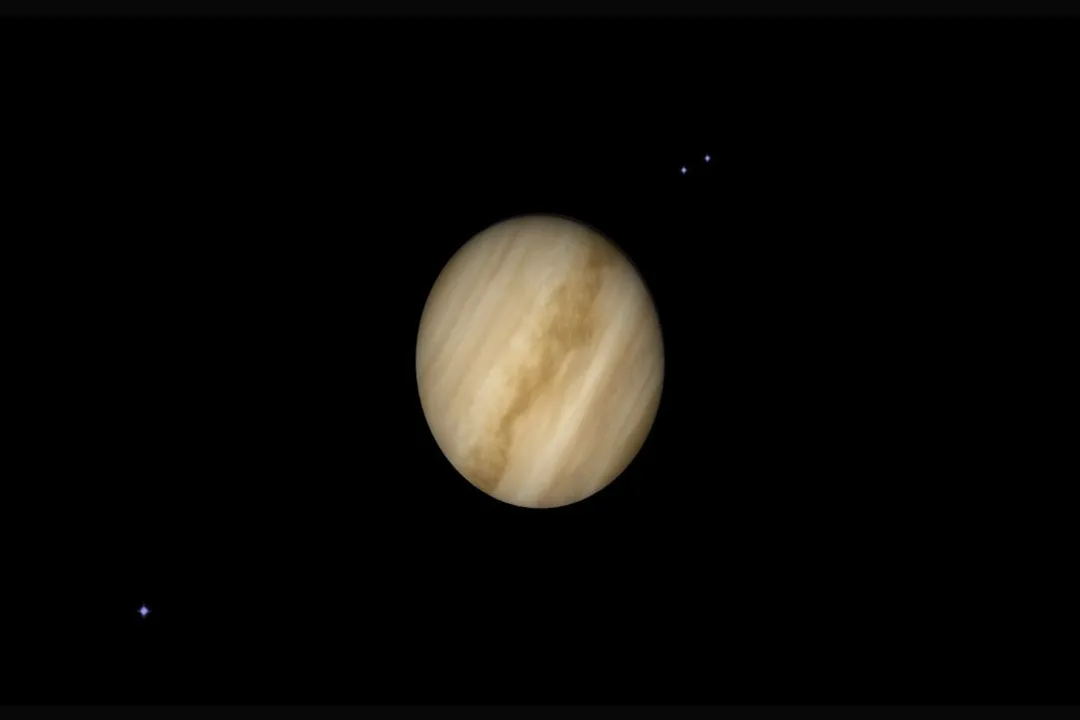
The sheer intensity of this light source is what sets it apart from the distant pinpricks of starlight. Venus is recognized as the brightest planet in our Solar System, second only to the Moon among all natural objects visible in the night sky. The Sun remains, by far, the brightest object at an apparent magnitude of approximately $-26.78$.
When Venus is at its most radiant, its apparent magnitude can plummet to about $-4.92$. To put this extreme brightness into perspective, we must understand the astronomical magnitude scale. This scale is inverted; lower or more negative numbers signify greater brightness. For comparison, the brightest true star in our sky, Sirius, shines at a magnitude of around $-1.46$.
The difference in magnitude between Venus at its brightest and Sirius is significant. A difference of one magnitude corresponds to a factor of about 2.5 times in brightness. Because the scale is logarithmic, the difference between $-4.92$ and $-1.46$ is $3.46$ magnitudes. This means that the brightest Venus is roughly times brighter than Sirius, equating to about 40 times brighter [original insight: The logarithmic nature of the apparent magnitude scale () means that Venus, at its peak magnitude of $-4.92$, is approximately 40 times brighter than Sirius ($-1.46$ mag), the second-brightest natural light source in the night sky. Stars visible to the naked eye typically top out around $+6$, meaning the difference between Venus and even the dimmest visible stars is immense]. This overwhelming luminosity is why the planet is so frequently mistaken for an unusually bright star or even a UFO.
# Physics of Brilliance
The dazzling nature of Venus is not due to its size, although it is the closest planet to Earth, but primarily a function of its atmosphere and its proximity. Venus is shrouded by a thick, dense atmosphere composed mostly of carbon dioxide and sulfuric acid clouds. These clouds act as an extremely efficient reflective surface.
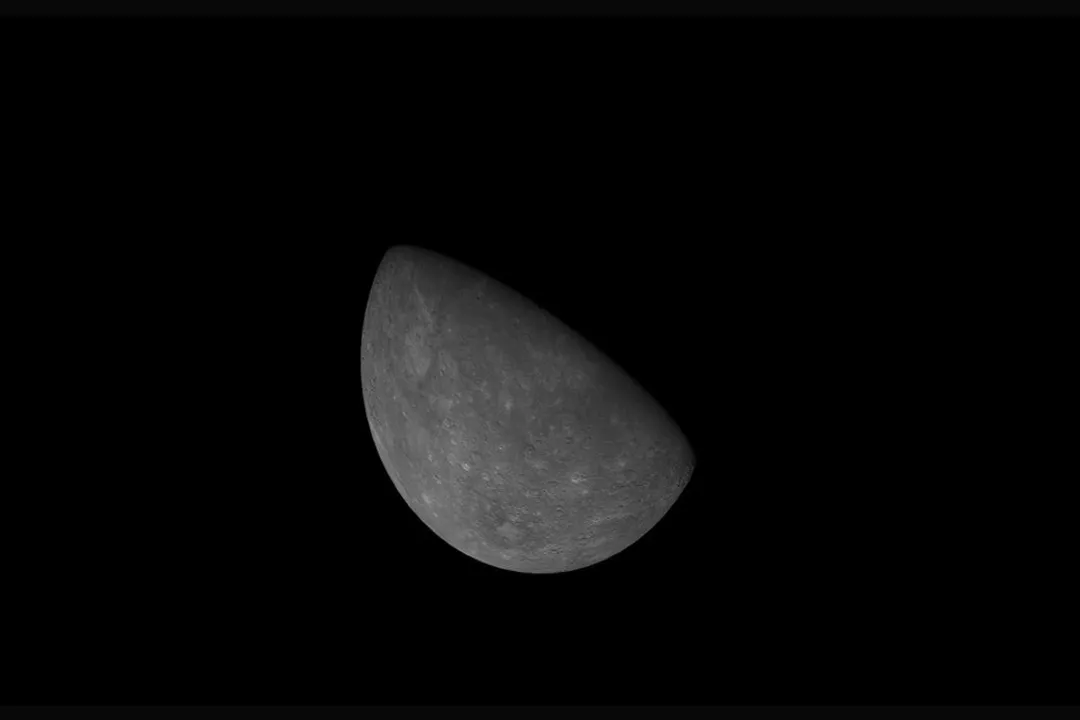
This reflectivity is quantified by the term albedo. Venus boasts an albedo of 0.7, which means that about 70% of the sunlight that strikes its cloud tops is reflected back out into space, ready to travel toward Earth. While this is high, it is worth noting that even Mercury has a higher albedo depending on the measurement system, but Venus's close approach to us overcomes any minor differences in reflectivity compared to other solar system bodies.
The location of Venus in the sky relative to the Sun dictates when and how we see it. It orbits closer to the Sun than Earth does, completing one orbit in about 225 Earth days. This tight orbit means Venus is never seen far from the Sun in our sky, resulting in it appearing either in the west shortly after sunset (the Evening Star) or in the east shortly before sunrise (the Morning Star).
# Orbital Mechanics
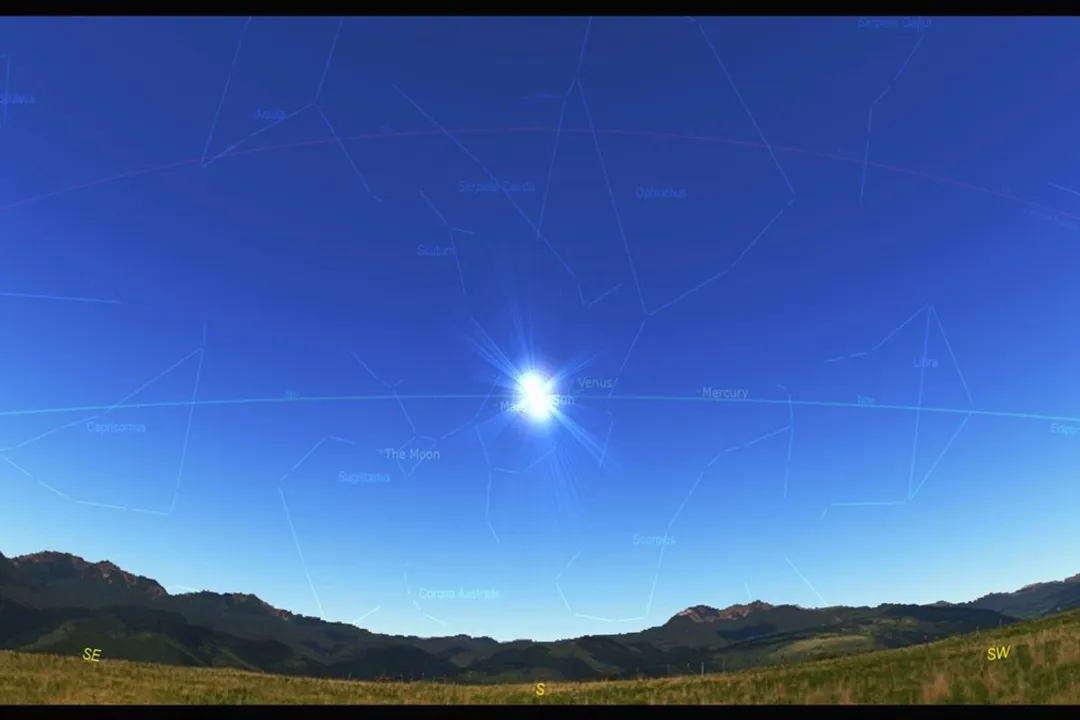
The period when Venus is most spectacular in the evening sky occurs when it reaches its maximum elongation. Elongation describes the angular distance between Venus and the Sun as viewed from Earth. When Venus reaches its maximum elongation, it is at its greatest apparent separation from the Sun in the sky, making it easiest to spot as it sets hours after the Sun has gone down. For instance, at one point, Venus was about 70 million kilometers from Earth and set four hours after sunset.
It is a common misconception that Venus shines brightest when it is at its absolute closest point to Earth, known as inferior conjunction. During inferior conjunction, Venus passes directly between the Earth and the Sun. While this is the minimum distance—as close as 42 million kilometers—we cannot observe it well for two key reasons. First, the Sun’s glare completely washes it out. Second, and perhaps more importantly for observation, at inferior conjunction, we are viewing the planet’s night side; its illuminated dayside is facing the Sun, away from us.
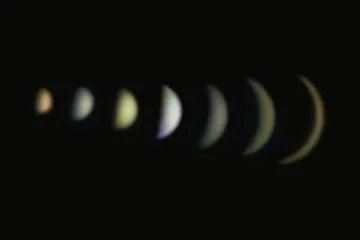
Therefore, the brightest views happen when the planet is close to Earth and we see a large illuminated portion of its dayside. At maximum elongation, however, we only see a crescent, meaning only a fraction of its surface is illuminated from our perspective. For example, one observation noted that when Venus was near maximum elongation, only 37% of its visible disc was illuminated, dropping to 26% shortly after. Even with only a portion of the day side visible, the sheer reflective power of the cloud deck ensures its overwhelming brightness.
The visibility period of Venus changes predictably due to its rapid orbit. Observers might notice it dominating the western sky for weeks or months, only for it to eventually sink into the glare of the Sun, becoming temporarily unobservable, before re-emerging as the Morning Star in the east. For example, one specific period noted Venus being lost in the dawn twilight and disappearing well before the end of December, only to begin appearing low in the western evening sky again after late February. This continuous shifting between being an evening object and a morning object, dictated by its quick 225-day lap around the Sun, is a defining characteristic of viewing Venus.
# Distinguishing from Stars
Observing the sky can present challenges, especially distinguishing between a planet like Venus and a true star, as both appear as points of light to the naked eye. While Venus is dazzling, actual stars exhibit a distinct behavior that planets do not: twinkling [cite: Reddit 2].
Stars are incredibly distant balls of plasma, and their light must travel immense distances before reaching us. As this light passes through Earth’s turbulent atmosphere, atmospheric distortion causes the star's apparent position and brightness to shift rapidly, which we perceive as twinkling or scintillation [original insight: The 'twinkling' effect observed in stars is caused by atmospheric turbulence blurring the point source of light, but planets, being much closer, present as tiny disks to the atmosphere. This slightly larger angular size means that the blurring effect is averaged out across the visible surface, resulting in a steady, non-twinkling appearance, which is a reliable field test for observers]. Planets, being far closer to Earth, appear as miniature discs rather than point sources to our eyes, causing the atmospheric distortions to be smoothed out across their face, resulting in a steady, unwavering glow [cite: Reddit 2]. If the bright light in the west is rock-steady, it strongly suggests a planet, and given its superior brightness, it is almost certainly Venus.
Comparing the top stellar object, Sirius ($-1.46$ mag), to Venus ($-4.92$ mag) highlights the gap: Sirius is the brightest star, but Venus is nearly 40 times brighter in total light received.
# Other Bright Objects
While Venus is the usual suspect for a spectacular western beacon, especially after sunset, it is important to know what else might compete for attention. Jupiter, when near its closest approach to Earth or at high brightness, can also be a dominant sight, shining at magnitudes like $-2.6$. In certain periods, such as when Venus is lost in twilight, Jupiter can momentarily claim the title of the brightest starlike object in the evening sky. However, Venus’s maximum brightness of $-4.92$ eclipses even Jupiter’s best showing.
For the true star list, the top contenders are:
| Rank | Proper Name | Apparent Magnitude () | Spectral Type | Distance (light-years) |
|---|---|---|---|---|
| 1 | Sirius | $-1.46$ | A0mA1 Va | $8.6$ |
| 2 | Canopus | $-0.74$ | A9 II | $310$ |
| 3 | Rigil Kentaurus ( Cen) | $-0.27$ (Combined) | G2 V, K1 V | $4.34$ |
| 4 | Arcturus | $-0.05$ | K0 III | $37$ |
| 5 | Vega | (Variable) | A0 Va | $25$ |
Notice that even the top stars are significantly dimmer than the potential maximum of Venus. Furthermore, as the Wikipedia list notes, most stars appear bright because they are nearby, not because they are intrinsically luminous when compared to the true powerhouses in the galaxy. Sirius, for instance, is a mere $8.6$ light-years away, whereas stars like Deneb, which is far fainter in our sky, are thousands of light-years distant but intrinsically much more luminous.
When you look west after sunset and see that dazzling, steady light, take a moment to appreciate the close proximity and reflective atmosphere of Venus. It is an object within our own cosmic neighborhood, putting on a far brighter show than any star in the distant heavens can muster.
Related Questions
#Citations
List of brightest stars - Wikipedia
Have You Seem A Bright Star to the West Shortly After Sunsets ...
The brightest planets in December's night sky: How to see them (and ...
Why is Venus so bright in the night sky? - Cool Cosmos
That bright light you can see in the western sky? That's Venus