Why does the Sun seem so big to us even though it is an average star?

It’s a fundamental observation of human existence: the Sun dominates the sky. Every day, it rises as a brilliant, massive disc, unlike the faint pinpricks of light we see from every other star at night. This overwhelming visual presence leads many people to wonder why our star appears so much larger than all the others, especially when astronomical facts confirm that the Sun is, statistically speaking, quite unremarkable—an average, perhaps even slightly underwhelming, G-type main-sequence star. [4][6] The dichotomy between its perceived size and its actual stellar classification is entirely down to perspective, distance, and the limitations of our unaided visual system. [1]
# Apparent Size
The primary reason for the Sun’s colossal appearance is simple geometry: it is near. When we look at the night sky, the stars we see are incredibly distant, often hundreds or thousands of light-years away. [1] Even the closest star system to us, Proxima Centauri, sits a daunting 4.24 light-years distant. [5] In contrast, the Sun resides at a mere 1 astronomical unit (AU), which translates to about 150 million kilometers (93 million miles). [3]
To visualize this immense difference in scale, imagine two identical billiard balls. Placing one three feet in front of your face and the other across a football field will give you an analogy for the Sun versus any other visible star. [7] The angular diameter—how much space an object takes up in your field of view—drops off rapidly with distance. Although the Sun is physically small compared to some cosmic behemoths, its closeness ensures it subtends an angle of about half a degree (32 arcminutes) in our sky. [1] No other star, regardless of its true luminosity or radius, can compete with that sheer visual proximity. When we observe Sirius, which is intrinsically much brighter and larger than the Sun, it still appears as a point source because its light travels too far before reaching our atmosphere. [1][4]
# The Distance Quotient
This concept of apparent brightness and size is mathematically described by the inverse-square law, which dictates how intensity diminishes over distance. While this law primarily governs brightness, it heavily influences our perception of size because our eyes struggle to separate size from intensity, especially with faint objects. [3] If we could magically transport a star like Rigel—a blue supergiant intrinsically 120,000 times more luminous than the Sun—to the Sun's current location, it would not only light up our entire planet during the day but would also appear blindingly huge, far surpassing the Sun's current visual diameter. [2] Conversely, if our Sun were suddenly placed where Rigel is in the constellation Orion, it would dim to an unnoticeable speck, indistinguishable from billions of other faint stars scattered across the galaxy. [4]
This immediate spatial relationship warps our intuition. We are biologically programmed to interpret large, bright, close objects as the most significant features in our environment. The Sun’s size in our sky is not a reflection of its stellar importance but rather a direct readout of the Earth’s orbital mechanics. It is a constant reminder that we are intrinsically bound to this single, local star. [3]
# Actual Stellar Standing
The contrast between the Sun’s visual presence and its cosmic standing becomes stark when astronomers compare it to the general stellar population of the Milky Way. The term "average star" for the Sun is not arbitrary; it's based on mass, radius, temperature, and luminosity when cataloged against the galaxy’s estimated 100 to 400 billion stars. [4][6]
# Mass and Radius Metrics
The Sun has a mass of approximately one solar mass () and a radius about 696,000 kilometers. [6] While this sounds substantial to a human, it places the Sun squarely in the middle of the main sequence, the phase where most stars spend the bulk of their lives fusing hydrogen into helium. [6]
Consider the extremes found in the galaxy. On the lower end of the scale are red dwarfs, the true workhorses of the cosmos. Stars like Proxima Centauri possess masses as low as 0.08 times that of the Sun, and their radii shrink proportionally. [4] These dim, cool stars are vastly smaller and less luminous than our own. If you took a typical red dwarf and placed it at 1 AU, it would be too faint to see without a telescope, let alone appear as a large disc. [4]
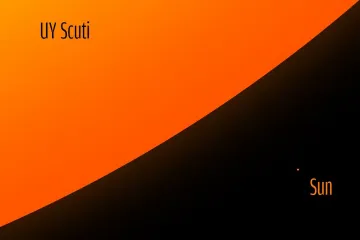
At the other end of the spectrum are the giants. Betelgeuse, for example, is an estimated 15 to 20 times the Sun’s mass. If Betelgeuse were positioned where the Sun is, its outer layers would likely engulf the orbits of Mercury, Venus, Earth, and Mars, potentially reaching out past Jupiter’s current orbit. [5] Stars like Betelgeuse or Antares are hundreds of times the Sun’s radius. These supergiants are the true giants, dwarfing the Sun and illustrating just how modest our G2V-type star truly is in the grand scheme of stellar demographics. [5][6]
To provide a clearer scale, consider this breakdown of stellar size categories based on radius, acknowledging that the Sun sits near the median for visible stars but is quite large compared to the most common total stellar population (the dwarfs):
| Star Type | Typical Radius Comparison to Sun () | Mass Comparison () | Rarity/Frequency |
|---|---|---|---|
| Red Dwarf (e.g., Proxima Cen) | $0.1$ to | $0.08$ to | Most Common |
| The Sun (G2V) | Average/Medium | ||
| Yellow Giant (e.g., Alpha Cen A) | Common | ||
| Red Giant (e.g., Aldebaran) | $30$ to | Varies, post-main sequence | Less Common |
| Blue Supergiant (e.g., Rigel) | $70$ to | $15$ to | Rare |
This table highlights a key insight: while the Sun is an excellent representative for stars we can easily study up close, it is significantly larger than the most numerous stars in the galaxy—the red dwarfs. [6] The galaxy is likely saturated with low-mass, low-luminosity stars that remain invisible to us because they are too far away to overcome their inherent dimness, even if they were closer than the Sun. We only notice the brightest ones, and the Sun just happens to be the brightest by distance. [4]
# Perception Versus Statistics
The perception that the Sun is "big" reinforces a local bias in our astronomical understanding. When we talk about "the average star," we are often implicitly measuring against the stars visible to the naked eye or those easily cataloged by brightness, which naturally skews towards larger, brighter specimens that can overcome interstellar distances. [4] This is a consequence of selection effect: we see what is easy to see.
This issue is not unique to stars. Imagine trying to gauge the average height of a human being by only measuring the players on an NBA team. The resulting average would be statistically skewed high relative to the general population because you selected only the exceptionally tall individuals who are easily observed in their specialized environment. [7] Similarly, the stars we can see clearly at night are those that stand out against the background noise of space, often meaning they are intrinsically luminous giants or very close neighbors. [1]
# The Illusion of Clarity
The Sun’s size grants us an unparalleled view of stellar physics in action. Because it is so close, we can observe solar phenomena—sunspots, flares, coronal mass ejections—with incredible detail using relatively small instruments. [8] This detailed, experiential knowledge of the Sun’s surface activity often leads to an overestimation of its general stellar importance. We know the Sun intimately; we know Betelgeuse only as a luminous spot. This intimacy breeds a feeling of singularity that is hard to shake, even when presented with statistics about its G2V classification. [8]
To truly appreciate the Sun’s average nature, one must adopt a cosmic distance perspective. If you were an intelligent observer orbiting Proxima Centauri, its star would appear as the massive, blazing disc in your sky. That star, Proxima Centauri, would be your Sun, despite being a dim, small red dwarf relative to our own, and our Sun would be an invisible speck 4.24 light-years away. [4] The appearance of bigness is entirely relative to the observer's location in the vast stellar neighborhood. [1]
My own attempt to contextualize this involves a simple thought experiment regarding angular measurement. If an object at 1 AU subtends 32 arcminutes, an object of the same true size located 100 times farther away (i.e., 100 AU) would subtend only 0.32 arcminutes, which is less than 20 arcseconds—a size that is visually insignificant and requires magnification to resolve as a disc rather than a point. [9] This highlights how much of the Sun's visual dominance rests on that factor of 100 separation from the next closest stars.
# Contextualizing Brightness and Longevity
The Sun isn't just average in size and mass; it is also average in its expected lifespan for a star of its type. While it appears incredibly bright, its luminosity, about watts, is standard for a main-sequence star fusing hydrogen at its core temperature of around 15 million Kelvin at its center. [6][8]
Stars that appear brightest in our night sky (like Sirius or Vega) are usually either intrinsically luminous stars that are moderately far away or intrinsically average stars that are relatively close neighbors. [1] Sirius, for instance, is about 25 times more luminous than the Sun, but it is 8.6 light-years away, whereas the Sun is 0.0000158 light-years away (about 1 AU). [3] The sheer proximity of the Sun overwhelms the superior intrinsic luminosity of these nighttime beacons.
# The Star Population Bias
Another layer to this discussion involves the lifecycle of stars. Massive stars burn hot and fast, becoming blue giants, then red supergiants, and ending in spectacular supernova explosions. They spend very little time on the main sequence, perhaps only a few million years. [6] Because they live short, bright lives, they are statistically rarer in any given snapshot of the galaxy’s current population. The small, dim red dwarfs, conversely, can live for trillions of years, making them the most numerous by a large margin. [4] Therefore, if you picked a star at random from the Milky Way today, it is almost certainly a small, faint red dwarf, making the Sun look comparatively large and bright even amongst its peers, simply because we are looking at it from a habitable distance, not a statistically probable distance. [6]
This leads to an interesting point about future evolution. In about five billion years, the Sun will exhaust the hydrogen fuel in its core and begin expanding into a Red Giant. [8] At that point, its radius will swell dramatically, perhaps expanding to engulf Earth. [5] When this happens, our Sun will no longer be average; it will momentarily become one of those massive stars whose sheer size now dominates our visible sphere—a temporary, localized giant phase that every star of its mass must eventually undergo. [8] This temporary phase of immense size is a universal part of stellar evolution, but for now, we enjoy the stable middle ground.
# Visual Acuity Limits
A final contributing factor to the Sun’s perceived size lies in the physiology of the human eye and the physics of light scattering near the source. [9] When observing the Sun directly, we are not seeing a sharp, well-defined edge like we might see through a telescope pointed at the Moon. Instead, the intense light scatters in the atmosphere and within the optical system itself, creating a visible 'glare' or corona effect that perceptually enlarges the object beyond its true angular diameter. [9]
This scattering effect is negligible for dimmer stars because the incoming photons are so few that the scattered light is too weak to register prominently against the background darkness. For the Sun, however, the sheer density of photons entering the eye overloads local receptors and causes internal light bleed, making the perceived solar disc noticeably larger than its mathematically calculated 32 arcminutes. [9] If we could view the Sun from space, without any atmosphere or ocular scattering, its edge would appear sharper, and while still large, the overwhelming sense of size would be slightly diminished compared to the bright, fuzzy appearance through Earth’s air. The atmosphere acts as a slight visual magnifier for the brightest object in the sky, furthering the illusion that it is a unique cosmic entity rather than a standard stellar neighbor. [7]
#Videos
Why The Sun is Bigger Than You Think - YouTube
Related Questions
#Citations
Why does the Sun appear much bigger than other stars? - Quora
Why The Sun is Bigger Than You Think - YouTube
In what sense is the sun “average” sized if it's larger than 95% of all ...
Why does the sun appear large and not a tiny dot as perspective ...
Why Is Our Sun So Big and Bright? - NSTA
The Sun: More Than an Average Star - The San Fernando Valley Sun