What component of a star's motion is measured by the Doppler shift, known as radial velocity?
Answer
Motion directly along the line of sight connecting the star and the observer.
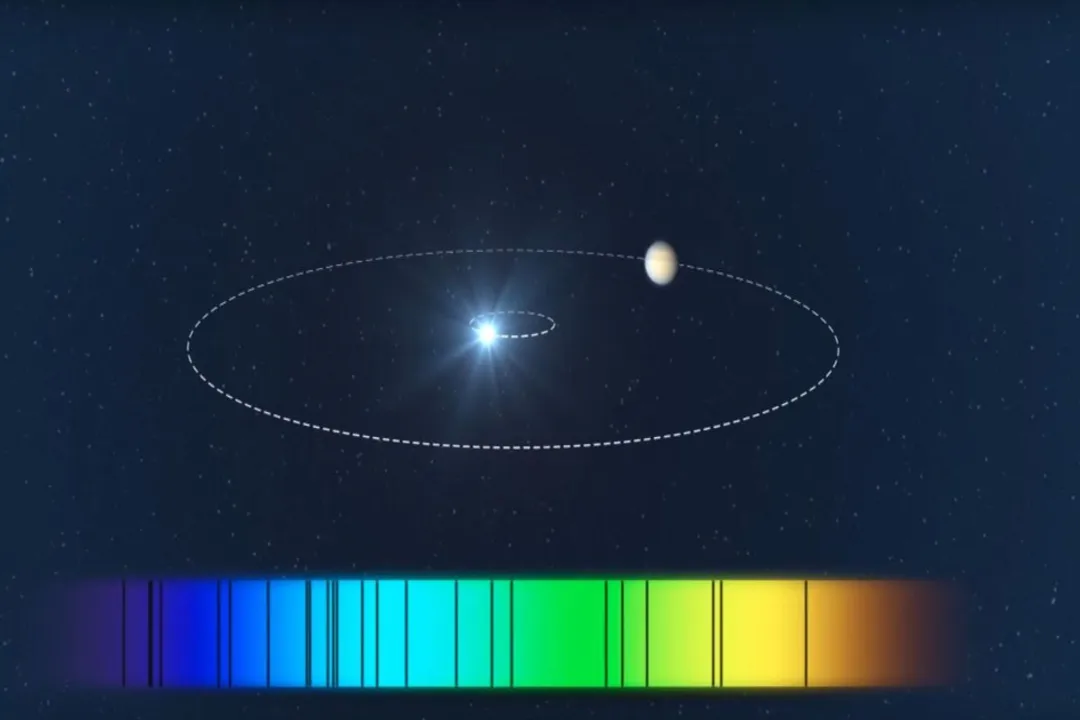
The Doppler effect measurement yields the radial velocity, which specifically quantifies the motion occurring directly along the line of sight between the star and the observer. This means it measures how quickly the distance between the two points is increasing or decreasing. It does not capture any motion that occurs perpendicular to this line of sight. That perpendicular motion, referred to as proper motion, must be calculated separately by tracking the star's angular position across the sky over extended periods, such as decades or centuries.
#Videos
Light and Motion: the Doppler Effect - YouTube
Related Questions
What physical effect determines if a star is racing toward or receding from Earth?What does observing a blueshift in a star's spectrum definitively indicate about its motion relative to Earth?What physical feature forms the unique spectral fingerprint analyzed by astronomers?What component of a star's motion is measured by the Doppler shift, known as radial velocity?If a star is moving away from Earth, what happens to the light waves it emits?What is the local gravitational significance of detecting a blueshift from the Andromeda Galaxy?How is the fractional change in wavelength ($
rac{\Delta\lambda}{\lambda_0}$) mathematically related to the star's radial velocity ($v$)?What is the primary observational evidence cited regarding the vast majority of distant galaxies?What is required to precisely measure the incredibly small wavelength shifts for nearby stars?How does the 'wobble' of a star due to an orbiting planet cause detectable spectral changes?