What physical effect determines if a star is racing toward or receding from Earth?
Answer
The Doppler Effect
The determination of whether a star is approaching or receding relies fundamentally on the Doppler Effect. This principle, analogous to the change in pitch heard when an ambulance passes by, applies to light waves as well as sound waves. When a source of waves, like a star, moves toward an observer, the emitted light waves are compressed, resulting in a shorter wavelength. Conversely, if the star is moving away, the light waves are stretched, leading to a longer wavelength. This shift in the observed wavelength is the core method used for calculating the star's radial velocity.
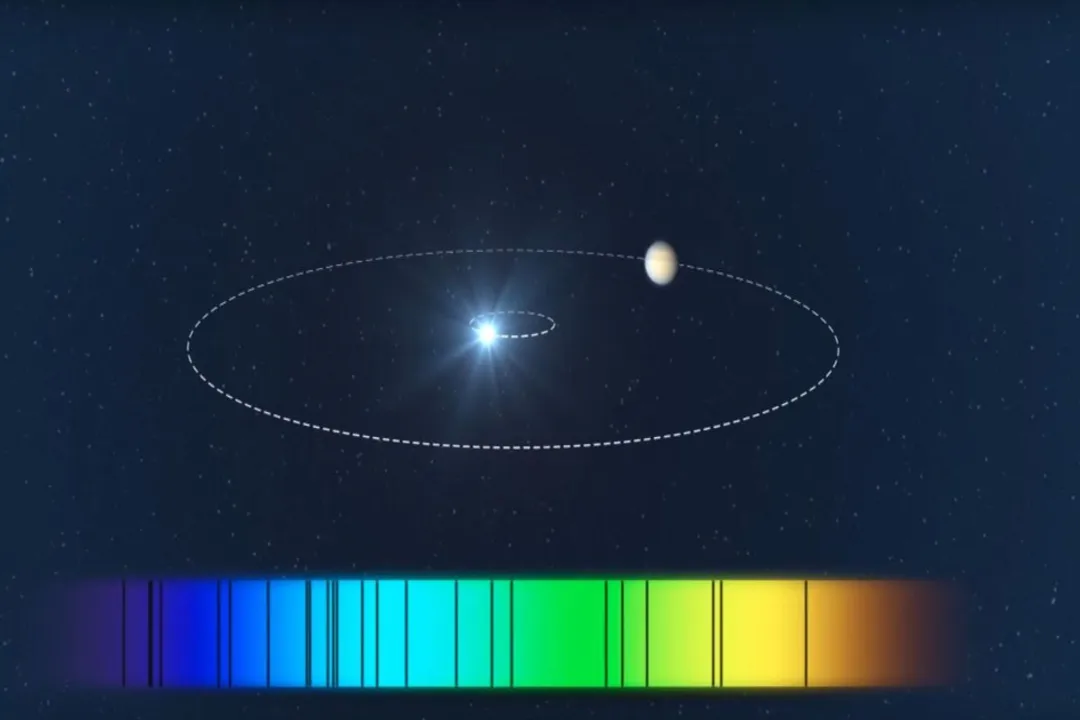
#Videos
Light and Motion: the Doppler Effect - YouTube
Related Questions
What physical effect determines if a star is racing toward or receding from Earth?What does observing a blueshift in a star's spectrum definitively indicate about its motion relative to Earth?What physical feature forms the unique spectral fingerprint analyzed by astronomers?What component of a star's motion is measured by the Doppler shift, known as radial velocity?If a star is moving away from Earth, what happens to the light waves it emits?What is the local gravitational significance of detecting a blueshift from the Andromeda Galaxy?How is the fractional change in wavelength ($
rac{\Delta\lambda}{\lambda_0}$) mathematically related to the star's radial velocity ($v$)?What is the primary observational evidence cited regarding the vast majority of distant galaxies?What is required to precisely measure the incredibly small wavelength shifts for nearby stars?How does the 'wobble' of a star due to an orbiting planet cause detectable spectral changes?