How is the fractional change in wavelength ($ rac{\Delta\lambda}{\lambda_0}$) mathematically related to the star's radial velocity ($v$)?
It is equated to the radial velocity ($v$) divided by the speed of light ($c$).
The quantification of the Doppler shift relies on a precise mathematical relationship derived from the physical principles involved. The fractional change in wavelength, calculated as the difference between the observed wavelength ($\lambda_{obs}$) and the rest wavelength ($\lambda_0$) divided by the rest wavelength ($\frac{\Delta\lambda}{\lambda_0}$), is directly proportional to the star's speed along the line of sight ($v$) relative to the speed of light ($c$). Therefore, the relationship established is $\frac{\Delta\lambda}{\lambda_0} = \frac{v}{c}$, allowing scientists to solve for the radial velocity when the speed of light is known.
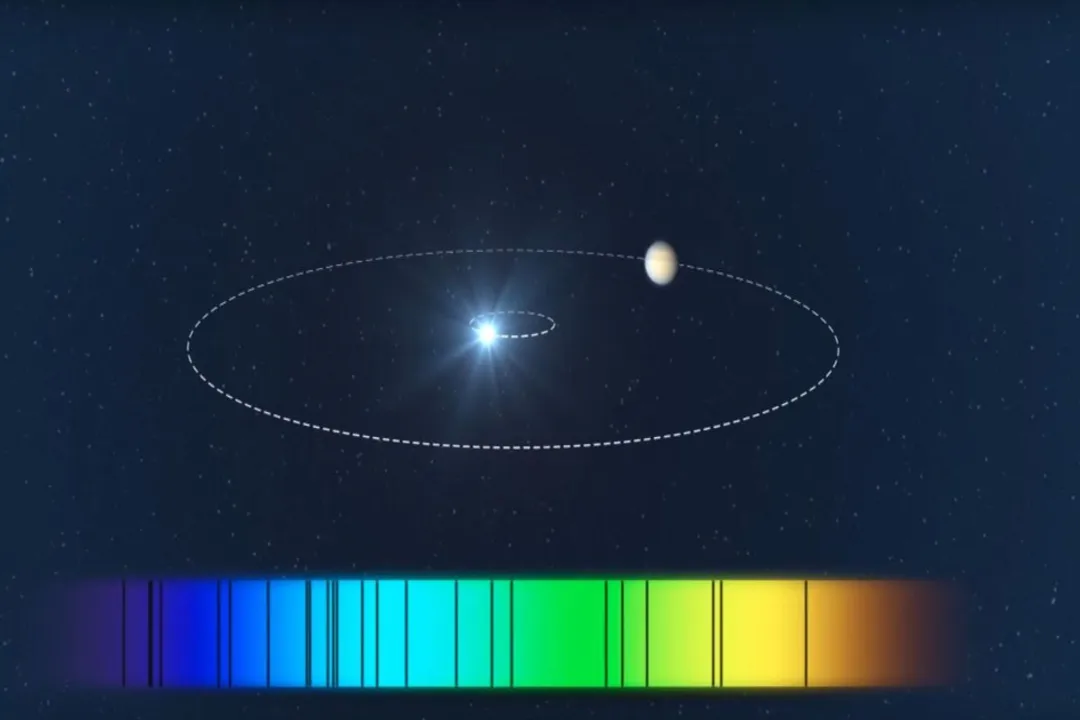
#Videos
Light and Motion: the Doppler Effect - YouTube