What sudden ignition event powers a low-to-mid mass star like the Sun after exhausting core hydrogen, leading toward the horizontal branch?
Answer
Helium flash
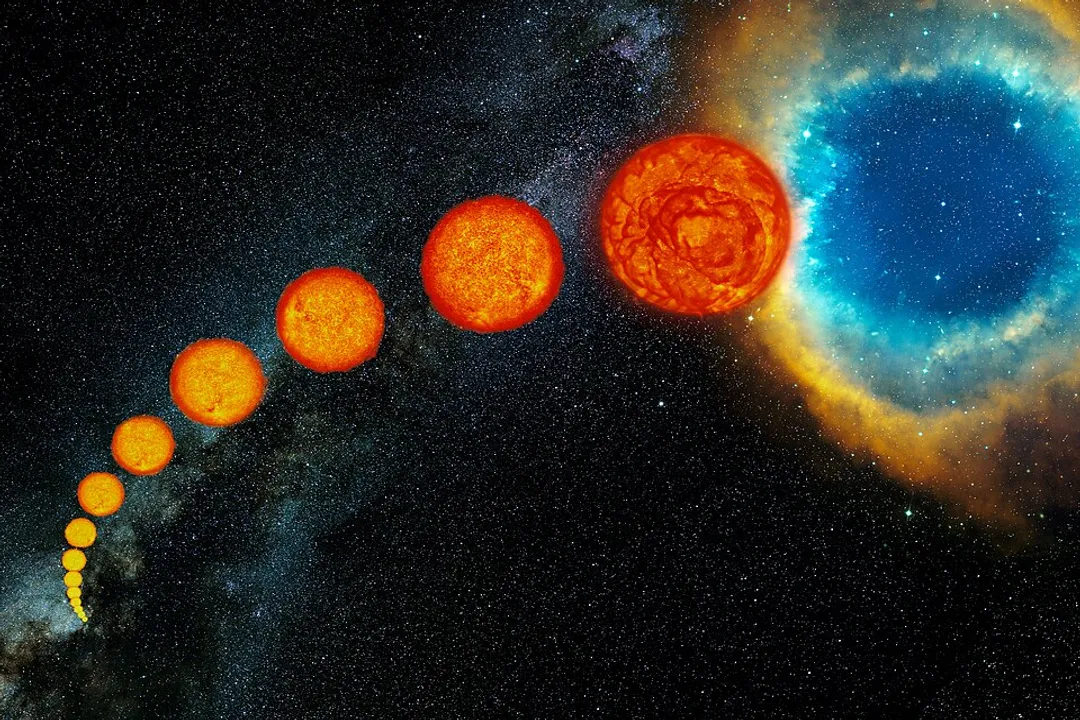
When a low-to-mid mass star exhausts the hydrogen in its core, the inert helium ash causes the core to contract and heat up dramatically. For stars similar in mass to the Sun, this contraction eventually forces the helium nuclei to fuse into carbon, but this ignition occurs explosively and suddenly in what is termed the helium flash because the core is supported by pressure that does not increase linearly with temperature. After this rapid powering event, the star briefly stabilizes and proceeds to the horizontal branch phase, continuing its evolution until the core is converted into an inert carbon/oxygen structure, preceding the Asymptotic Giant Branch.
Related Questions
What fundamental property dictates the destiny and evolutionary pathway of any star?What phase follows gravitational collapse within a birth cloud, resulting in a baby star shrouded in dust?What precise force balance must a star achieve to leave core ignition and settle onto the main sequence?Why does the fuel consumption rate escalate so steeply with increasing stellar mass?What sudden ignition event powers a low-to-mid mass star like the Sun after exhausting core hydrogen, leading toward the horizontal branch?What specific pressure supports an Earth-sized White dwarf against gravitational collapse after the AGB phase?In a high-mass star, the catastrophic halt of energy generation occurs immediately after the core produces what element?What limit dictates whether a supernova remnant becomes a Neutron star or collapses into a Black hole?What specific process in a close binary system can push a White dwarf past its stability limit, causing a Type Ia supernova?Which variable star type is crucial for measuring cosmic distances due to its Period-Luminosity relation?