What precise force balance must a star achieve to leave core ignition and settle onto the main sequence?
Answer
Hydrostatic equilibrium
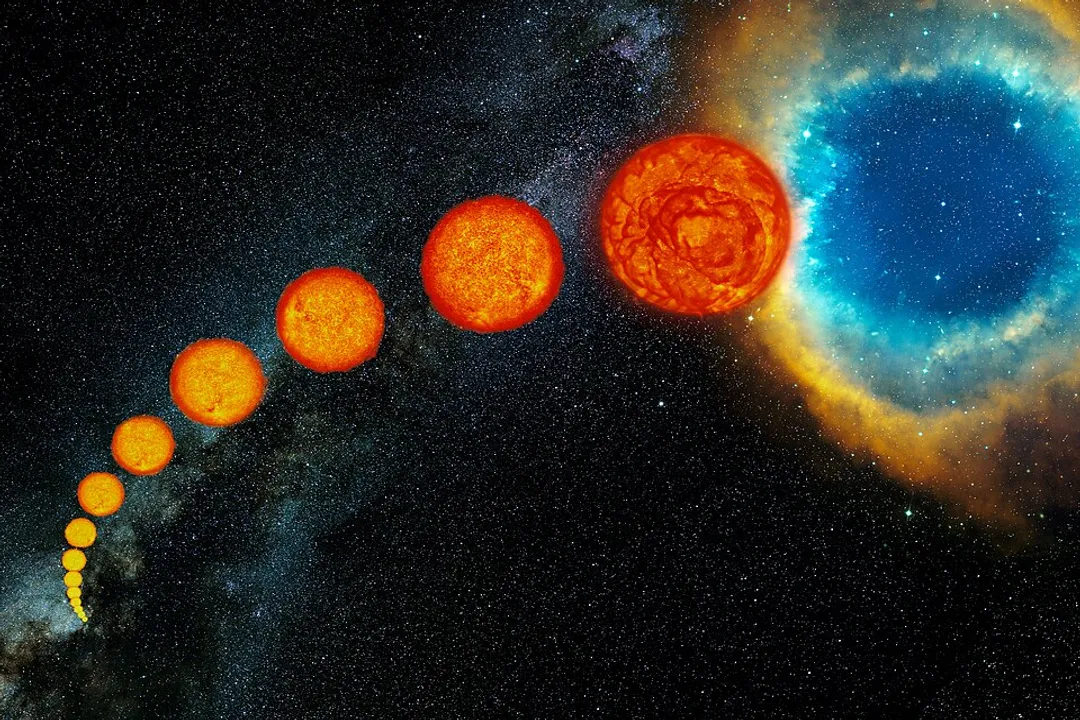
Hydrostatic equilibrium is the defining state of stability for a star during its longest phase of life, the main sequence. This equilibrium is established when the immense inward crushing force of the star's own gravity is perfectly counteracted by the massive outward pressure generated by the energy released from sustained nuclear fusion in the core. When these two opposing forces are balanced, the star maintains a constant size and stable energy output. If the balance is disturbed slightly—for example, if the core cools—gravity compresses it, raising the temperature and consequently speeding up fusion until the outward pressure restores the original balance.
Related Questions
What fundamental property dictates the destiny and evolutionary pathway of any star?What phase follows gravitational collapse within a birth cloud, resulting in a baby star shrouded in dust?What precise force balance must a star achieve to leave core ignition and settle onto the main sequence?Why does the fuel consumption rate escalate so steeply with increasing stellar mass?What sudden ignition event powers a low-to-mid mass star like the Sun after exhausting core hydrogen, leading toward the horizontal branch?What specific pressure supports an Earth-sized White dwarf against gravitational collapse after the AGB phase?In a high-mass star, the catastrophic halt of energy generation occurs immediately after the core produces what element?What limit dictates whether a supernova remnant becomes a Neutron star or collapses into a Black hole?What specific process in a close binary system can push a White dwarf past its stability limit, causing a Type Ia supernova?Which variable star type is crucial for measuring cosmic distances due to its Period-Luminosity relation?