What property dictates a star's surface temperature, subsequently influencing its color appearance?
Answer
Its mass
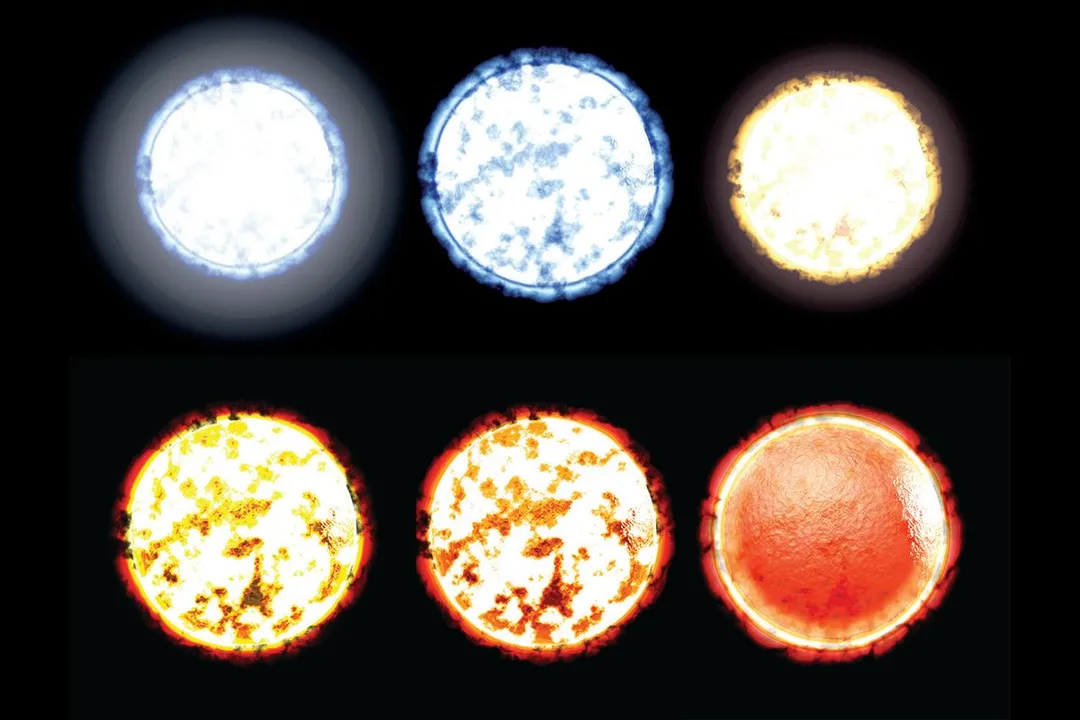
The intrinsic surface temperature of a star is almost entirely governed by its initial mass. Stars with greater mass generate substantially higher core pressures and, as a direct result, sustain much more rapid and intense nuclear fusion rates. This elevated energy generation pushes significantly more heat outward, leading to much higher surface temperatures, which manifest as a blue or blue-white color. Conversely, lower-mass stars experience less intense core conditions, burn their fuel more slowly, remain cooler, and thus display a reddish hue.
#Videos
The Colors of Stars - YouTube
Related Questions
What physical property is a direct and precise indicator of a star's perceived color?What is the approximate surface temperature range for cool stars that radiate most intensely in redder wavelengths?Why does the Sun appear yellow from Earth despite its peak radiation being in the green portion of the visible spectrum?What does a B–V color index calculation resulting in a small or negative number signify about a star?What property dictates a star's surface temperature, subsequently influencing its color appearance?Which stellar classification letter represents the coolest stars, often appearing red, in the sequence O, B, A, F, G, K, M?What surface temperature is stated for the red supergiant Betelgeuse, which results in its orange appearance?Why are faint stars perceived as white, regardless of their true physical color like blue?What observational aid, involving a telescope, can enhance the visual perception of a star's intrinsic hue?What specific binary star system is cited as providing an immediate side-by-side comparison of vastly different stellar colors?