How do scientists know how far away stars are?
Determining the true distance to a star is one of the most fundamental and challenging tasks in astronomy. Stars do not come equipped with built-in odometers, and since light travels at a fixed speed, simply measuring how bright a star appears isn't enough; we need to account for the immense distances involved, which cause light to dim dramatically according to the inverse square law. [4] To tackle this vast scale, scientists employ a tiered approach, often referred to as the cosmic distance ladder, where one reliable technique for nearby objects is used to calibrate a less direct technique for farther ones. [2][3]
# Nearby Triangulation
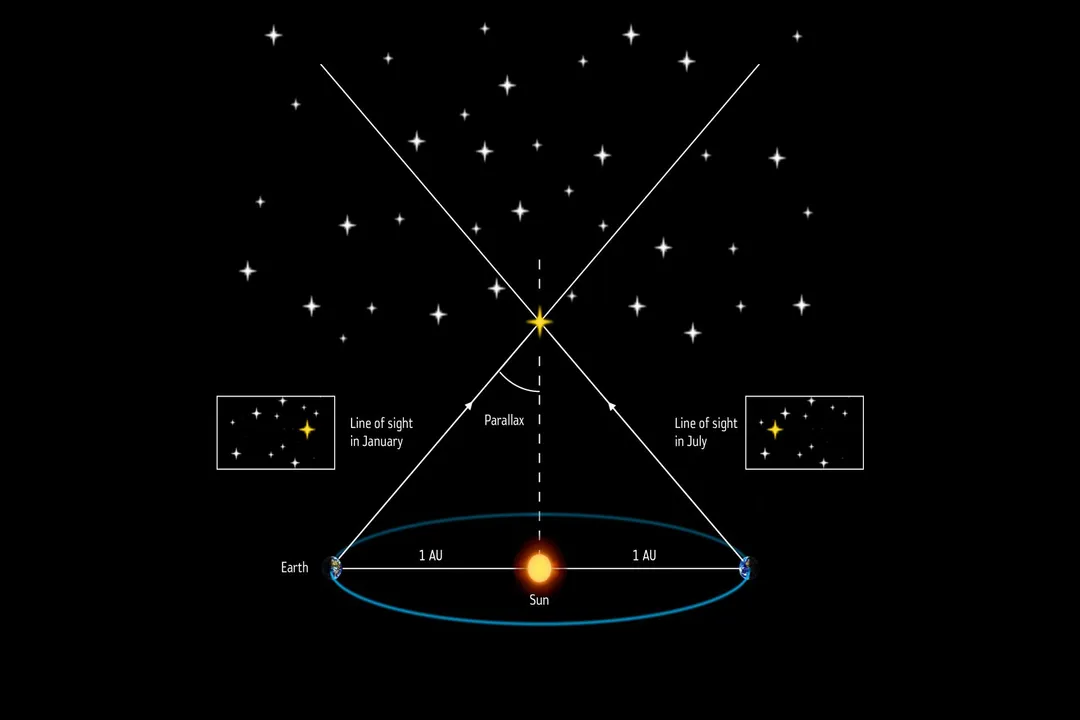
For the stars closest to us, astronomers rely on a purely geometric method: stellar parallax. [5][7] This technique uses the principle of triangulation, much like estimating the distance across a river by sighting an object from two different points on the bank. [5]
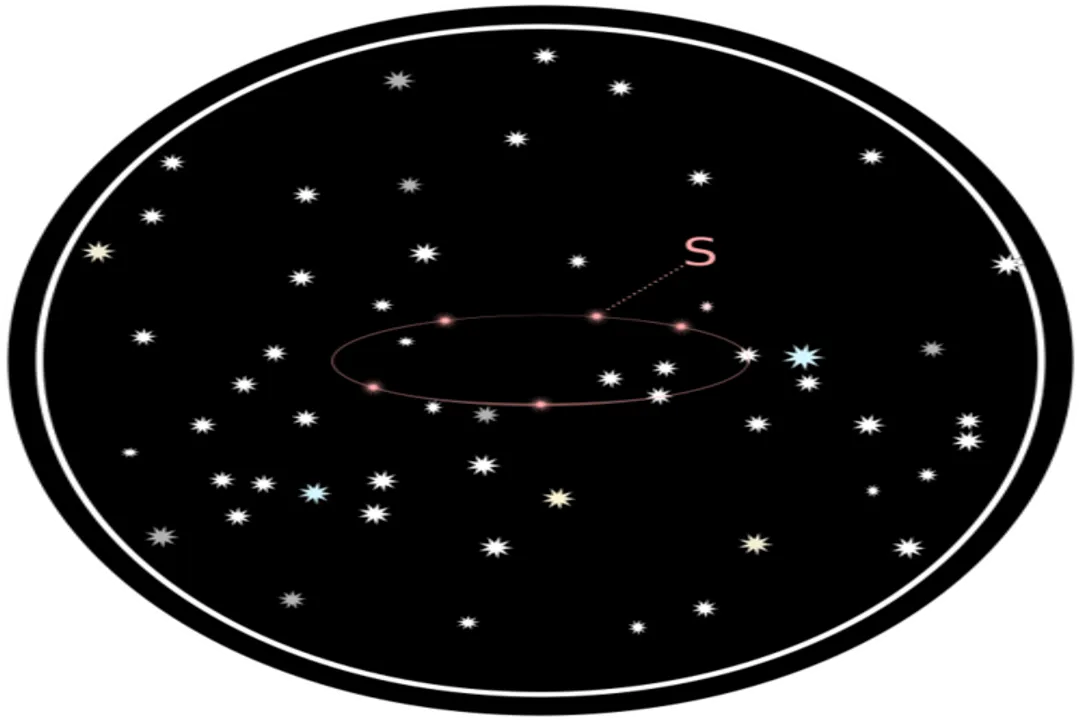
In the case of stars, the two sighting points are our own planet’s orbit around the Sun. [5] Scientists measure a nearby star’s position against the background of much more distant, stationary stars at one point in the year. Then, they wait about six months for Earth to move to the opposite side of its orbit—a baseline distance of roughly two Astronomical Units (about 300 million kilometers). [7][10] They measure the star's apparent shift against the background stars. [5][7]
This angular displacement is the parallax angle. [10] The closer the star, the larger this angle appears to be. [10] Astronomers measure this shift in tiny fractions of an arcsecond. [10] For instance, the nearest star system to our Sun, Proxima Centauri, exhibits a parallax angle of only about $0.77$ arcseconds. [7] The distance is then calculated using simple trigonometry, where the distance () is inversely proportional to the parallax angle (), typically expressed in parsecs when is measured in arcseconds: . [10]
The limitation of this direct trigonometric approach is precision. As the stars get farther away, the parallax angle shrinks until it becomes virtually impossible to measure reliably, even with the best modern instruments like the Gaia space observatory. [7] For stars beyond a few thousand light-years, the parallax angle becomes smaller than the measurable uncertainty, meaning we must rely on other methods to climb the next rung of the distance ladder. [2] The sheer accuracy required is astounding; consider that one arcsecond is th of a degree. To measure a star 100 parsecs away, you need to detect an angle $100$ times smaller than that, forcing instrument designers to account for every tiny vibrational influence in their hardware.
# Intrinsic Brightness
Once parallax falls short, astronomers shift to methods based on the true power of a star or stellar event, known as its absolute magnitude or intrinsic luminosity. [3][4] If you know exactly how bright an object truly is, you can compare that known brightness to how dim it appears from Earth (apparent magnitude) to determine the distance. [4] This relationship is the foundation for all "standard candle" techniques.
# Pulsating Markers
One of the most reliable standard candles involves a specific class of aging stars called Cepheid variables. [3] These stars physically expand and contract in a regular cycle, causing their brightness to fluctuate predictably. [3] Crucially, in the early 1900s, Henrietta Swan Leavitt discovered a direct relationship between a Cepheid’s pulsation period and its true luminosity: the longer the period, the brighter the star is intrinsically. [3]
By measuring how quickly a distant Cepheid brightens and dims over days or weeks, astronomers know its true wattage. Comparing that wattage to the received light allows calculation of its distance. [3] This method is incredibly effective for measuring distances throughout our Milky Way galaxy and out to nearby galaxies whose individual stars we can still resolve. [3]
# Explosive Yardsticks
For measuring distances between galaxies—distances far too great for even Cepheids to be resolved clearly—we need something much brighter. This brings us to Type Ia supernovae. [3] These events are not individual stars; they are the catastrophic explosions of white dwarf stars that have accumulated too much mass from a companion star, pushing them over the Chandrasekhar limit and triggering a runaway fusion reaction. [3]
What makes them excellent standard candles is their remarkable consistency: because the explosion mechanism is always the same (the total mass detonating is nearly identical), the resulting peak absolute luminosity of the explosion is very uniform and incredibly high. [3] These brief, brilliant flashes can outshine entire galaxies, making them visible across billions of light-years and allowing astronomers to test cosmological models on the grandest scales. [3]
# Cosmic Expansion
When we look at the most distant galaxies, no single star can be seen, and the light from any standard candle we might spot is too faint or too much of an extrapolation from calibration data. At this furthest scale, the primary tool relies on the fact that the universe itself is expanding. [3]
As space stretches between us and a distant galaxy, the light waves traveling through that space also get stretched. [3] This phenomenon is known as cosmological redshift. [3] The farther away a galaxy is, the faster it appears to be receding from us, and the more its light is shifted toward the red end of the spectrum. [3]
This forms Hubble’s Law, which states that recessional velocity is proportional to distance (). [3] The proportionality constant, , is the Hubble Constant, which represents the current rate of the universe’s expansion. To find the distance to the remotest quasars or galaxies, astronomers measure the redshift to find the velocity, and then use a well-calibrated value for to deduce the distance. [3] This entire measurement chain relies critically on the previous rungs: Cepheids and supernovae were used to calculate the accurate value of in the first place. [3]
| Measurement Technique | Basis of Measurement | Typical Range of Use | Critical Calibration Step |
|---|---|---|---|
| Stellar Parallax | Geometric angular shift | Nearby Stars (up to thousands of ly) | None (Pure Geometry) |
| Cepheid Variables | Pulsation Period vs. Luminosity | Within our Galaxy and Local Group | Calibrated by nearby Cepheids with measured parallax [3] |
| Type Ia Supernovae | Consistent peak explosion luminosity | Distant Galaxies (billions of ly) | Calibrated by Cepheids in nearby galaxies where both can be seen [3] |
| Redshift / Hubble's Law | Stretching of spacetime (Doppler effect) | Farthest Observable Universe | Requires accurate , determined by standard candles [3] |
The elegance of this method lies in its layered dependency. If the measurement of parallax for the nearest stars was slightly off, that small error would propagate up the ladder, causing the calculated distances to all Cepheids to be slightly incorrect, which in turn would skew the derived value of the Hubble Constant and make our measurements of distant galaxies inaccurate. [2] The effort to refine the measurement at the bottom—the parallax—is therefore foundational to understanding the scale of the entire cosmos.
#Videos
How Scientists Measure The Distance To Stars and Galaxies
Related Questions
#Citations
How are astronomers able to measure how far away a star is?
How can we tell how far away a star is or how old it is? - Reddit
How do astronomers measure distances to stars and galaxies?
How Do You Measure the Distance to the Moon, Planets, Stars and ...
Stellar Parallax - Las Cumbres Observatory
How Scientists Measure The Distance To Stars and Galaxies
What Is Parallax? - How Astronomers Measure Stellar Distance
How do astronomers measure the distance to a star or other ...
How do we measure the distance to stars? If we say a star is ... - Quora
Stellar parallax - Wikipedia