Is every galaxy a spiral?

The universe is populated by countless island universes, each containing billions of stars, and while the iconic, pinwheel shape of the Milky Way often dominates our mental image of a galaxy, the reality is far more varied. It is a common assumption, perhaps stemming from the sheer visual beauty of these cosmic whirls, that every galaxy must possess that elegant, spinning structure. However, the truth revealed by astronomical observation is that spiral galaxies represent just one major class among several distinct morphological types found throughout the cosmos. [1][9][10]
# Galaxy Shapes
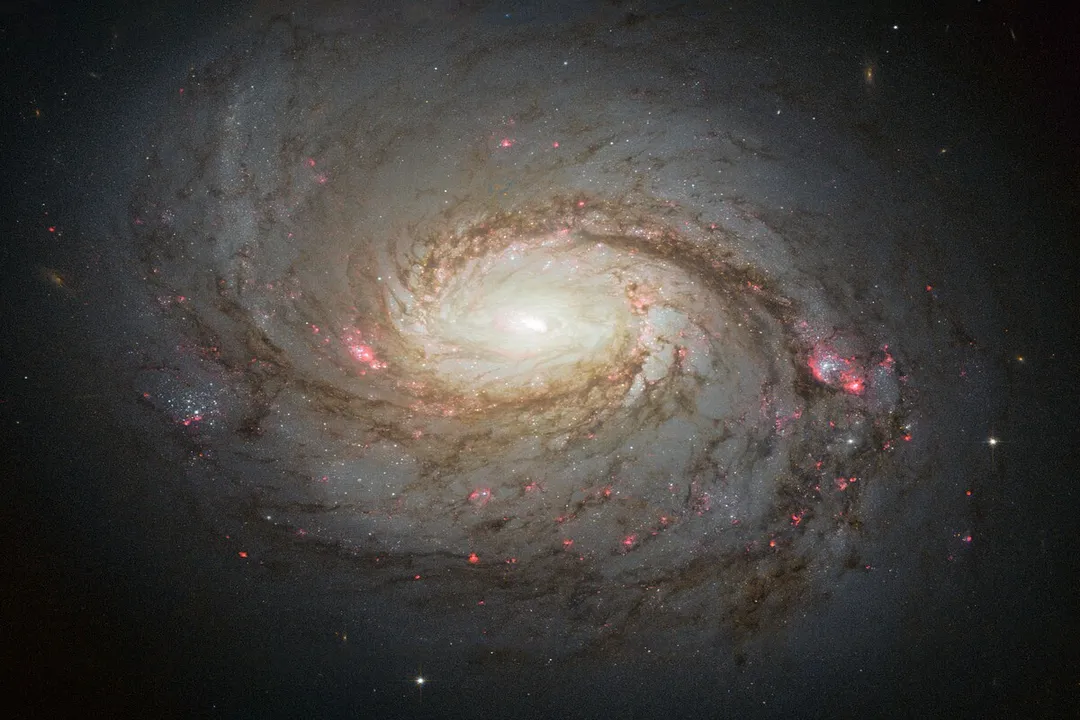
Galaxies are categorized primarily by their visual appearance, a system developed historically that remains highly effective for general classification. [10] When astronomers classify these massive collections of stars, gas, dust, and dark matter, they generally divide them into three main groups: spirals, ellipticals, and irregulars. [1][10] This classification scheme immediately tells us that the answer to whether every galaxy is a spiral is a definite "no," as the other two categories account for a significant portion of the observed galactic population. [9]
# Spiral Structure
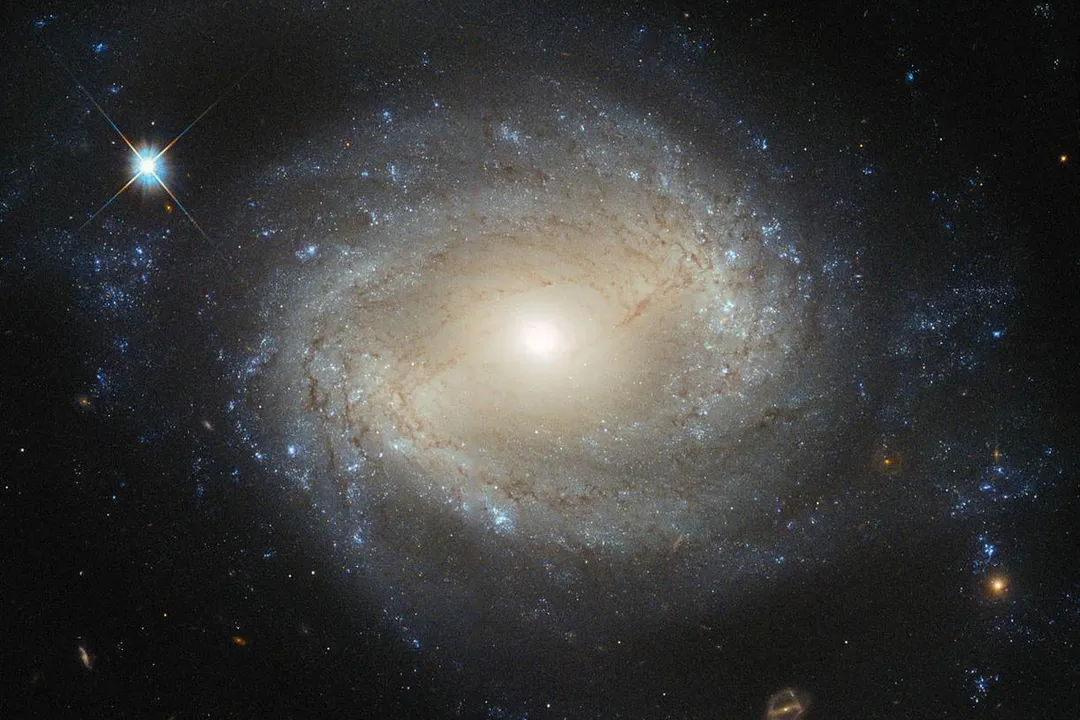
A spiral galaxy is immediately recognizable by its flattened, rotating disk structure embedded with distinct spiral arms that wind outward from a central region, known as the bulge. [2][3] This disk contains the majority of the galaxy's stars, gas, and dust, and it is the primary site of ongoing star formation. [3][4] The spiral arms themselves are not rigid structures but rather areas of higher density—often called density waves—that propagate through the disk. [6][7] As gas clouds enter these denser regions, they are compressed, triggering the birth of new, luminous, blue stars, which is why the arms appear brighter and bluer than the older stellar population in the central bulge or the surrounding halo. [3][4]
The central bulge is typically composed of older, redder stars and lacks the abundance of the cold gas required for prolific star birth, making it relatively quiescent compared to the arms. [2] Surrounding the entire system is a vast, roughly spherical halo of much older stars and globular clusters, extending far beyond the visible disk. [2] Our own galaxy, the Milky Way, is a classic example of a spiral galaxy, possessing this characteristic flattened shape and active stellar nurseries within its arms. [4]
# Variations within Spirals
The spiral class itself is not monolithic; galaxies exhibit a range of tightness in their arms and the prominence of their central bulge. [2] Astronomers often use a sub-classification system, which maps onto the famous Hubble tuning fork diagram, to sort these out. Galaxies are often designated by letters like Sa, Sb, or Sc, depending on the size of the bulge relative to the disk and how tightly wound the arms are. [2] An Sa galaxy, for instance, has a very large bulge and tightly wound arms, whereas an Sc galaxy features a smaller central bulge and loosely defined, sprawling arms. [2]
A further important distinction within the spiral group is the presence or absence of a bar structure cutting across the nucleus. [1] Barred spiral galaxies, like the Milky Way is thought to be, possess a bar-shaped structure composed of stars that extends from the central bulge before the spiral arms begin to emerge from the ends of the bar. [1] Unbarred spirals lack this central stellar feature. This variation shows that even within the "spiral" designation, there is significant architectural diversity driven by the internal dynamics and distribution of mass within the stellar population. [2]
# Density Waves
Understanding why spiral arms exist is key to appreciating their mechanics. They are not like spokes on a wheel, where the same stars perpetually remain in the arm. [7] Instead, the formation of spiral structure is attributed to density waves moving through the galactic disk, much like a traffic jam forms on a highway. [6][7] These waves compress the interstellar medium, causing star formation to ignite along their path. [6] The stars and gas move into the compressed region, light up brightly for a time, and then move out of it as the wave passes, which explains why the arms appear defined but the overall structure persists over billions of years. [7] This mechanism is an elegant explanation for the persistence of the spiral shape despite the differential rotation of the disk components. [6]
# The Elliptical Group
If spirals are defined by their active, ordered rotation, elliptical galaxies stand in sharp contrast. [1] These are, fundamentally, massive, spheroidal systems that appear as smooth, featureless ellipses when viewed through a telescope. [10] They lack the defined disk structure and spiral arms seen in their swirling counterparts. [1]
Elliptical galaxies range widely in size, from tiny dwarf ellipticals containing only a few million stars up to enormous giant ellipticals that can host trillions of stars and dominate entire galaxy clusters. [1] Structurally, they are collections of stars orbiting in randomized, rather than ordered, paths, giving them their blob-like or football shape. [10] Because the gas and dust required for star formation have largely been used up or expelled over cosmic timescales, elliptical galaxies are generally dominated by old, red stars and exhibit very little current star formation. [10]
Considering the fundamental difference in star formation activity, one can see a clear dichotomy in galactic life cycles: the spiral galaxy is the vibrant, active stellar nursery, constantly churning out new stars and reshaping its structure through rotation and density waves, while the elliptical galaxy represents an older, more settled state where the raw materials for stellar birth have been exhausted. [9] This difference in stellar population age and ongoing activity is often the most striking difference between a spiral and an elliptical when spectral data is analyzed. [10]
# Irregular Shapes
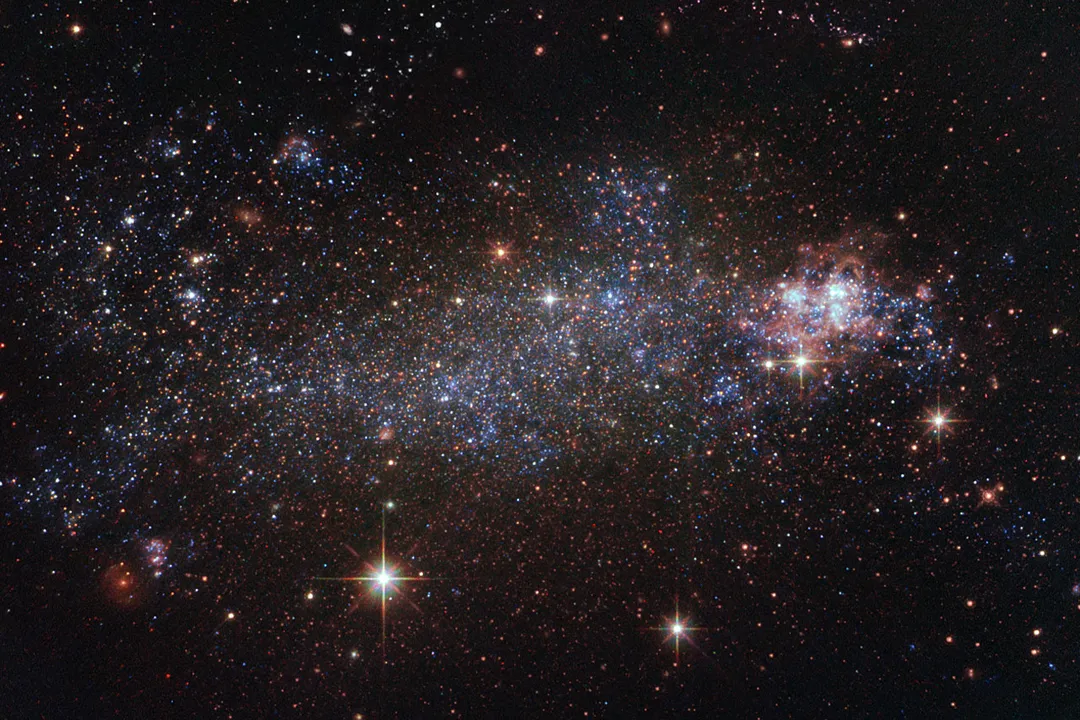
The third major class comprises galaxies that simply do not fit neatly into the spiral or elliptical molds. [1] These are the irregular galaxies, and they are often chaotic in appearance, showing no clear symmetry or defined structure. [10]
Irregular galaxies typically arise from two primary scenarios: either they are young galaxies that have not yet developed a stable, recognizable structure, or they are galaxies that have had their shapes distorted by gravitational interactions with neighboring galaxies. [9] These interactions, like close flybys or outright mergers, can effectively tear apart the delicate structure of a spiral or elliptical, leaving behind a messy, star-studded landscape. [9] Because of their often-turbulent nature, irregular galaxies can sometimes be rich in gas and dust, leading to bursts of intense, localized star formation, albeit in a disordered fashion. [1] Their existence provides strong evidence that galactic morphology is not static; shapes are influenced by the gravitational history of the local cosmic environment. [9]
# Viewing Angle Distortion
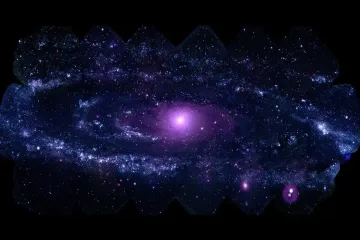
When examining images of distant galaxies, it is crucial to remember that our perspective matters immensely. While we might easily classify face-on spirals like the Andromeda Galaxy, a galaxy that is a spiral but happens to be viewed edge-on from our vantage point can be easily mistaken for a different type, such as a featureless lens shape, or even an elliptical galaxy if the dust lane is obscure. [2]
If we assume a theoretical sample of galaxies where 100 are observed, perhaps 75% are spirals or barred spirals, 15% are ellipticals, and 10% are irregulars. If 50% of those spirals are seen edge-on, an inexperienced observer might estimate the number of true spirals is far lower than reality, because the defining arms become invisible, reducing the classification pool for the unwary eye. [2] This presents an interesting conceptual difficulty: the intrinsic type of a galaxy is based on its physical structure, which is only perfectly revealed when viewed face-on, a luxury the universe rarely grants us for all its inhabitants. [4]
This observation leads to an interesting analytical point: the sheer observational difficulty in resolving fine structure in very distant galaxies means that many of the smallest, earliest, or most remote galaxies categorized as "unresolved" or "amorphous" in older surveys may, upon closer inspection with next-generation instruments like the James Webb Space Telescope, reveal themselves to be highly disturbed spirals or distinct irregulars, further complicating any attempt to rigidly count the populations. [3]
# Galactic Ecosystems
The universe is a dynamic place, and galaxy shapes are not permanent labels stamped at birth. [9] Interactions between galaxies are a fundamental driver of their evolution. A close encounter between two spiral galaxies can eventually lead to a merger, eventually settling into a large, often featureless, elliptical galaxy devoid of ongoing spiral activity. [9] Understanding the distribution of shapes—spirals dominating in less dense areas, and ellipticals clustering in the centers of dense galaxy groups and clusters—tells astronomers a great deal about the history of mass congregation and the frequency of mergers in those regions. [1][9]
The sheer variety in shape, from the perfectly symmetrical spiral to the amorphous irregular and the smooth elliptical, confirms that galaxy formation and evolution are complex processes shaped by initial conditions, internal dynamics like star formation rates, and external forces like gravitational encounters. [9] Therefore, while spirals are perhaps the most visually striking and familiar, they are merely one compelling example in the grand menagerie of galactic forms that populate the cosmos. [10]
#Videos
We Can't Explain Spiral Galaxies - The Winding Problem - YouTube
Related Questions
#Citations
Galaxy Types - NASA Science
Spiral galaxy - Wikipedia
Spiral Galaxy | ESA/Webb
Spiral Galaxy - ESA/Hubble
We Can't Explain Spiral Galaxies - The Winding Problem - YouTube
Astroquizzical: Why do galaxies have two spiral arms? - Medium
What causes spiral galaxies to be spiral, not evenly distributed like a ...
Galaxies—facts and information | National Geographic
What is a spiral galaxy? - Cool Cosmos - Caltech
Why Do Galaxies Come In Their Mix Of Shapes? - IFLScience