What is found in a spiral galaxy?
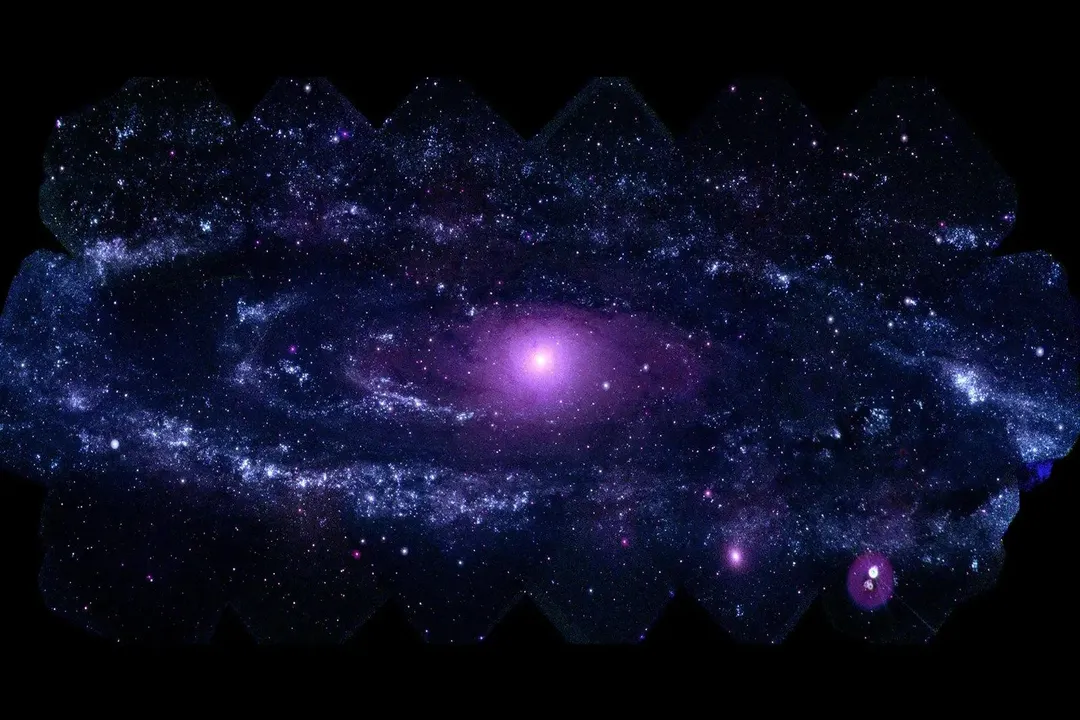
This is what a spiral galaxy looks like: a vast, rotating pinwheel of stars, gas, and dust, usually set against the deep blackness of intergalactic space. [3][5] These grand structures, which include our own Milky Way, are characterized by a flattened, spinning disk containing prominent arms that wind outwards from a central concentration of stars. [1][4][6] To truly understand what is found within these cosmic islands, we must break them down into their primary components: the flat disk, the central bulge, and the vast, encompassing halo. [4][8]
# Disc Shape
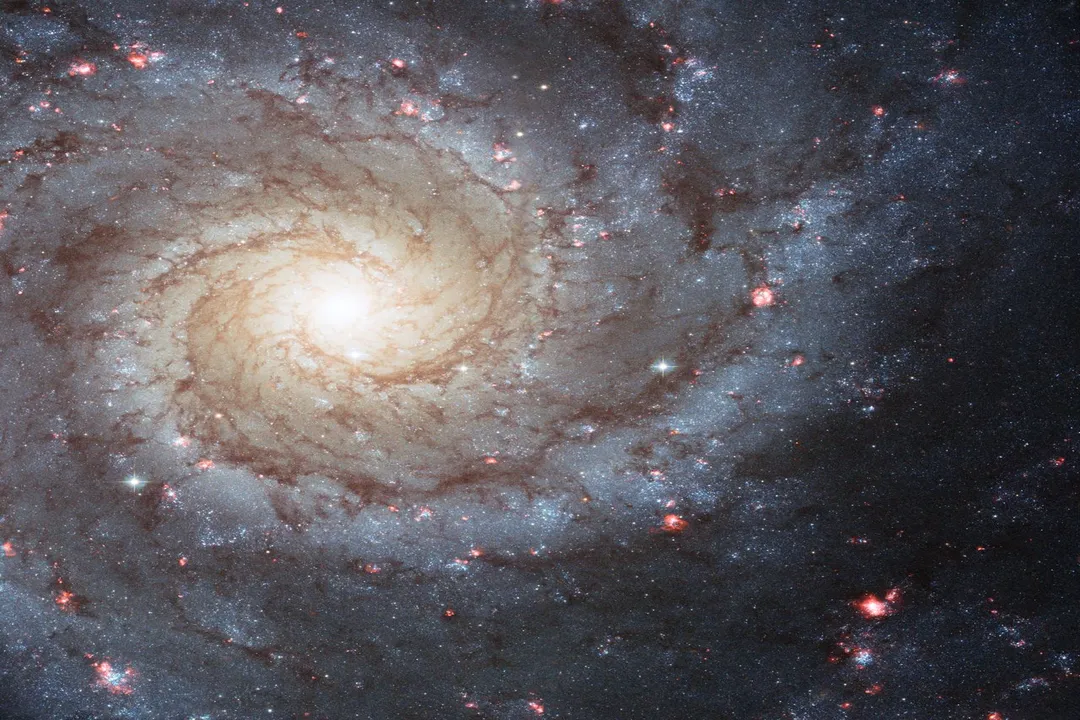
The most distinctive feature of a spiral galaxy is its disk. [6] This structure is relatively thin compared to its diameter, resembling a cosmic vinyl record or a pancake. [3][8] The entire disk is in constant rotation, with material closer to the center orbiting much faster than the material further out. [4] This rotation is fundamental to how the spiral pattern itself is maintained, even though the stars and gas within the arms are constantly moving in and out of them over time. [4]
Within this flat plane resides the majority of a spiral galaxy’s visible light, driven by ongoing stellar birth and the presence of abundant interstellar material. [1][6] It is here that we find the dense lanes of obscuring dust that make the spiral structure so visually striking, often appearing as dark, serpentine lines tracing the inner edges of the bright arms. [2][3]
# Spiral Features
The arms are the defining characteristic, sweeping out from the center in elegant curves. [1][3] Despite their appearance, these arms are not fixed structures like spokes on a wheel; they are better thought of as density waves moving through the disk. [4] As gas and dust enter these denser regions, they become compressed, triggering the collapse of molecular clouds and initiating the birth of new stars. [2][3]
This continuous cycle of compression and birth results in the arms being predominantly populated by young, hot, blue stars. [1][4] These massive, short-lived stars emit copious amounts of bright blue and white light, which is why the spiral arms are the brightest parts of the galaxy when viewed in visible light. [1] The contrast between these bright, blue arms and the often yellowish or reddish light emanating from the older stellar populations in the core and the surrounding disk is a signature feature of spiral systems. [4][6]
When we look at images taken by telescopes like Hubble or Webb, the complexity of the contents becomes evident. The Webb Space Telescope, operating primarily in infrared light, pierces through the obscuring dust clouds that block visible light, revealing the hidden regions where stars are actively forming deep inside the molecular clouds located within those arms. [2] This difference in perspective—visible light emphasizing the hot, young stars, and infrared highlighting the cooler dust and forming protostars—shows that what is "found" in the arms changes dramatically depending on which part of the electromagnetic spectrum we examine. [1][2] This is a subtle but important realization: the galaxy is not static; its visible contents are spectral-dependent proxies for underlying physical processes.

# Central Hub
At the very heart of the spiral galaxy lies the bulge, a dense, roughly spherical concentration of stars. [1][4][8] Unlike the arms, the stellar population in the bulge tends to be much older and redder, composed mostly of low-mass, long-lived stars. [4][6] This older population gives the bulge a warmer, yellower hue compared to the blue arms. [4]
Surrounding the central bulge, there is often a more sparsely populated region known as the peanut-shaped component or the inner disk, depending on the specific galaxy classification. [4]
Crucially, the bulge harbors the galaxy's supermassive black hole (SMBH). [1][4] While the black hole itself is invisible, its immense gravitational influence shapes the motion of the stars nearest the galactic center. [1] In many spirals, like the Milky Way, the central region also features a bar structure—a long, elongated bar composed of stars—that channels gas towards the center, potentially fueling the central black hole or triggering star formation in the inner disk. [4][6]
# Surrounding Halo
Extending far beyond the visible disk and bulge is the halo, a much larger, more diffuse, and generally spherical region. [1][4] The halo is sparse, containing very few gas clouds or sites of active star formation. [6]
The primary contents of the halo are:
- Ancient Stars: These stars are typically found clustered in structures called globular clusters. [1][4] These dense, spherical collections contain some of the oldest stars in the galaxy, dating back near the galaxy's formation time. [4]
- Dark Matter: Perhaps the most significant component by mass, the halo is believed to be dominated by dark matter. [1][6] This mysterious substance does not emit, absorb, or reflect light, making it undetectable by traditional telescopes, yet its gravitational pull is necessary to explain the observed rotational speeds of the outer edges of the disk. [6] When considering the total mass inventory of a spiral galaxy, the dark matter in the halo likely outweighs all the stars, gas, and dust combined by a factor of ten or more. [1]
If we were to assign mass percentages based on typical models, we might find the following distribution, though these figures are highly dependent on the exact galaxy model chosen: [4]
| Component | Typical Mass Percentage (Estimate) | Stellar Age |
|---|---|---|
| Stars (Disk & Bulge) | Mixed (Young in Disk, Old in Bulge) | |
| Interstellar Medium (Gas/Dust) | N/A (Fuel for new stars) | |
| Dark Matter (Halo) | N/A (Non-baryonic) |
The sheer gravitational dominance of the dark matter component in the halo means that the visible structure we observe—the beautiful arms and bright core—is essentially just the luminous residue suspended within a much larger, unseen gravitational scaffold. [6]
# Galaxy Ingredients
Beyond the structural zones, a closer look reveals the fundamental stuff that makes up the stellar and gaseous components of the disk and bulge.
# Stellar Populations
Spiral galaxies contain stars of nearly every conceivable age. [4] The arms host the hottest, youngest stars, which burn brightly for only a few million years before exploding as supernovae. [3] The disk, away from the active star-forming regions, contains stars that formed long ago but are still fusing hydrogen, like our own Sun, which reside in the intermediate age bracket. [4] The bulge, as mentioned, is populated by older, lower-mass stars that have been burning for billions of years. [4] The distribution of stellar ages across the galaxy provides a chronological record of its development. [6]
# Gas and Dust
The interstellar medium (ISM) is the material between the stars, crucial for maintaining the galaxy's life cycle. [1] This medium is composed primarily of gas, mostly hydrogen and helium, existing in various states—from cold molecular clouds where stars form, to hot ionized gas. [1]
The gas is found both diffusely spread throughout the disk and concentrated in the distinct dust lanes seen in the spiral arms. [2][3] This material is recyclable; stars are born from it, live their lives, and eventually return enriched heavier elements (metals, in astronomical terms) back into the ISM through stellar winds or supernovae, which then seed the next generation of stars and planets. [4] This constant recycling process is what differentiates active spirals from older, quiescent elliptical galaxies. [5]
# Spiral Types
Not all spirals look identical. Astronomers categorize them based on the structure of their central region and the tightness of their arms, which speaks to differences in their formation history and current dynamics. [5]
The primary divisions are:
Normal Spirals (S): These galaxies feature arms that emerge directly from the central nucleus. [4] They are further subdivided based on how tightly wound the arms are:
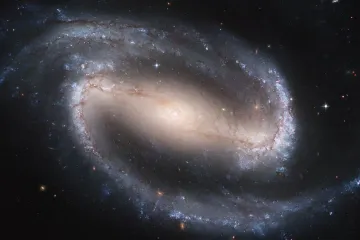
Barred Spirals (SB): As the name suggests, these galaxies possess a distinct bar structure passing through the nucleus, from which the spiral arms then emerge. [4][6] Our Milky Way is believed to be a barred spiral galaxy. [4] They also follow a similar a, b, c classification based on the bulge size and arm tightness (e.g., SBb). [4]
A galaxy's classification offers clues about its past. A galaxy with very tightly wound arms (Sa or SBa) might be in a state where less new star formation is occurring in the outer disk, or perhaps it has experienced less gravitational disturbance that might have "fluffed up" the arms into a looser configuration (Sc or SBc). [5] The sheer variety means that while the basic recipe—bulge, disk, halo—remains, the final structure found inside is a direct result of billions of years of rotation, gravitational interaction, and star birth cycles. [6]
#Videos
What Are The Four Main Parts Of A Spiral Galaxy? - Physics Frontier
Related Questions
#Citations
Spiral Galaxy - ESA/Hubble
Spiral Galaxy | ESA/Webb
What Is a Spiral Galaxy? - Space
Galaxies – Spirals - NMSU Astronomy
Galaxy Types - NASA Science
Spiral Galaxy | COSMOS
What Are The Four Main Parts Of A Spiral Galaxy? - Physics Frontier
Slide 3 - IPAC/Caltech
Spiral Galaxy Lesson for Kids: Definition & Facts | Study.com