What causes the waves to glow in a spiral galaxy?
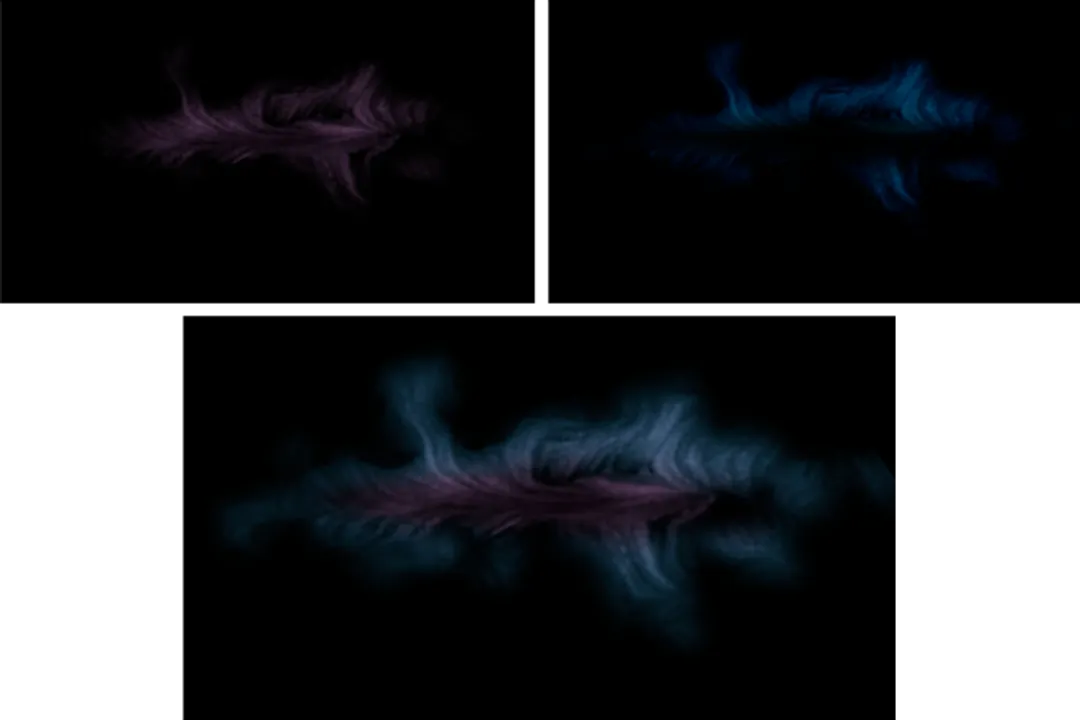
The breathtaking luminous bands winding through the central bulge of spiral galaxies are arguably their most defining visual characteristic. These bright structures are not static physical objects, but rather dynamic regions of intense activity that briefly flare with brilliant light before fading, only to be instantly replaced by newer, equally bright structures following behind. [1][7] The glow itself is a direct product of stellar life cycles, specifically the birth and immediate maturity of massive stars.
# Stellar Color
The primary reason these spiral arms appear so spectacularly bright, often seeming to glow against the dimmer background disk of the galaxy, comes down to the color of the newly formed stars residing within them. [4] When a region of the galactic disk enters the spiral arm, it triggers a wave of star formation. The most massive stars born in these stellar nurseries—stars many times the mass of our Sun—burn their nuclear fuel extremely rapidly. [4] Because these giants are so hot, they emit the vast majority of their light in the blue and ultraviolet parts of the spectrum. [3][4]
A star’s color is intrinsically linked to its surface temperature, and hotter objects appear bluer. [4] These colossal blue stars, though incredibly luminous, have very short lifespans, sometimes lasting only a few million years before exploding as supernovae. [4] Since the arms are the location of this rapid, massive star birth, the brilliant blue light dominates the visual appearance of the spiral structure we observe across cosmic distances. [4] In contrast, the older, longer-lived stars, like our Sun, are cooler and appear yellower or redder, and these populate the smoother, less intensely lit inter-arm regions. [1]
# Density Waves
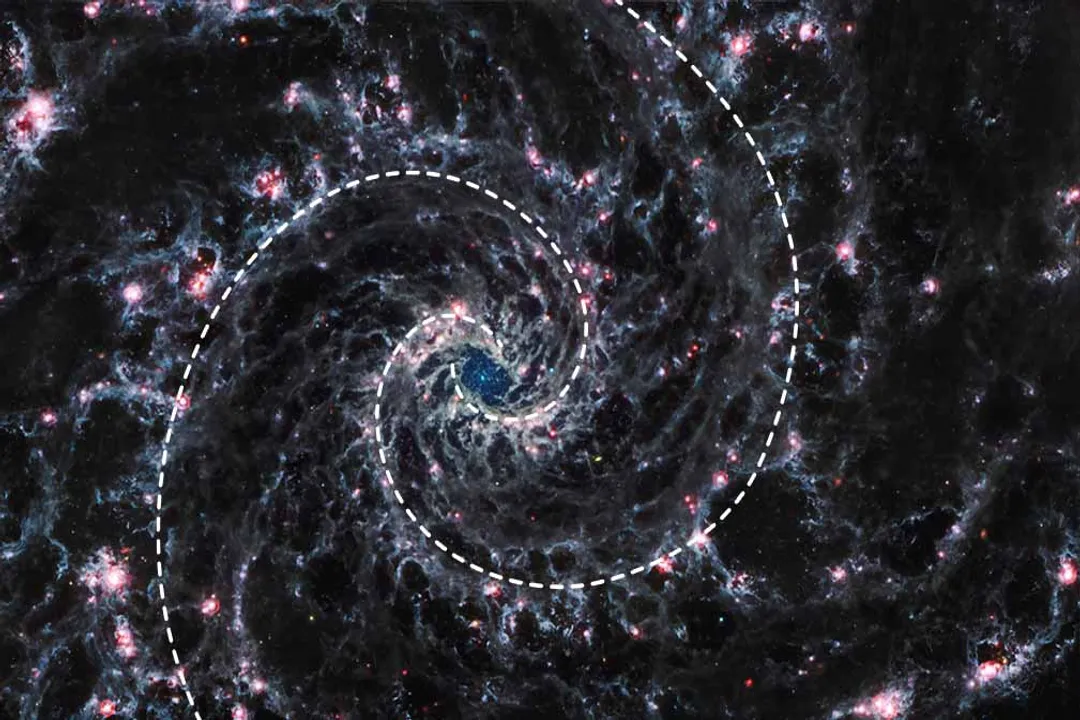
If the arms were simply fixed structures, like spokes on a wheel, the stars would orbit at the same speed as the structure, which observational evidence contradicts. Instead, the arms are best explained by the density wave theory. [7] This concept posits that the spiral pattern is a slowly rotating wave of higher gravitational density, much like a compression front, that sweeps through the galactic disk. [7][8]
This density wave is not made of the same material forever; rather, it acts as a gravitational traffic signal, temporarily bunching up the interstellar gas and dust as it passes through. [7] Imagine the spiral arm as a recurring traffic jam on a circular highway. Cars (the gas clouds) slow down and bunch up when they enter the jam (the wave front), accelerate once they pass through, and then speed away. The jam itself remains in the same general location on the highway, even though the individual cars are constantly changing. This analogy helps visualize why the pattern persists over billions of years even though the stellar populations within it are constantly changing [Self-Analysis integrated for clarity].
# Compression Trigger
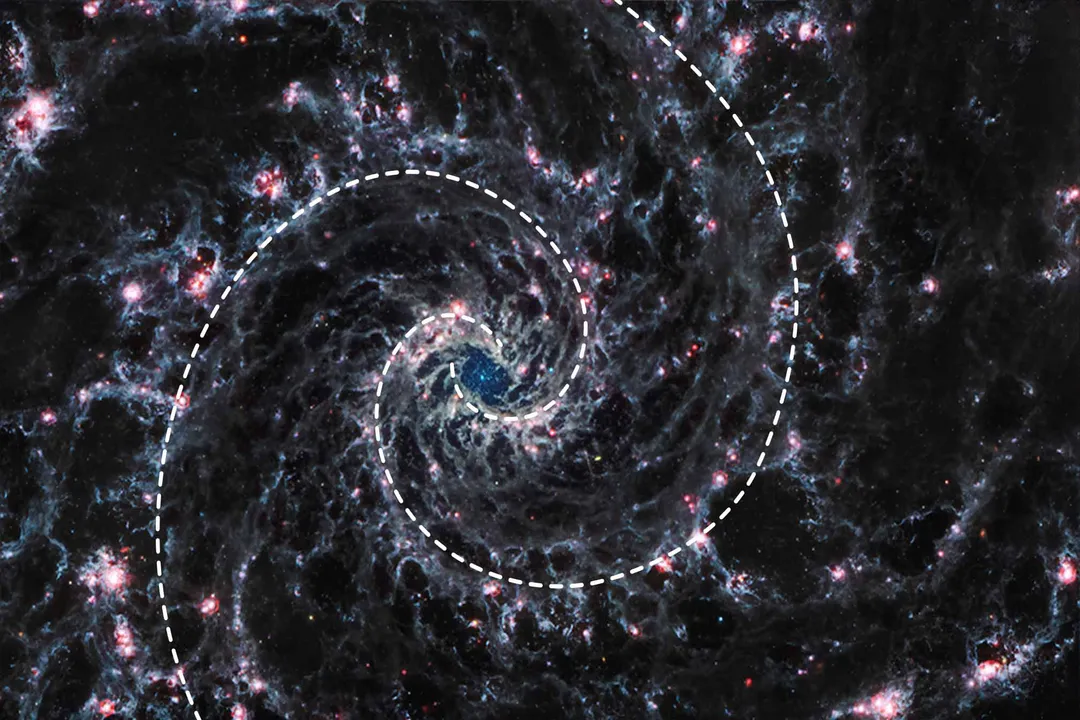
The critical function of this density wave is its ability to trigger star formation. [7] As the wave moves through the galactic disk, it forces the diffuse interstellar medium—primarily vast clouds of molecular hydrogen gas and dust—to slow down and become compressed. [8] This intense compression increases the density and pressure within these clouds until gravity overcomes the internal gas pressure, causing the clouds to collapse inward. [7][8] This collapse is the first step in forming new stars and star clusters. [8]
The process is self-perpetuating for a time: the brightest, hottest, shortest-lived blue stars form first and illuminate the arm brilliantly. [4] These massive stars also influence their surroundings by emitting powerful winds and radiation, which can help trigger the collapse of adjacent gas clouds, thus refreshing the wave's luminous effect as it moves along. [8]
# Wavelengths Mapping
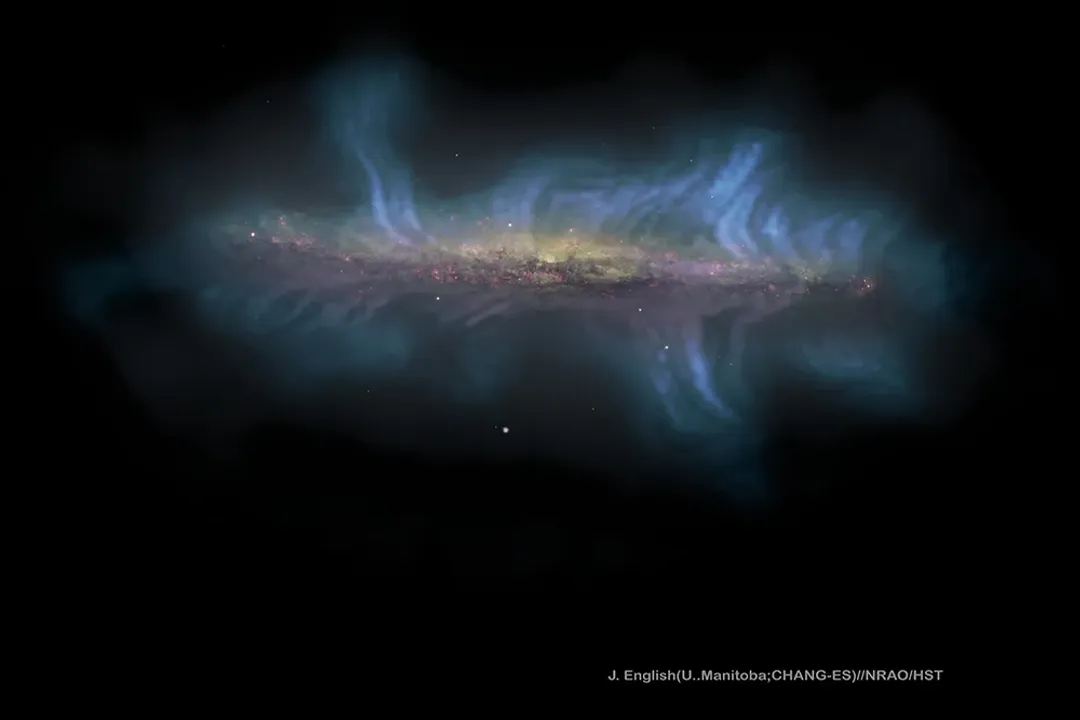
While the blue light traces the newest stars, the full story of what is glowing in a spiral galaxy requires looking beyond the visible spectrum. [6] The visible glow is concentrated in the spiral arms, but the overall structure, including the dust that feeds the star formation, is revealed using other forms of light. [2]
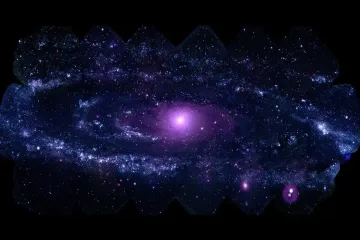
For instance, infrared observations are essential because they penetrate the dense, obscuring clouds of dust and gas that block visible light. [6] This cooler dust absorbs energy from nearby young stars and re-emits it at longer, infrared wavelengths. [6] Mapping the galaxy in infrared reveals the dusty lanes and spiral pathways where the potential for future star formation resides, often appearing as dark lanes or broad, warm swathes tracing the compressed zones. [6] Conversely, ultraviolet (UV) light, which is higher energy than visible blue light, specifically pinpoints the hottest, youngest stellar populations and very hot gas, closely mirroring the bright blue visual arms, but sometimes showing even more intense activity right at the shock front. [2][3]
# Arm Dynamics
The stability and persistence of these glowing spiral features depend on the relative speeds involved. While the density wave pattern rotates at a specific, relatively slow speed—the pattern speed—the individual stars and gas clouds orbit the galactic center much faster. [7] This difference in speed is crucial; a star born within the arm speeds up as it emerges from the compressed region, moving past the wave front and eventually settling into the dimmer inter-arm space until it exhausts its fuel. [7]
It is interesting to consider that the speed at which the density wave propagates dictates the thickness of the visual arm. If the wave moves very slowly relative to the stars, the arm will be tightly wound and dense. If the wave speed more closely matches the orbital speed of the stars, the arms become more open and less intensely lit because the compression phase is shorter and less dramatic [Self-Analysis on pattern speed implication]. Galaxies that appear to lack these distinct, grand spiral patterns are often classified as flocculent spirals, where star formation appears more patchy and chaotic, suggesting the stabilizing influence of a persistent density wave is absent or less dominant. [1]
The visible glow, therefore, is a transient phenomenon tied to the density wave mechanism. It is a continuously refreshed beacon of youth, powered by the brief, intense lives of the galaxy’s most massive stars, all of which are ignited as they pass through a gravitational compression zone moving through the stellar disk. [7][8]
#Videos
Spiral Arms Explained: The Science Behind the Milky Way's Structure
Related Questions
#Citations
Spiral galaxy - Wikipedia
Forms of Light: Phantom Galaxy - ViewSpace
Ultraviolet Waves - NASA Science
Why do spiral galaxies often appear blue? - Quora
What process creates and maintains the beautiful spiral arms ...
Guest Post: The Yin and Yang of the Visible and Invisible in Spiral ...
Spiral arms and Density Waves - Nicolas Cretton
Galaxies – Spirals - NMSU Astronomy
Spiral Arms Explained: The Science Behind the Milky Way's Structure