Is our galaxy spiral elliptical or irregular?
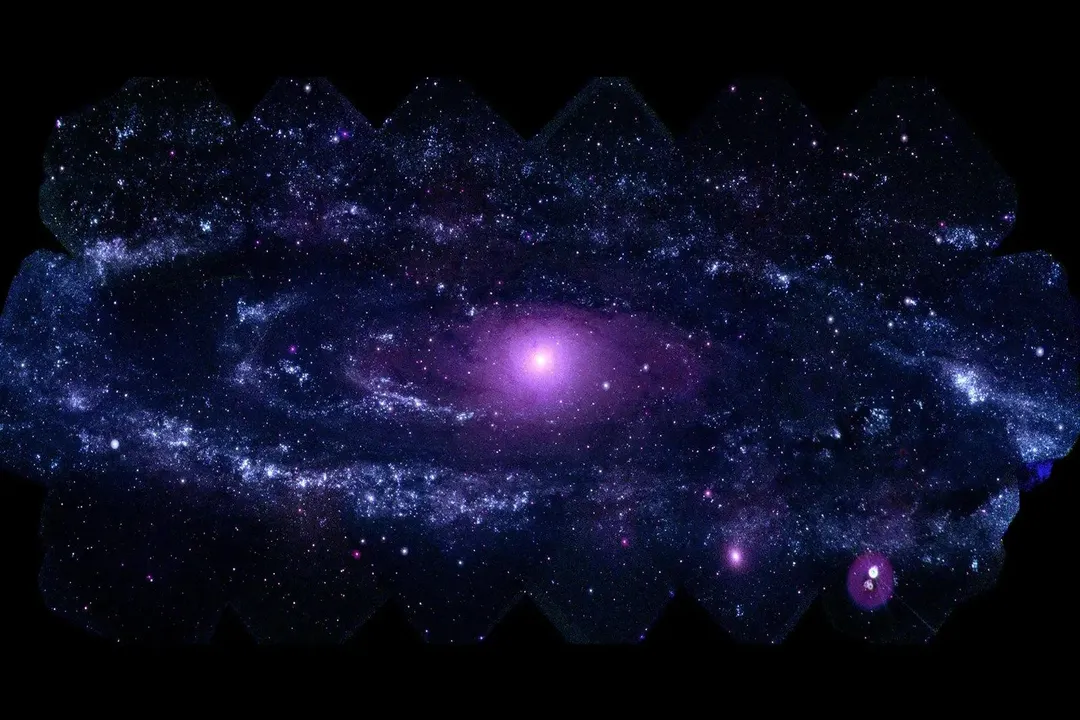
The shapes that galaxies adopt across the universe present astronomers with a fascinating glimpse into their history, mass, and evolution. When we look up at the night sky, even with the naked eye, we observe pinpricks of light that are, in reality, immense collections of stars, gas, and dust, all bound by gravity. These stellar cities do not all look the same; they fall into three primary categories based on their visual morphology: spiral, elliptical, and irregular. Our own galactic home, the Milky Way, fits squarely into one of these classifications, giving us a direct observational anchor for understanding the broader galactic zoo.
# Galaxy Shapes
Galaxies are categorized based on their appearance, a system largely rooted in Edwin Hubble's early classifications. This morphology tells a story about the galaxy's stellar population, its rate of star formation, and how much internal or external disturbance it has experienced. Understanding these basic shapes—the organized whirls, the smooth blobs, and the chaotic collections—is the first step in mapping the cosmic architecture.
# Spiral Features
Spiral galaxies are perhaps the most visually stunning and recognizable type, characterized by distinct, sweeping arms that curve outward from a central concentration of stars. These structures are not static; they are density waves moving through the galactic disk, compressing gas and dust, which triggers the birth of new, bright, blue stars.
A typical spiral galaxy possesses three main components: the central bulge, a relatively flat rotating disk, and the surrounding halo. The bulge, located at the center, is a densely packed spheroid primarily containing older, yellower stars. Extending from this bulge is the disk, which contains the spiral arms, vast amounts of interstellar gas and dust, and younger, hotter stars. Because of this abundance of cool gas and dust—the raw materials for star creation—spirals remain very active sites of ongoing star formation.
# Barred Spirals
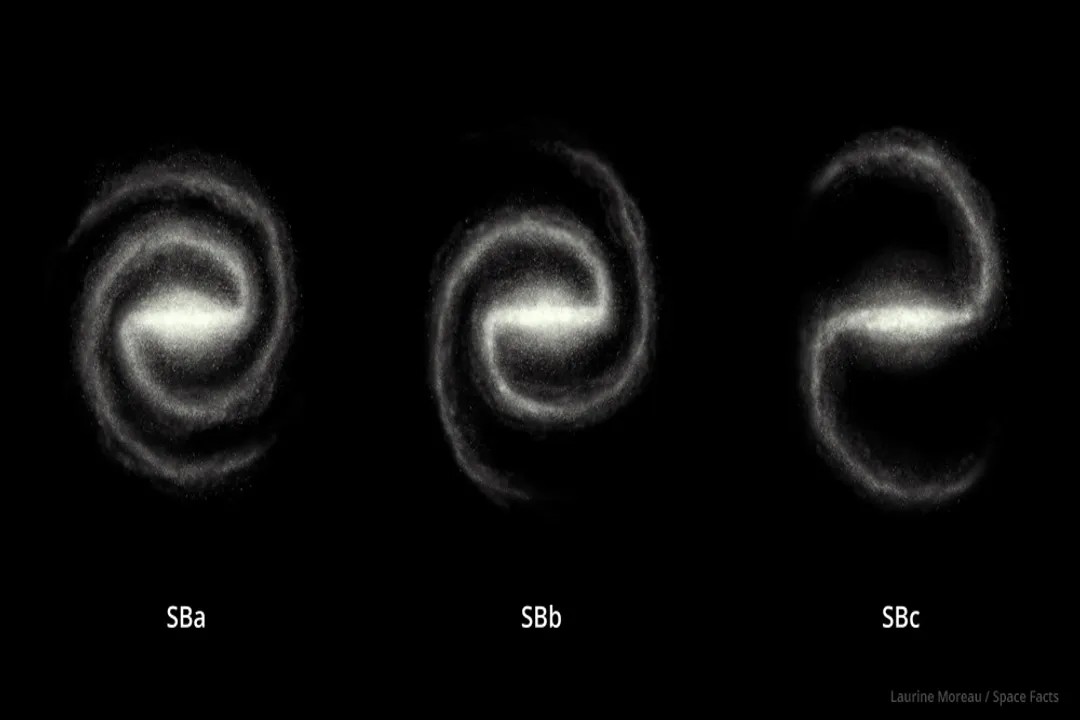
A critical subdivision within the spiral category is the distinction between normal spirals (designated 'S' types) and barred spirals (designated 'SB' types). In a barred spiral, a central bar-shaped structure, composed of stars, crosses the nucleus, and the spiral arms appear to emerge from the ends of this bar rather than directly from the central bulge. Astronomers estimate that a significant majority of spiral galaxies, perhaps two-thirds, possess these central bars. The Milky Way itself is classified as a barred spiral galaxy. The existence of the bar is believed to influence the rotation and the distribution of gas within the disk, affecting how and where new stars form.
If you were to map the rotational velocity of stars in the Milky Way disk, you would observe that the bar acts as a funnel, efficiently channeling material from the outer disk regions inward toward the galactic center, a process that is far more organized than what might occur in a non-barred spiral. This internal dynamic sculpting, driven by the bar's gravity, represents a unique evolutionary pathway for these galaxies.
# Elliptical Forms
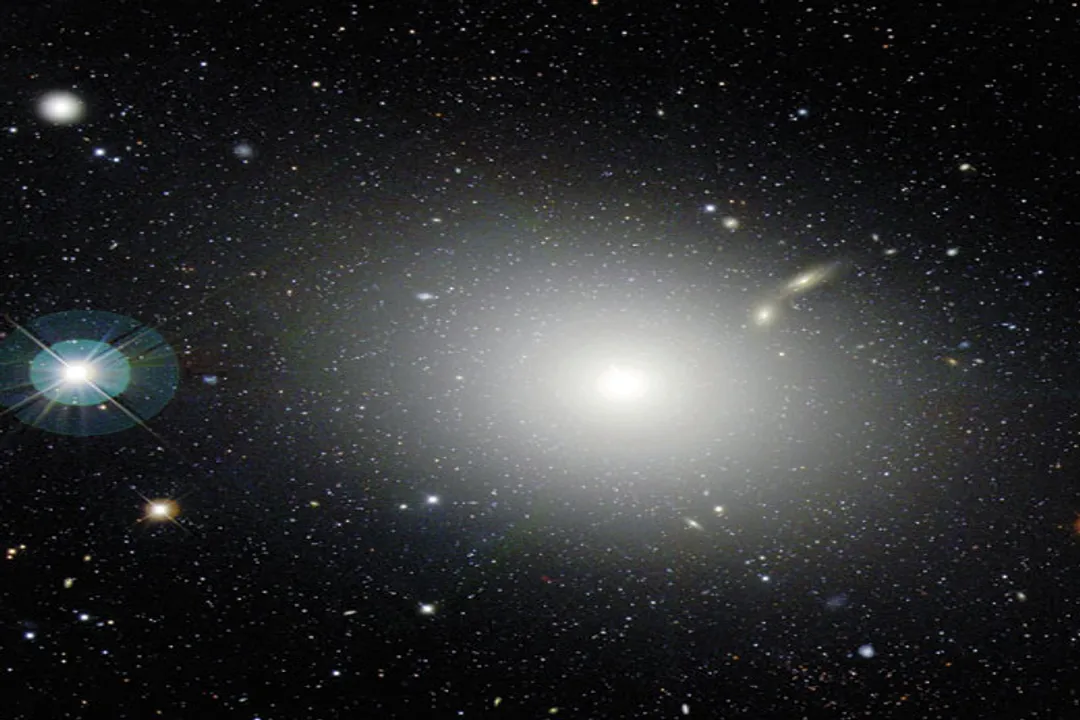
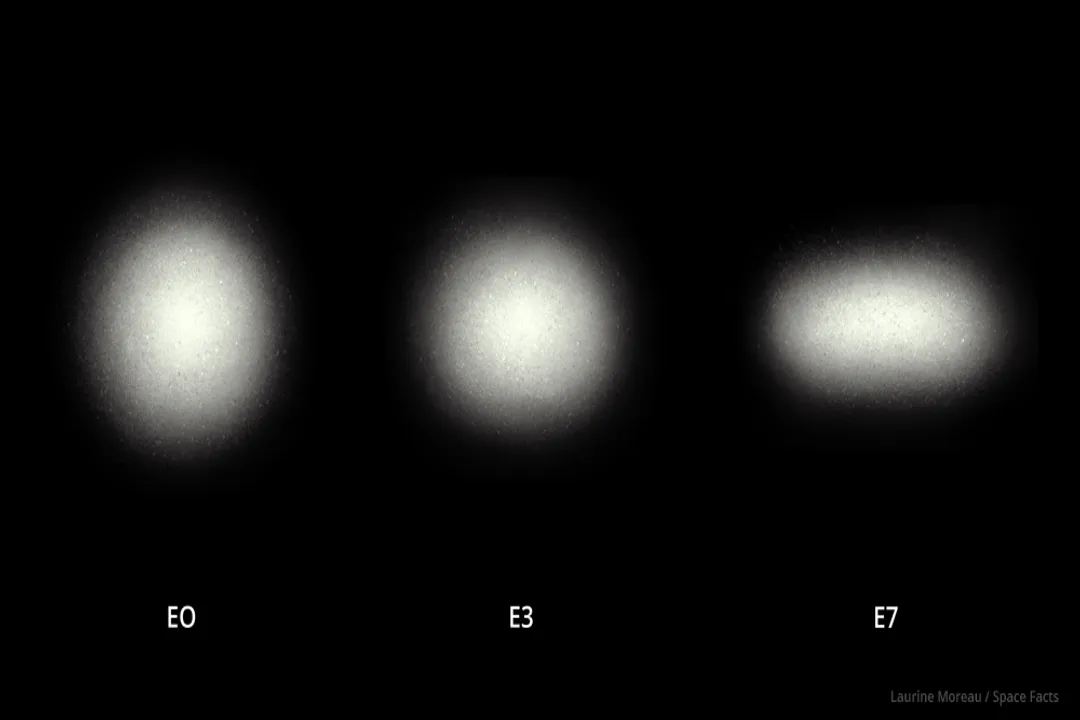
Contrasting sharply with the flattened, busy structures of spirals are elliptical galaxies. These systems appear as smooth, featureless blobs, ranging from nearly perfect spheres to elongated ovals. They are classified based on their apparent flatness, denoted by the letter 'E' followed by a number from 0 to 7, where E0 is the most spherical and E7 is the most elongated or flattened.
The key difference in composition compared to spirals is the lack of cold gas and dust. Consequently, elliptical galaxies have very little ongoing star formation. Their stellar populations are dominated by older, redder stars, giving these galaxies a generally more uniform, yellowish-red hue when observed across the spectrum. They are often thought to be the end product of major galactic mergers, where the collision triggers a massive burst of star formation that quickly consumes all the available gas, halting subsequent star birth and leaving behind a quiescent collection of aged stars. Ellipticals span an enormous range in size, from dwarf ellipticals containing only a few million stars to giant ellipticals that can host trillions of stars and far outshine any spiral galaxy.
Imagine an E0 galaxy as a perfectly still, enormous cosmic bubble filled with ancient embers, while an E7 galaxy looks like a stretched-out, slightly dusty rugby ball of old starlight. It is the absence of the defining features—the spiral arms, the dust lanes, the blue star nurseries—that defines this class.
# Irregular Variety
The third major category comprises galaxies that simply do not fit neatly into the spiral or elliptical molds. These are the irregular galaxies, and their description is inherent in their name: they have no regular, symmetric structure.
Irregular galaxies are often smaller than spirals or ellipticals, though some very large examples exist. They tend to be rich in gas and dust, meaning they are often vibrant with new star formation, sometimes appearing as bright, chaotic clumps. The reason for this lack of symmetry is usually external influence. Many irregular galaxies are thought to be either galaxies that have not yet developed a stable form or, more commonly, systems that have been severely distorted by gravitational interactions or collisions with other galaxies. When two galaxies pass close to one another, their mutual gravitational pull can rip stars, gas, and dust into long tidal tails, effectively scrambling any pre-existing spiral or elliptical structure into something irregular.
For instance, the Large and Small Magellanic Clouds, visible in the Southern Hemisphere, are two well-known examples of irregular galaxies orbiting the Milky Way. Their dynamic, uneven shapes are a direct result of their ongoing gravitational dance with our own galaxy.
# Our Home Galaxy
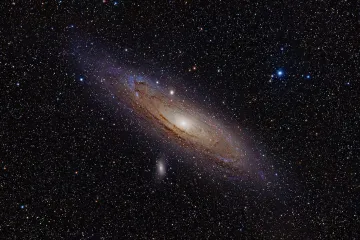
To answer the implied question of our galaxy’s nature, the Milky Way is definitively a spiral galaxy. Specifically, it is classified as a barred spiral galaxy, often designated as type SBbc in the Hubble classification scheme, indicating a moderately wound set of spiral arms emerging from a bar structure.
We reside in the disk, roughly two-thirds of the way out from the center, within one of the minor spiral arms, often identified as the Orion Spur or Local Arm. From our vantage point inside the disk, looking toward the center gives us the thick, hazy band of light we call the Milky Way—the combined glow of billions of unresolved stars in that dense central region. The Milky Way contains an estimated 100 billion to 400 billion stars, a scale that makes conceptualizing its structure from within a real challenge.
# Galactic Environment
The classification of a galaxy is not static over cosmic timescales, and this is where the Milky Way's future must be considered. While our galaxy currently boasts a beautiful spiral form, its environment dictates its eventual fate. Galaxies are not isolated; they exist in clusters and groups, and interactions are inevitable.
The most significant gravitational event on our immediate horizon involves our nearest large neighbor, the Andromeda galaxy (M31). Andromeda is also a spiral galaxy, though larger than the Milky Way. In about 4.5 billion years, these two massive spirals are predicted to collide and eventually merge. This massive gravitational interaction will likely destroy the delicate spiral structures of both galaxies. Stars within the galaxies will mostly pass by each other due to the vast space between them, but the gas clouds will collide violently, triggering a tremendous, galaxy-wide burst of new star formation that could last for hundreds of millions of years. After the dust settles and the merger completes, the resulting galaxy is expected to be a much larger, featureless elliptical galaxy, marking the end of the Milky Way's spiral phase.
This expected transformation illustrates a key concept in galactic evolution: major mergers often convert the actively star-forming, gas-rich spiral morphology into the old, quiescent, gas-poor elliptical form. Understanding that our Milky Way is currently a spiral but is destined to become an elliptical provides a practical, forward-looking example of galactic change, moving from one Hubble type to another over eons.
# Classification Summary
To keep the distinctions clear, a summary table based on morphology and composition is helpful:
| Galaxy Type | Primary Shape | Key Components | Star Formation Status | Typical Stellar Age |
|---|---|---|---|---|
| Spiral (e.g., Milky Way) | Flat disk, arms, central bulge | Gas, dust, young/old stars | Active, ongoing | Mixed |
| Elliptical | Spherical to elongated ovals | Mostly stars, little gas/dust | Very low or none | Predominantly old |
| Irregular | No defined symmetry | Abundant gas and dust | High, active | Mixed, many young stars |
| [1][2][4][10] |
This table highlights that while shape is the visual cue, the presence or absence of interstellar medium (gas and dust) is what dictates the galaxy's current evolutionary state—whether it is actively building new stars or winding down. A spiral is dynamically structured and actively producing; an elliptical is gravitationally settled and fading; an irregular is often dynamically disturbed and vigorously forming stars where material has been compressed.
Our place within this framework is clear: we are residents of a magnificent barred spiral, currently experiencing a relatively calm period of star birth in the outer regions of the Orion Spur, all while heading toward an inevitable, gravitationally induced transition into a new, massive elliptical state billions of years from now.
Related Questions
#Citations
Galaxy Types - NASA Science
Types of Galaxies - Spiral, Elliptical & Irregular Galaxies - Space Facts
Spiral Galaxy | ESA/Webb
The two main galaxy families: spirals and ellipticals - AEGIS
Types of Galaxies and Their Characteristics - Facebook
Galaxy | McGraw Hill's AccessScience
Three Shapes of Galaxies | Elliptical, Spiral, and Irregular | Britannica
Spiral Galaxy - ESA/Hubble
The Three Types of Galaxies - Slooh
Irregular galaxy - Wikipedia