What are the properties of elliptical galaxies?
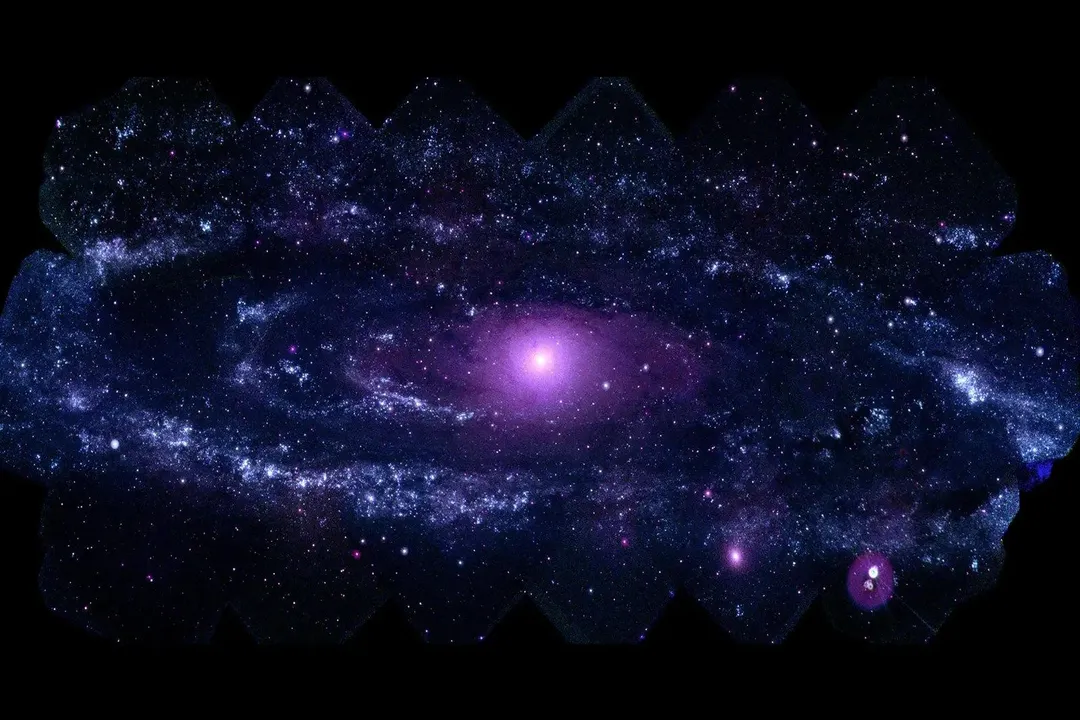
Elliptical galaxies represent a major class of stellar systems, often standing out due to their smooth, featureless light profiles and their sheer diversity in size, ranging from dwarf ellipticals containing only a few million stars to massive central galaxies in clusters that can harbor trillions of stars and span millions of light-years across. [2][5][7] Unlike the familiar spiral galaxies, which boast organized arms and abundant cool gas, ellipticals present a more uniform, ellipsoidal glow, leading early astronomers to categorize them simply based on how elongated they appeared from our vantage point. [2][6] The name itself hints at their fundamental geometry, though it can be misleading, as the apparent shape often depends on the viewing angle; a nearly spherical galaxy seen edge-on might be classified incorrectly compared to one viewed face-on. [2]
# Classification Scale
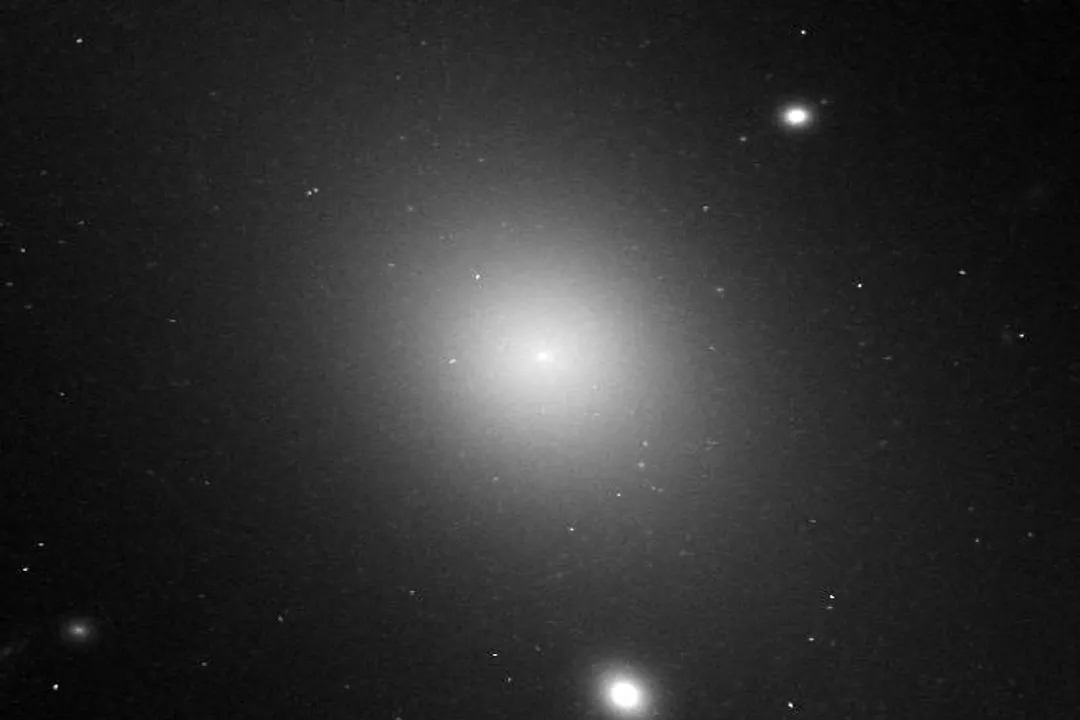
The morphological classification scheme for these smooth systems is remarkably straightforward, relying primarily on the degree of apparent flattening, codified by Gérard de Vaucouleurs. [2][6] This system uses the letter followed by a number from 0 to 7, where represents the most spherical, or roundest, systems, and denotes the most elongated or flattened galaxies. [5][6]
The designation is calculated based on the apparent major and minor axes of the galaxy's image on the sky, using the formula:
where is the semi-major axis and is the semi-minor axis. [2] An galaxy has , resulting in an ellipticity value close to zero, while an galaxy has a much larger ratio of to , pushing the ellipticity towards its maximum value of 7. [2] It is important to note that this classification is purely two-dimensional, meaning it describes the appearance projected onto the plane of the sky, not necessarily the true three-dimensional shape, which could be prolate (cigar-shaped) or oblate (pancake-shaped). [2][6] A crucial aspect of this system is the continuity between types; there are no sharp boundaries, and galaxies transition smoothly from one E category to the next. [2]
For those analyzing distant ellipticals, comparing their measured shapes against expected distributions reveals interesting trends. For instance, simulations suggest that while the E0 to E3 range is well-populated, very few galaxies are truly observed at the extreme based on this purely visual classification, hinting that factors beyond simple projection, such as internal dynamics or substructure that we might miss in faint outer regions, influence the apparent flattening. [8]
# Stellar Content
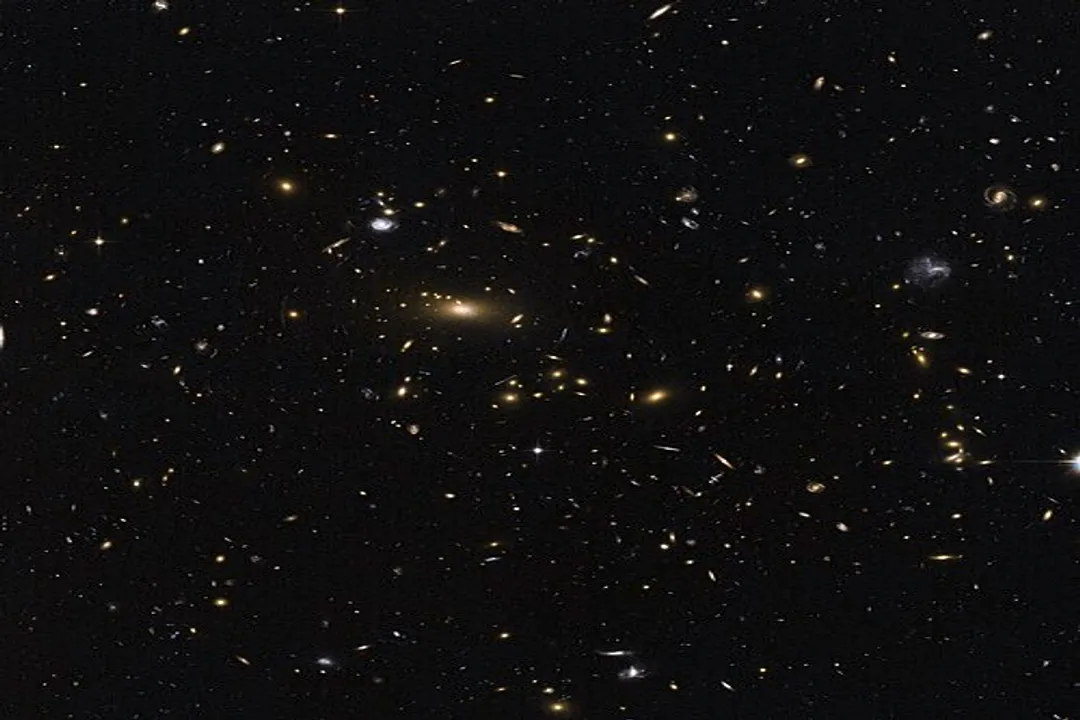
One of the most defining properties of elliptical galaxies is their stellar population. They are typically dominated by old, low-mass, red stars, which gives them a characteristic reddish-yellow hue when viewed through optical telescopes. [5][7] This population is often described as consisting of Population II stars, which formed very early in the galaxy's history. [10]
The lack of intense, ongoing star formation is a direct consequence of their internal composition. Compared to spiral galaxies, ellipticals contain very little cold, neutral gas and dust—the raw materials necessary for forming new stars. [2][5][8] The interstellar medium that remains is generally hot, ionized gas, which does not readily collapse to form stars. [2] This quiescent state contrasts sharply with the vibrant blue knots of active star formation seen in spiral arms. [7] While they are often considered "red and dead," extremely deep exposures or observations at different wavelengths sometimes reveal faint pockets of cold gas or very low rates of recent star formation, particularly in the centers of some massive ellipticals. [9]
To put this stellar aging into perspective, we can synthesize some general characteristics across the range of elliptical types, although these values are heavily dependent on the specific galaxy and its environment: [2][8][10]
| Property | E0 Galaxy (Roundest) | E4/E5 Galaxy (Intermediate) | E7 Galaxy (Most Elongated) |
|---|---|---|---|
| Stellar Age (Median) | Very Old ( Gyr) | Old ( Gyr) | Old ( Gyr) |
| Star Formation Rate | Very Low to Negligible | Very Low | Low to Very Low |
| Color (Visual) | Yellowish-Red | Red | Reddish-Brown |
| Gas/Dust Content | Extremely Low | Low | Low, potentially more localized |
This comparison shows that while shape varies widely, the age of the dominant stellar population remains consistently old across the whole class, suggesting a common, rapid early formation phase for most ellipticals. [10]
# Internal Dynamics
The internal structure and motion of stars within an elliptical galaxy differ fundamentally from those in disk galaxies, which possess rotationally supported, relatively flat disks. [4][8] In ellipticals, the stellar motions are generally pressure-supported, meaning the stars move on highly randomized, three-dimensional orbits, much like atoms in a gas, rather than following a unified, ordered rotation around a central axis. [4][6] This random motion is what gives the galaxy its spherical or ellipsoidal shape, as there is no net torque to pull the material into a plane. [4]
However, this description isn't universally true. While the most spherical galaxies often exhibit purely random orbits, the flatter galaxies ( to ) can sometimes show a degree of rotation, though this rotation is usually much slower and less dominant than the ordered rotation seen in spirals. [6][8] The internal kinematics—the velocity dispersion of the stars—is a key diagnostic tool for astronomers studying their mass distribution. [1]
The size range is another extraordinary property. Giant ellipticals, often found at the centers of galaxy clusters, are among the single largest gravitationally bound objects in the universe, extending outwards for hundreds of kiloparsecs. [2][5] Conversely, dwarf ellipticals are small, low-luminosity systems, sometimes containing only scattered globular clusters and very little dark matter compared to their giant cousins. [2]
A subtle but important structural feature is the central brightness profile. While some models predict a singular, infinitely dense point called a cusp at the center, observations of many large ellipticals reveal a much flatter, brighter region known as a core. [3] This core often implies that the central region has been dynamically "heated" or stripped of its central stellar density, perhaps through past mergers with other smaller galaxies. [3] Analyzing the transition between the central core and the outer, more steeply declining light profile provides excellent insight into the galaxy's merger history. [3] Thinking about this from a dynamic perspective, if a major merger between two comparable spirals is the dominant formation channel, the resultant system should be pressure-supported and have a large core—a clear signature that distinguishes it from a galaxy that slowly built up mass through quiet accretion. [4]
# Evolutionary Paths
Elliptical galaxies are generally thought to be the result of past violent events, primarily major galaxy mergers. [4][9] When two spiral galaxies of roughly equal mass collide, the resulting gravitational chaos disrupts their organized rotational motions, dissipating the gas in a starburst and leaving behind a single, large, pressure-supported elliptical system. [4] This process is efficient at quenching star formation, explaining the old stellar populations. [9]
The environment where a galaxy resides appears to strongly dictate whether it becomes an elliptical or remains a spiral. [9] Ellipticals are significantly more common in dense environments, such as the centers of rich galaxy clusters, than they are in the field—isolated regions of space. [9] This correlation suggests that cluster environments promote the formation or transformation into ellipticals through mechanisms like galaxy harassment (frequent, minor gravitational encounters) or ram-pressure stripping (hot gas being stripped away by the surrounding cluster medium). [9]
A comparison of the most massive ellipticals (cD galaxies) in cluster cores with typical field ellipticals often reveals differences in their outer structure. cD galaxies, for example, frequently possess extremely extended, diffuse halos that seem to be built up by cannibalizing smaller neighboring galaxies that fall into the cluster center over cosmic time. [9] This suggests that even after the initial merger that formed the elliptical shape, growth continues, especially in the densest regions of the universe. [9] The historical context is that most bright galaxies in the early universe were gas-rich and actively forming stars, implying that the transformation into the quiescent elliptical state happened relatively early in cosmic history. [10]
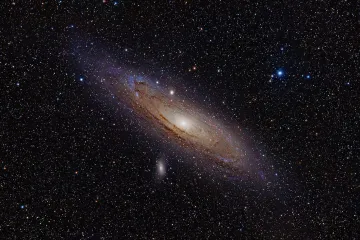
# Mass Density
The relationship between the light profile and the mass density is complex, especially when dark matter is included. Early studies attempted to model the total mass by assuming the light traced the mass distribution, often finding a central mass concentration steeper than the light profile suggested, pointing toward dark matter halos. [1] Later work refined this, using concepts like the relation, which links the observed angular diameter () of an elliptical galaxy to the velocity dispersion () of its stars. [1] This empirical relationship holds remarkably well across large samples and implies a tight coupling between the total mass (including dark matter) and the galaxy's internal velocity structure. [1]
If we were to look at a hypothetical galaxy and an galaxy of the same total mass and luminosity, the would be spatially stretched along one axis. Because the random stellar motions are the primary support mechanism, the stretched galaxy must, on average, have its stars moving with slightly lower velocities perpendicular to the long axis compared to the near-spherical system, just to maintain equilibrium against the anisotropic gravity field. [4] This difference in internal dynamics between the two extremes, despite similar total mass, underscores why kinematics are essential for truly understanding their 3D structure, going beyond the simple 2D visual classification. [6]
Related Questions
#Citations
Fundamental Properties of Elliptical Galaxies - NASA ADS
Elliptical galaxy - Wikipedia
Galaxies, Elliptical
[PDF] Properties of Elliptical Galaxies
Elliptical Galaxy | ESA/Hubble
[PDF] Properties of Ellipticals and Spirals
Galaxy Types - NASA Science
[PDF] 4 Elliptical galaxies
I. Elliptical galaxies | Astronomy & Astrophysics (A&A)
[PDF] Spiral & Elliptical Galaxies I - Rijksuniversiteit Groningen