What are the classification of galaxies and their properties?
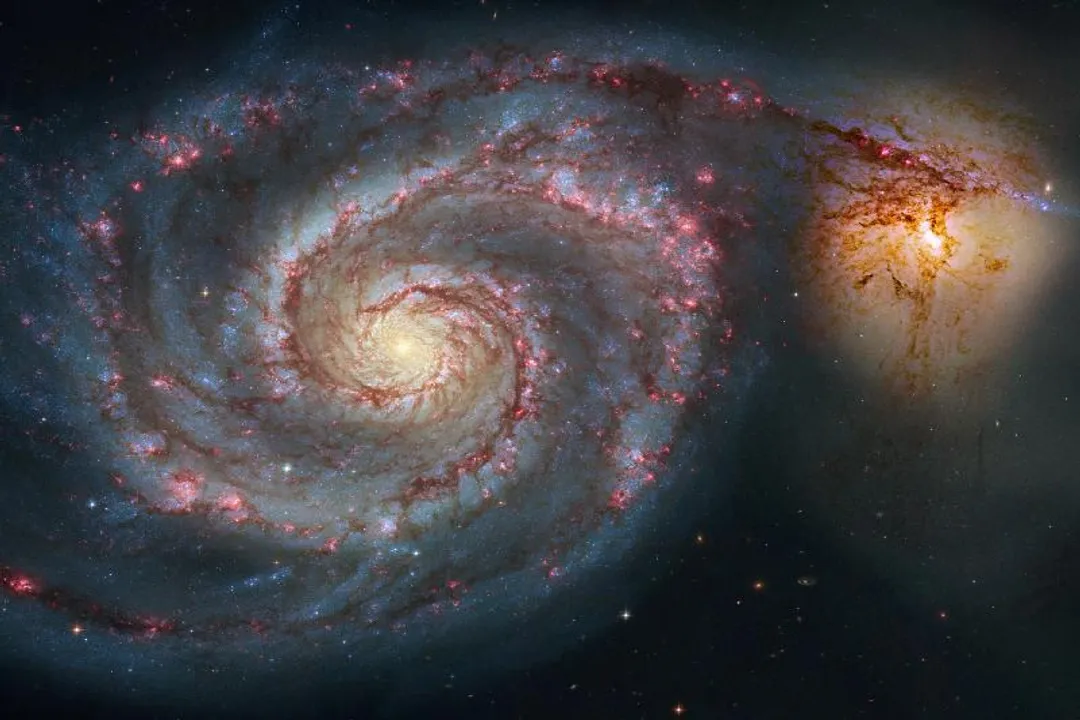
The process of making sense of the universe's vast collection of stellar cities—galaxies—begins with classification. Since Edwin Hubble first set up his famous sequence in the late 1920s, astronomers have organized these enormous structures primarily based on their visible shapes, or morphologies. This sorting system helps us understand their physical properties, history, and where they fit into the grand cosmic architecture. We categorize them into a handful of primary groups: ellipticals, spirals, lenticulars, and irregulars, each telling a distinct story about the galaxy's formation and current state.
# Tuning Fork
The structure most often used for this arrangement is known as the Hubble Sequence, frequently visualized as the "Tuning Fork Diagram". This diagram isn't meant to imply a strict evolutionary path where every galaxy must progress from one end to the other, though some evidence suggests galaxies can shift their morphology over cosmic timescales. Instead, it serves as a systematic flowchart for grouping based on visual features. The handle of the fork is occupied by the smooth, featureless elliptical galaxies, while the two prongs branch out to accommodate the more structured spiral and barred spiral galaxies. Lenticular galaxies sit right at the junction where the handle meets the prongs, acting as a transitional class.
# Smooth Ellipticals
Elliptical galaxies, designated by the letter 'E', are characterized by their smooth, featureless, and generally ellipsoidal light profiles. They look like giant, slightly stretched balls of light, lacking the internal structure of spiral arms or a distinct disk. Their shapes are described using a numerical index from to , where is nearly perfectly spherical, and is the most elongated or flattened shape.
These galaxies represent environments where star formation has largely ceased. They consist mostly of older, redder stars, having used up or lost most of their cold gas and dust reserves necessary for birthing new stellar generations. In the cosmic context, massive elliptical galaxies are often found at the centers of large galaxy clusters, suggesting that perhaps dense environments or frequent mergers strip away the necessary gas to halt star production. While the to system accurately describes their shape, it's interesting to note that the most common ellipticals in reality, especially outside of major clusters, are the smaller dwarf ellipticals, which are far less luminous than their giant counterparts. This sheer abundance of smaller, dimmer systems suggests that mass plays a huge role in whether a galaxy retains the fuel to remain structurally complex.
# Disk Galaxies
The next major category is the spiral galaxy, often denoted by 'S', which presents a distinctly different picture from the ellipticals. Spiral galaxies are essentially flat, rotating disks embedded within a larger, fainter halo. The defining feature is the presence of distinct spiral arms that wind outward from a central bulge. These arms are regions of active, ongoing star formation, appearing bluer due to the presence of hot, massive, young stars, contrasting sharply with the older stellar populations dominating the central bulges and the elliptical category. This visible gradient—blue, star-forming arms against a redder, older central core—is a key diagnostic for these systems.
Spirals are further subdivided based on two main characteristics: the size of their central bulge and how tightly wound their spiral arms are. The classifications run from (large bulge, tightly wound arms) to (small bulge, loosely defined, knotty arms).
There is also a significant variation within the spirals: the barred spirals, designated 'SB'. These galaxies possess a distinct, elongated bar-shaped structure made of stars that passes through the center, from which the spiral arms emerge. Our own Milky Way galaxy is classified as a barred spiral, likely an or type. Some systems, like the famous (Pinwheel Galaxy), are classic, unbarred spirals (). Comparing a tightly wound to a loose reveals systems where the efficiency or timing of star formation and angular momentum distribution vary significantly across the disk.
# Intermediate Forms
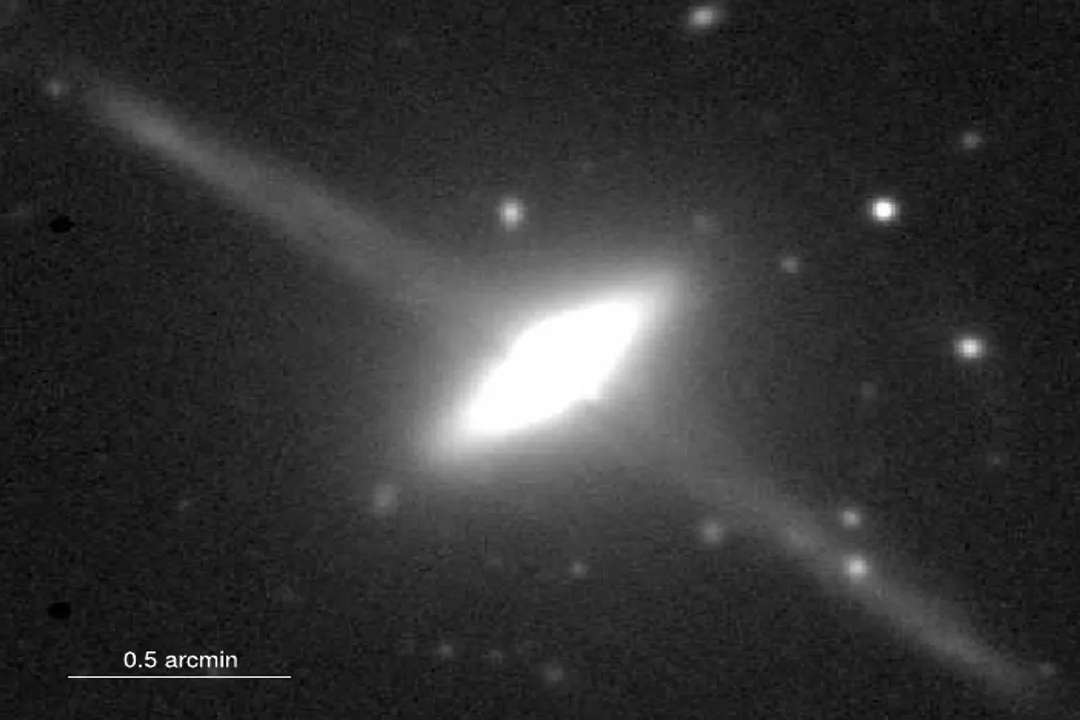
Nestled between the ellipticals on the handle and the spirals on the prongs is the Lenticular class, denoted 'S0'. These galaxies possess a disk component and a central bulge, much like a spiral, but they have definitively lost their spiral arms. This means they have very little cool interstellar gas and dust and, consequently, exhibit little to no current star formation, making them look structurally more like an elliptical galaxy. They are, in essence, "faded" spirals, having used up or been stripped of the raw materials for star birth. They represent a morphological endpoint for galaxies that have settled into a quiescent state without the complete destruction that often results in a purely elliptical appearance.
# Chaotic Shapes
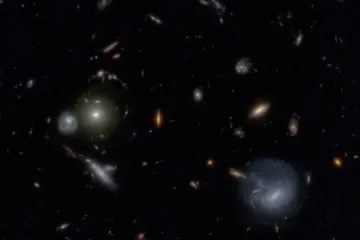
Not all galaxies fit neatly into the structured forms of ellipticals or spirals. Galaxies that do not exhibit a clear, regular structure—lacking a defined bulge or spiral pattern—are classified as Irregular galaxies, or 'Irr'. These systems often appear chaotic or amorphous.
Irregulars are frequently rich in interstellar gas and dust and are known for vigorous, though sometimes localized, pockets of star formation. This vigorous activity often makes them appear quite blue across large regions. Many irregulars are thought to be the result of recent gravitational interactions, such as close flybys or outright collisions, that have gravitationally tugged and distorted their original shapes. This makes the irregular category a temporary resting place for many galaxies that are currently undergoing a major structural change, rather than a stable long-term morphology.
# Peculiar Groupings
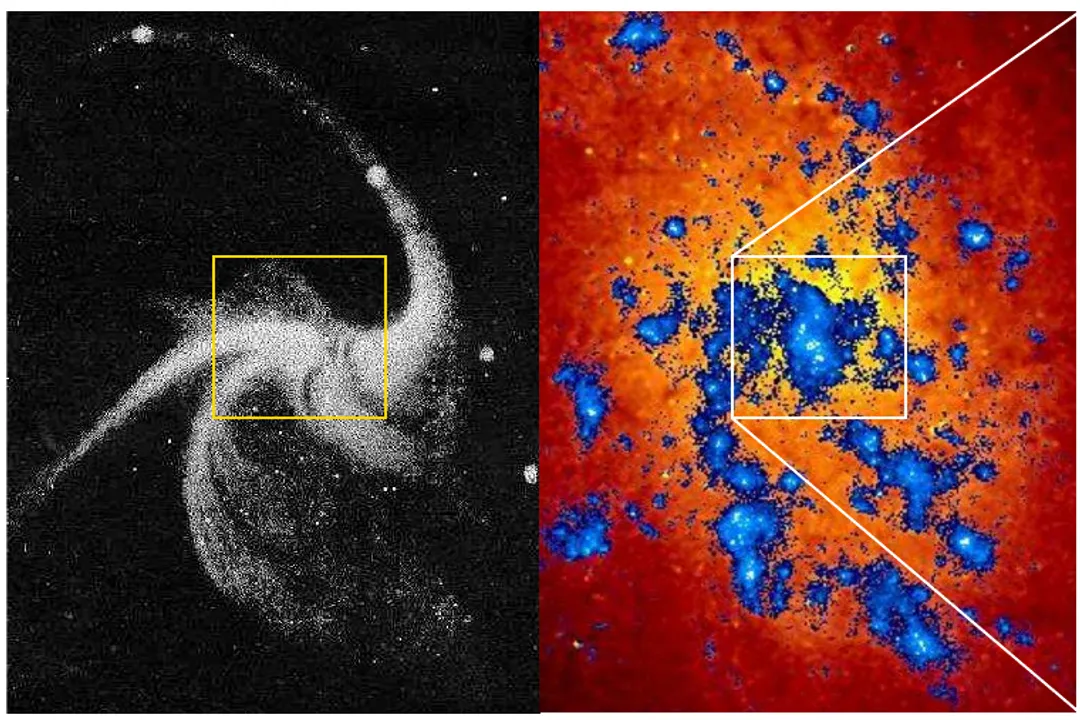
The Hubble classification system is fundamentally based on looking at a galaxy's static, current appearance. However, when galaxies interact violently, they can enter a transient, highly disturbed phase that earns them the label of 'Peculiar' galaxies. These are often products of mergers or tidal interactions, displaying bridges, tails, or highly distorted shapes that don't fit the standard E, S, or Irr morphology. While they are technically a subset of the irregular category, they are often singled out in catalogs because their appearance is explicitly linked to dynamic processes rather than just internal structure.
One interesting facet of classification that goes beyond the Hubble sequence involves scale. While the sequence effectively sorts luminous galaxies, there is a massive population of much smaller galaxies known as dwarf galaxies. These include dwarf ellipticals (), dwarf spheroidals (), and dwarf irregulars (). The existence of these fainter, lower-mass systems highlights a limitation in morphology-based studies that often focus only on the brightest members of the universe; in terms of raw numbers, the dwarfs likely outnumber their larger cousins by a significant margin. Understanding the properties of these dwarfs—which are often chemically primitive and lack the violent merger history of the giants—is becoming essential for fully modeling galaxy formation across cosmic history.
Related Questions
#Citations
Galaxy Types - NASA Science
Galaxy Classification - Las Cumbres Observatory
Galaxy morphological classification - Wikipedia
Galaxy - Elliptical, Spiral, Irregular | Britannica
Guide to Classification of Galaxies and AGNs - Astrobites
Hubble's Galaxy Classification | Research Starters - EBSCO
The Hubble tuning fork - classification of galaxies
[PDF] Galaxy Classification
Galaxy Classification - UA Astronomy