What is the density wave theory for spiral arm formation?
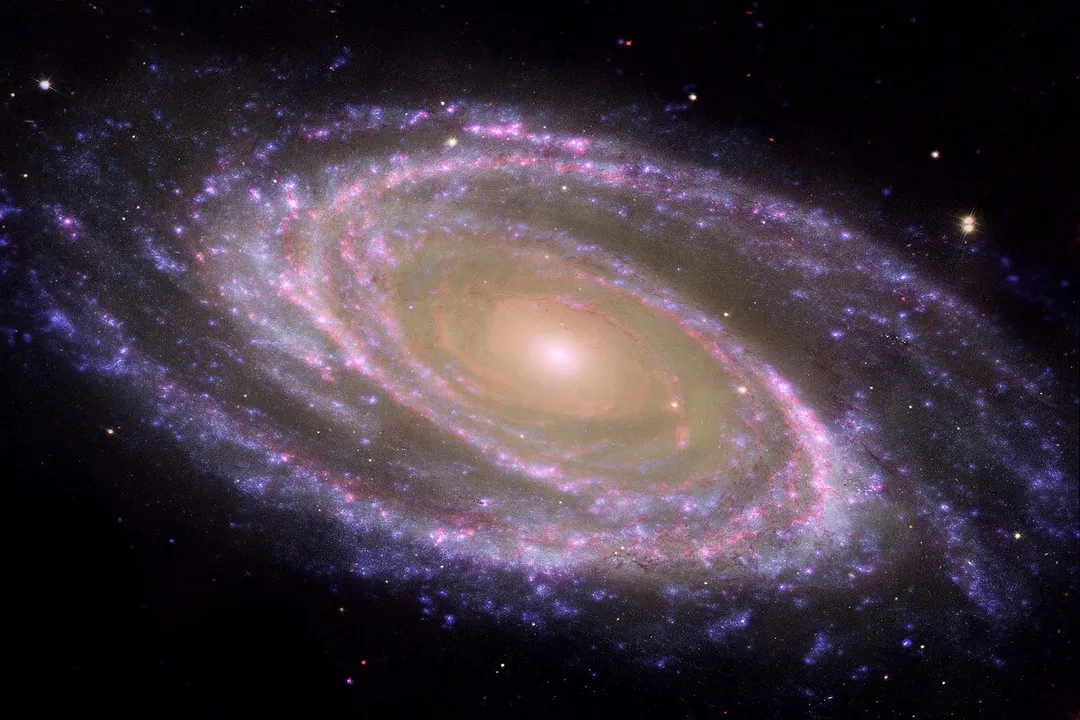
The mesmerizing spiral arms seen in countless galaxies, including our own Milky Way, are not permanent fixtures made of fixed material. If they were, the phenomenon of differential rotation—where matter closer to the galactic center orbits faster than material farther out—would cause these arms to rapidly wind up, becoming tightly coiled and essentially invisible after only a few galactic orbits. This challenge, known as the winding problem, baffled astronomers for decades. [2]
# A Slow Traffic Jam
The resolution to this puzzle came in the mid-1960s from C.C. Lin and Frank Shu, who proposed the Density Wave Theory. [2] This theory posits that the spiral arms are not made of the same stars and gas throughout their existence; rather, they are long-lived, large-scale quasi-stationary spiral structures (QSSS) that propagate through the galactic disk at a speed that is different from the orbiting material. [2]
To grasp this, the best way to think about it is using a traffic analogy, often described as a cosmic traffic jam on a busy freeway. [1][3] Imagine cars zooming along the highway—these are the individual stars and gas clouds in the galactic disk, each moving at its own orbital speed, which varies with distance from the center. [1][2] Now, picture a very slow-moving truck on this highway. As cars approach the truck, they must slow down to avoid a collision, bunching up behind the truck. This creates a distinct region of high density that moves slowly along the road with the truck. [1]
In a galaxy, the spiral arm is this slow-moving density wave, which rotates at a specific, constant angular speed known as the pattern speed (). [2] The stars and gas clouds flow into this region, get compressed, and then move out again as they speed past the wave, much like cars pass through the slow lane. [1] The structure persists because the traffic jam itself persists, even though the individual vehicles within it are constantly changing. [1]
# Pattern Speed Dynamics
The key to the density wave model is the difference between the speed of the structure and the speed of the matter. Stars orbit faster than the pattern inside a certain radius and slower outside it. [2] The radius where the stars and the spiral pattern move together at the exact same speed is known as the corotation radius. [2][4] This radius is important because it defines a boundary where the dynamical interaction between the matter and the wave changes significantly. [4]
For the gravitational field of the density wave to be effective at maintaining the structure, the stars must be able to respond to the local increase in density. This response is governed by the epicyclic frequency () of the star's orbit. The theory dictates that a long-lived spiral structure can only be sustained within the region bounded by two critical radii called Lindblad resonances: [2] the Inner Lindblad Resonance (ILR) and the Outer Lindblad Resonance (OLR). [2][4] Past the OLR or inside the ILR, the wave's gravitational influence tugs on the stars too frequently (or too infrequently, depending on the exact resonance dynamics), preventing the stars from moving in a way that reinforces the density enhancement. [2] Therefore, the visible, long-lasting spiral structure is typically confined between the ILR and OLR. [2]
# Star Formation Engine
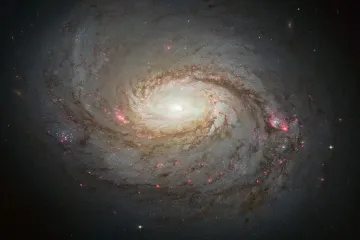
The density wave does more than just organize matter; it is the engine for the galaxy’s most brilliant features: the luminous blue spiral arms. [1] When interstellar gas and dust clouds, which orbit faster than the pattern, enter the high-density region, they are compressed. [1][4] This compression can force the clouds to reach the Jeans criterion, triggering gravitational collapse and star formation. [2][4]
This process is often associated with galactic shocks, which occur when gas flows into the arm at supersonic speeds. [4] The gas experiences a sudden, dramatic increase in density and pressure at this shock front. [6] While the initial theory by Lin and Shu focused on the smooth stellar disk dynamics, later work, notably by Roberts, confirmed that the gaseous component exhibits much more extreme behavior. [6] In fact, the density contrast in the gas component is expected to be far larger than the relatively modest contrast seen in the stellar distribution—perhaps fivefold or more in density right at the shock. [4][6] It is this extreme compression of the gas that makes the spiral arms so prominent in optical light.
The visibility of the arm is short-lived relative to the galaxy's lifetime. The most massive, luminous stars, like the blue OB stars, form right at or just behind the shock front, but they burn out quickly, expiring before they can orbit far out of the wave structure. [1] This is why the bright, young stars and H II regions (ionized gas clouds) appear precisely within the arm boundaries. [2][4] Less massive, redder stars formed in the arm live long enough to leave the wave and populate the regions between the arms, which is why the general galactic disk still contains older stars. [1] The sharp, dark lanes often seen defining the inner edge of the bright spiral arm are the dust bands lying just ahead of the shock, where the gas is beginning to pile up. [6]
# Generating Stability
A major question that follows is how these waves, which require immense energy to initiate and sustain against dissipative effects like shocks, persist for billions of years? [1] While internal instabilities of the stellar disk (self-gravity) can theoretically start a pattern, [2] other mechanisms are likely needed to maintain them across the entire disk, as completely coherent global waves are observed to be rare.
One proposed mechanism involves Swing Amplification. This process shows how a small, existing density disturbance can be transformed by differential rotation and epicyclic motion into a much larger, trailing wave pattern. Furthermore, the presence of a central star bar or gravitational interactions with neighboring galaxies can provide the initial "kick" or continuous forcing needed to generate the waves in the first place. Some models even suggest a "waser cycle," analogous to a laser, where waves are amplified near the corotation radius and reflected from the center, potentially involving the ILR. However, early criticisms noted that if the gas streamlines were perfectly closed (implying a perfectly stationary, energy-conserving structure), the model faced issues with angular momentum transfer and energy dissipation, suggesting that these structures must be quasi-steady rather than perfectly eternal, gradually feeding energy back into the wave or causing gradual inward migration of gas. [6]
We observe that not all galaxies have the same structure. Those with two remarkably clear, grand, persistent arms are termed grand design spirals. [3] In contrast, galaxies with many small, disconnected, patchy arm segments are called flocculent spirals. [3] Our own Milky Way exhibits features of both, classifying it as a mixed galaxy. [3] This variety suggests that the conditions—such as the presence and strength of a central bar, the gas content, or the history of interactions—determine whether a galaxy sustains a strong, two-armed global density wave or develops more localized, self-regenerating spiral segments via mechanisms like swing amplification.
# The Broader Application
The principles governing galactic spiral arms are not strictly limited to disks of stars and gas spanning thousands of light-years. This same mathematical description of density waves was successfully applied to the rings of Saturn. [2] In Saturn's A Ring, for instance, spiral density waves are excited by orbital resonances with the system’s moons. [2] The physics remains largely the same—a pattern moves at a speed different from the orbiting particles—though the scale is vastly smaller due to Saturn's massive central gravity dominating the disk dynamics. [2] Analyzing these ring waves gives us a smaller, more immediate laboratory to test the same physics that explains the beautiful structure of distant spiral galaxies. [2]
Related Questions
#Citations
Density wave theory - Wikipedia
Density Wave Model | COSMOS
Spiral Density Wave Theory | Overview, Galaxy Types & Examples
Density-Wave Spiral Theories in the 1960s. II - I.I. Pasha
Density wave theory | Collège de France
Spiral Structure and Density Wave Theory - Astrophysics II - Fiveable