flat curve articles
What is the expected relationship for orbital velocity (v) versus radius (r) in a spiral galaxy containing only visible matter?
How do the observed rotational velocities of stars and gas behave in the outskirts of spiral galaxies compared to predictions?
What mass distribution M(r) is mathematically required for the orbital speed v to remain constant (v \approx constant)?
In the Milky Way example, what does the mass discrepancy at 50 kpc imply about the unseen component?
What mechanism does Modified Newtonian Dynamics (MOND) propose to explain flat rotation curves?
What puzzle do the orbital velocities of stars and gas in spiral galaxies present to modern astrophysics?
Over what enormous scale have observations confirmed the flatness of the rotation curve persists?
Which solar system object comparison illustrates why mass concentrated near the center predicts a speed decline with distance?
What specific function does the inferred Dark Matter halo serve regarding outlying stars in spiral galaxies?
What required consistency check must both Dark Matter and modified gravity models pass regarding galaxy properties?
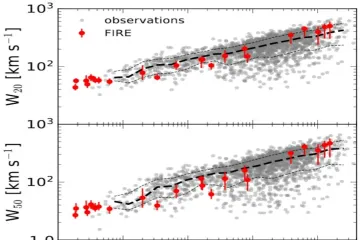
What two parameters are plotted against each other to create a galaxy rotation curve?
If a galaxy followed strict Keplerian expectations based only on visible matter, what should happen to orbital velocity far from the center?
What observational tool allows astronomers to calculate the precise line-of-sight velocity of gas clouds?
What key finding did Vera Rubin and Kent Ford discover when comparing measured rotation speeds to Keplerian predictions?
What does a flat rotation curve imply about the distribution of total mass ($M$) as a function of radius ($r$) based on standard gravitational formulas?
What is the unavoidable conclusion drawn from a galaxy rotation curve that refuses to drop off at large radii?
What geometric structure is postulated to contain the vast majority of a galaxy's unseen mass?
How can astronomers calculate the total mass ($M$) enclosed within a specific radius ($r$) using a known orbital velocity ($v$)?
What alternative cosmological theory is mentioned that attempts to explain flat rotation curves by altering gravity rather than invoking unseen mass?